
Level:
Correct: 0
Incorrect: 0
Marks: 0/0
Exam Practice
Course:
Topics:
Edexcel GCSE Business (Paper 2) Smart practice A mixed round aimed at your weak spots
Unit 1
Growing the business
Unit 2
Making marketing decisions
Unit 3
Making operational decisions
Unit 4
Making financial decisions
Business calculations
Understanding business performance
Unit 5
Making human resource decisions
Avg
score:
–
Topics
done:
0/24

Managing stock

Practise 20 exam-style questions on Managing stock for Edexcel GCSE Business (Paper 2). Write your answer as you would in the exam and get it marked in seconds against the mark scheme, point by point, with the Study Helper on hand if you get stuck.

  • 20 questions
  • 1–12 marks each
  • Instant marking
  • No sign-up needed
20 questions, marked as you go

Sample questions with model answers

Here are 4 of the questions in this topic, each with a model answer, an explanation of why it earns the marks and the mark scheme an examiner would use.

Question 1

1 mark

Define the term 'buffer stock'.

Model answer

The minimum amount of stock a business plans to hold at all times, kept as a reserve in case a delivery is late or demand rises unexpectedly.

Explanation

Buffer stock is a planned safety reserve: the lowest level of stock the business intends to keep, so that it can carry on if a delivery is late or demand suddenly rises. It is shown on a bar gate stock graph as the lowest horizontal line. It is not the same as the re-order level, which is the higher level at which a new order is placed.

Mark scheme
  1. 1 mark

    A definition showing that buffer stock is the minimum amount of stock a business plans to keep at all times, as a reserve in case of unexpected events such as a late delivery or a rise in demand.

    Award 1 mark for a correct definition. Accept, for example: 'the lowest level of stock a business plans to hold, kept as a safety reserve'; 'extra stock kept in case a delivery is late or demand suddenly rises'; 'the minimum stock level the business aims never to fall below'. Do not accept 'stock kept in a warehouse', 'stock left over' or 'stock that has not been sold' (these miss the idea of a planned minimum kept for emergencies), or a description of the re-order level (the level at which a new order is placed).
Question 2

2 marks

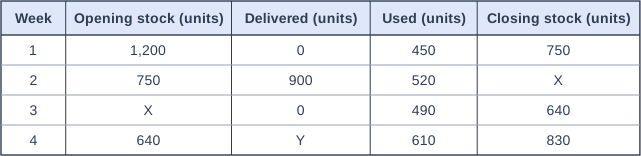
A manufacturer of garden furniture keeps a weekly record of the steel tubing it holds, measured in units. Part of the record for four weeks is shown in the table.

Work out the values of X and Y.

Table with columns "Week", "Opening stock (units)", "Delivered (units)", "Used (units)", "Closing stock (units)". Week: 1; Opening stock (units): 1,200; Delivered (units): 0; Used (units): 450; Closing stock (units): 750 | Week: 2; Opening stock (units): 750; Delivered (units): 900; Used (units): 520; Closing stock (units): X | Week: 3; Opening stock (units): X; Delivered (units): 0; Used (units): 490; Closing stock (units): 640 | Week: 4; Opening stock (units): 640; Delivered (units): Y; Used (units): 610; Closing stock (units): 830.

Model answer

X = 750 + 900 - 520 = 1,130 units
Y = 830 + 610 - 640 = 800 units

Explanation

Closing stock = opening stock + stock delivered - stock used, and each week's closing stock is the next week's opening stock. For Y, rearrange: stock delivered = closing stock + stock used - opening stock. Week 3 lets you check X, because 1,130 - 490 = 640.

Mark scheme
  1. 1 mark

    X = 1,130 (units)

    Answers of 1,130 for X and 800 for Y with no working score 2 marks. 1 mark for each correct value. X = 750 + 900 - 520 = 1,130 (check: Week 3 closing stock 1,130 - 490 = 640). Accept 1130 or 1,130 units. Do not accept 230 (the delivery left out), 2,170 (the stock used added instead of taken away) or 1,650 (the stock used left out).

  2. 1 mark

    Y = 800 (units)

    Y = 830 + 610 - 640 = 800. Accept 800 or 800 units. Do not accept 190 (closing minus opening stock, leaving out the stock used), 1,440 (closing stock plus stock used, leaving out the opening stock) or 2,080 (all three figures added).

Question 3

3 marks

Explain one risk to a business of setting its re-order level too low.

Model answer

If the re-order level is too low, orders are placed too late for the delivery to arrive before stock runs out. This means production may have to stop while the business waits for the delivery. As a result, workers are paid while they are idle and customers' orders are delayed, so the business may lose sales.

Explanation

The re-order level must leave enough stock to last until the delivery arrives (the lead time), so setting it too low risks running out. The two strands should follow the risk through to its effect on production, costs or customers. Points about holding too much stock answer a different question.

Mark scheme
  1. 1 mark

    Award 1 mark for identification of a risk of setting the re-order level too low.

    Answers that list more than one risk with no explanation will be awarded a maximum of 1 mark. Accept any other appropriate response. Valid risks include: orders are placed too late for the delivery to arrive before stock falls below the buffer stock; the business may run out of stock before the delivery arrives; production may have to stop while the business waits for stock; customers' orders may not be met on time; the business may have to pay extra for urgent deliveries. Do not accept risks of setting the re-order level too high, such as holding too much stock or high storage costs.

  2. 2 marks

    Award up to 2 further marks for explaining this risk (1 mark for each linked strand of development).

    Examples: If the re-order level is too low, orders are placed too late for the delivery to arrive before stock runs out (1). This means production may have to stop while the business waits for the delivery (1). As a result, workers are paid while they are idle and customers' orders are delayed, so the business may lose sales (1). / Stock may fall into the buffer stock before each delivery arrives (1), so there is little stock left to cover a late delivery or a sudden rise in demand (1). Therefore the business is more likely to run out and let its customers down, and they may switch to competitors (1). A restatement of the risk or a definition of the re-order level is not a strand.

Question 4

6 marks

Transomly Windows Ltd makes uPVC windows and doors to measure for homeowners in County Durham and Teesside, and its own teams fit them. The factory uses about 60 sealed glass units a day, one for each window it makes, and its 40 factory workers are paid whether or not there is work to do. Fitting teams are booked weeks in advance, and each customer is told the date on which their windows will be fitted. The glass supplier usually delivers six days after an order is placed.

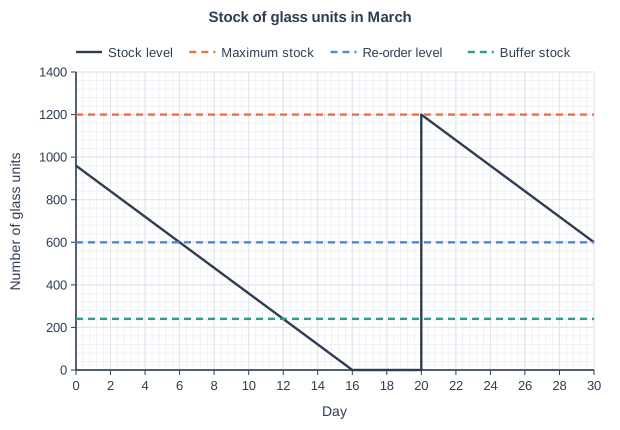
The graph is a bar gate stock graph showing Transomly's stock of glass units in March. The delivery that should have arrived on Day 12 was delayed by a breakdown at the supplier's factory.

Analyse the impact on Transomly Windows Ltd of running out of glass units in March.

Stock of glass units in March. Line graph of number of glass units (y-axis, 0 to 1400) against day (x-axis, 0 to 30). "Stock level" joins the points (0, 960), (16, 0), (20, 0), (20, 1200), (30, 600). "Maximum stock" (dashed) joins the points (0, 1200), (30, 1200). "Re-order level" (dashed) joins the points (0, 600), (30, 600). "Buffer stock" (dashed) joins the points (0, 240), (30, 240).

Model answer

The graph shows that Transomly had no glass units from Day 16 until the late delivery arrived on Day 20. The factory uses about 60 glass units a day, so about 240 windows could not be finished in those 4 days. However, the 40 factory workers still had to be paid. This means Transomly paid wages without producing any windows, so the cost of each window made in March rose. When the glass arrived, it may have had to pay overtime to catch up on the 240 windows. As a result, its costs rose and its profit for March fell.

The shortage also affects customers. Fitting teams are booked weeks in advance, and each homeowner has been told the date their windows will be fitted. Without glass, some of these fittings had to be put back. This means homeowners may have taken time off work for nothing and may complain or leave poor online reviews. Therefore other homeowners in County Durham and Teesside may choose a rival window firm instead, so Transomly could lose future sales as well as the goodwill of its existing customers.

Explanation

A top answer reads the graph accurately (no glass from Day 16 to Day 20, so about 240 windows not finished) and follows one or two impacts through about five linked strands, such as idle workers raising costs, and missed fitting dates damaging the business's reputation. Context must be used in each paragraph. A generic answer about running out of stock cannot score more than 3 marks.

Mark scheme
  1. 6 marks

    Levels of response (6 marks).
    Level 3 (5-6 marks): Detailed application of knowledge and understanding of business concepts and issues to the business context throughout (AO2). Deconstructs business information and/or issues, finding detailed interconnected points with logical chains of reasoning (AO3a).
    Level 2 (3-4 marks): Sound application of knowledge and understanding of business concepts and issues to the business context although there may be some inconsistencies (AO2). Deconstructs business information and/or issues, finding interconnected points with chains of reasoning, although there may be some logical inconsistencies (AO3a).
    Level 1 (1-2 marks): Limited application of knowledge and understanding of business concepts and issues to the business context (AO2). Attempts to deconstruct business information and/or issues, finding limited connections between points (AO3a).
    0 marks: No rewardable material.

    Indicative content (not a checklist; credit other valid points):
    - The graph shows stock fell to zero on Day 16 and stayed there until the delivery on Day 20, 8 days later than the Day 12 it was due, so for 4 days about 60 windows a day, about 240 windows, could not be finished (AO2).
    - The 40 factory workers were paid even though they could not finish windows, and fitting teams booked weeks in advance had no windows to fit on the dates customers had been given (AO2).
    - Paying the 40 workers while no windows are finished raises the cost of each window made in March. Transomly may also have to pay overtime to catch up on the 240 unfinished windows once the glass arrives, so its costs rise further and its profit for March falls (AO3a).
    - Homeowners whose fitting dates are cancelled may complain or leave poor online reviews. As a result, fewer homeowners in County Durham and Teesside may choose Transomly, and some customers may cancel their orders and buy from rival window firms, so future sales fall (AO3a).
    - To stop it happening again, Transomly may raise its buffer stock above 240 glass units or find a second supplier. This would tie up more cash in stock and increase storage costs (AO3a).
    Marking notes: only the best two points are credited; Level 3 for AO3a needs about five linked strands from one or two points. Context only counts inside a valid point, and copying the case or the graph or using the business name or words from the question is not application. A generic answer with no application to Transomly Windows Ltd cannot score more than 3 marks. Evaluation is not required and is not credited.

Ready to try the rest? Every answer you write is marked against the mark scheme, so you can see exactly where the marks are.

Study Helper Hints first, answers after you try

Stuck on this one? Ask for a hint and I’ll point you in the right direction, without giving the answer away. Once you’ve checked your answer, I’ll show you how the marks are awarded.