
Level:
Correct: 0
Incorrect: 0
Marks: 0/0
Exam Practice
Course:
Topics:
Edexcel GCSE Business (Paper 2) Smart practice A mixed round aimed at your weak spots
Unit 1
Growing the business
Unit 2
Making marketing decisions
Unit 3
Making operational decisions
Unit 4
Making financial decisions
Business calculations
Understanding business performance
Unit 5
Making human resource decisions
Avg
score:
–
Topics
done:
0/24

Effective recruitment

Practise 19 exam-style questions on Effective recruitment for Edexcel GCSE Business (Paper 2). Write your answer as you would in the exam and get it marked in seconds against the mark scheme, point by point, with the Study Helper on hand if you get stuck.

  • 19 questions
  • 1–12 marks each
  • Instant marking
  • No sign-up needed
19 questions, marked as you go

Sample questions with model answers

Here are 4 of the questions in this topic, each with a model answer, an explanation of why it earns the marks and the mark scheme an examiner would use.

Question 1

1 mark

Define the term 'job description'.

Model answer

A job description is a document produced by the business that sets out the duties and responsibilities of a job, such as its title, its main tasks and who the employee reports to.

Explanation

The key idea is that a job description describes the job itself: what the person will do and what they are responsible for. It is written by the business, usually alongside a person specification, which describes the person needed instead. A CV and a completed application form come from the applicant, so they are not job descriptions.

Mark scheme
  1. 1 mark

    A definition showing that a job description is a document, written by the business, that sets out the duties and responsibilities of a job / what the person doing the job will have to do.

    Award 1 mark for a correct definition of a job description. Accept 'a list of the tasks and responsibilities of a job', 'a document that describes a job, such as its title, main duties, who the employee reports to and the hours' or 'a description of what a job involves'. An answer that names only one item that may appear in it (e.g. 'the job title' or 'the rate of pay') is not a definition and scores 0. Do not accept a description of the person the business wants, such as the skills, qualifications, experience or personal qualities needed (this is a person specification), a document that the applicant writes or sends (e.g. a CV or a completed application form), or 'a job advert' with no idea of setting out the duties of the job.
Question 2

2 marks

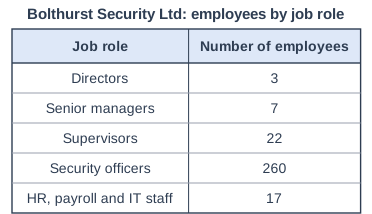
Bolthurst Security Ltd provides security officers for offices, shopping centres and building sites across Greater Manchester. The table shows the number of people Bolthurst employs in each job role.

Using the information in the table, calculate, to 2 decimal places, the percentage of Bolthurst's employees who are operational staff. You are advised to show your workings.

Bolthurst Security Ltd: employees by job role. Table with columns "Job role", "Number of employees". Job role: Directors; Number of employees: 3 | Job role: Senior managers; Number of employees: 7 | Job role: Supervisors; Number of employees: 22 | Job role: Security officers; Number of employees: 260 | Job role: HR, payroll and IT staff; Number of employees: 17.

Model answer

Total employees = 3 + 7 + 22 + 260 + 17 = 309
Operational staff = the 260 security officers
Percentage = 260 ÷ 309 × 100 = 84.14%

Explanation

Operational staff carry out the main work of the business, so at a security firm they are the security officers; supervisors, senior managers and directors are separate job roles, and the HR, payroll and IT staff are support staff. Add up all the employees, then divide the operational staff by this total and multiply by 100. Counting the supervisors as operational staff, which gives 91.26%, is the usual error.

Mark scheme
  1. 1 mark

    Fully correct working, e.g. 260 ÷ (3 + 7 + 22 + 260 + 17) × 100; or a correct final answer of 84.14% with no working

    Max 1 if the answer is not given to 2 decimal places: a correct answer given to a different number of decimal places (e.g. 84.1% or 84.142%) scores 1 mark in total, with or without working. An answer of 84.14% with no working scores 2 marks. If the final answer is wrong, award this mark only for fully correct working (total employees 3 + 7 + 22 + 260 + 17 = 309, then 260 ÷ 309 × 100); a formula alone or partly correct working scores 0. If several different final answers are given, award 0.

  2. 1 mark

    84.14%

    Accept 84.14 without the % sign. The operational staff are the 260 security officers, who carry out the main work of the business. Do not accept 91.26% (the supervisors counted as operational staff), 5.50% (the HR, payroll and IT staff, who are support staff), 15.85% or 15.86% (the employees who are not operational staff) or 530.61% (260 divided by the 49 other employees).

Question 3

3 marks

Explain one reason why a business might use a recruitment agency to fill a vacancy.

Model answer

A recruitment agency already has a list of people who are looking for this type of work. This means it can put forward suitable applicants within a few days instead of the business waiting for replies to an advert. As a result, the vacancy is filled sooner, so the business does not lose output or have to pay overtime to cover the empty post.

Explanation

One mark is for the reason and two are for linked strands that explain why it helps the business. Saying that an agency is cheaper is wrong: agencies charge a fee, often a percentage of the new employee's pay. Listing several reasons earns only 1 mark.

Mark scheme
  1. 1 mark

    Award 1 mark for identification of a reason why a business might use a recruitment agency to fill a vacancy.

    Answers that list more than one reason with no explanation will be awarded a maximum of 1 mark. Accept any other appropriate response. Valid reasons include: the agency already has a list of suitable people looking for work, so the vacancy can be filled quickly; it saves the business's own managers the time spent advertising, reading applications and holding first interviews; the agency has specialist knowledge of a type of job and can find people with scarce skills; the agency can check applicants' qualifications and references; the agency can supply temporary staff at short notice. Do not accept 'it is cheaper' (agencies charge a fee, so using one usually costs more than advertising the job itself) or 'it guarantees the best employee'.

  2. 2 marks

    Award up to 2 further marks for explaining this reason (1 mark for each linked strand of development).

    Examples: A recruitment agency already has a list of people who are looking for this type of work (1). This means it can put forward suitable applicants within a few days instead of the business waiting for replies to an advert (1). As a result, the vacancy is filled sooner, so the business does not lose output or have to pay overtime to cover the empty post (1). / Using an agency saves the business's managers from advertising the job, reading applications and holding first interviews (1). Therefore the managers can spend this time on their normal work, such as supervising staff or dealing with customers (1). This means the business keeps running smoothly while the vacancy is being filled (1). A restatement of the reason, a definition of a recruitment agency or the name of an agency is not a strand. Vague endings such as 'the business will be more successful' are not credited.

Question 4

6 marks

Porterhurst Facilities Ltd provides cleaning and portering services for offices, schools and hospitals in the North East. It has won a five-year contract to clean a large hospital, and it must recruit 30 cleaners before the contract starts in two months. The hospital checks the standard of cleaning every week, and Porterhurst must pay a penalty for any week in which its cleaning score falls below 95%.

Porterhurst's operations manager has written a person specification for the cleaners. It says that applicants must be able to follow written cleaning and infection-control procedures and must be able to start work at 6am. Experience of cleaning in a hospital or care home is desirable but not essential. Porterhurst expects more than 200 applications, and two supervisors will have three days to decide who to invite to interview.

Analyse the benefit to Porterhurst Facilities Ltd of using a person specification to recruit the 30 cleaners.

Model answer

The person specification gives the two supervisors a clear list of what each applicant must be able to do, such as following infection-control procedures and starting work at 6am. Applicants who do not meet these essential criteria can be rejected quickly, so the supervisors can get through more than 200 applications in the three days they have. Therefore interviews can be held sooner, and the new staff are more likely to be in place before the hospital contract starts in two months.

The person specification also means Porterhurst chooses people who can do what the hospital contract needs. Staff who can follow written infection-control procedures are more likely to clean the wards to the right standard. As a result, the hospital's weekly cleaning score is more likely to stay above 95%, so Porterhurst avoids penalty payments, which protects its profit and makes it more likely to keep the five-year contract.

Explanation

A top answer links the person specification, step by step, to what matters in this case: shortlisting 200 applications in three days and keeping the weekly cleaning score above 95%. Context such as the 6am start, the infection-control procedures and the penalty must run through both paragraphs. A generic answer about person specifications cannot score more than 3 marks, and drawbacks earn nothing in an 'Analyse' question.

Mark scheme
  1. 6 marks

    Levels of response (6 marks).
    Level 3 (5-6 marks): Detailed application of knowledge and understanding of business concepts and issues to the business context throughout (AO2). Deconstructs business information and/or issues, finding detailed interconnected points with logical chains of reasoning (AO3a).
    Level 2 (3-4 marks): Sound application of knowledge and understanding of business concepts and issues to the business context although there may be some inconsistencies (AO2). Deconstructs business information and/or issues, finding interconnected points with chains of reasoning, although there may be some logical inconsistencies (AO3a).
    Level 1 (1-2 marks): Limited application of knowledge and understanding of business concepts and issues to the business context (AO2). Attempts to deconstruct business information and/or issues, finding limited connections between points (AO3a).
    0 marks: No rewardable material.

    Indicative content (not a checklist; credit other valid points):
    - The person specification gives the two supervisors a clear list of essential and desirable criteria to compare each of the 200 or more applications against (AO2).
    - It sets out what the hospital contract needs, such as following infection-control procedures and starting work at 6am (AO2).
    - Applicants who do not meet the essential criteria can be rejected quickly, so the supervisors can shortlist within the three days. Therefore interviews can be held sooner and the cleaners are more likely to be in place before the contract starts in two months, so Porterhurst does not have to pay for temporary cover (AO3a).
    - Cleaners chosen against the criteria are more likely to follow the infection-control procedures correctly, so the weekly cleaning score is more likely to stay above 95%. As a result, Porterhurst avoids penalty payments, protects its profit and is more likely to keep the five-year contract (AO3a).
    - Because every applicant is judged against the same criteria, selection is fairer and Porterhurst is less likely to face a claim that it discriminated against an applicant (AO3a).
    Marking notes: only the best two points are credited; Level 3 for AO3a needs about five linked strands from one or two points. Context only counts inside a valid point, and copying the case or using the business name or words from the question (person specification, recruit, 30, cleaners) is not application. A generic answer with no application to Porterhurst cannot score more than 3 marks. Evaluation (drawbacks of a person specification) is not required and is not credited. Do not credit points that describe a job description (the duties of the job) as if they were the person specification.

Ready to try the rest? Every answer you write is marked against the mark scheme, so you can see exactly where the marks are.

Study Helper Hints first, answers after you try

Stuck on this one? Ask for a hint and I’ll point you in the right direction, without giving the answer away. Once you’ve checked your answer, I’ll show you how the marks are awarded.