
Level:
Correct: 0
Incorrect: 0
Marks: 0/0
Exam Practice
Course:
Topics:
Edexcel GCSE Business (Paper 2) Smart practice A mixed round aimed at your weak spots
Unit 1
Growing the business
Unit 2
Making marketing decisions
Unit 3
Making operational decisions
Unit 4
Making financial decisions
Business calculations
Understanding business performance
Unit 5
Making human resource decisions
Avg
score:
–
Topics
done:
0/24

Promotion

Practise 20 exam-style questions on Promotion for Edexcel GCSE Business (Paper 2). Write your answer as you would in the exam and get it marked in seconds against the mark scheme, point by point, with the Study Helper on hand if you get stuck.

  • 20 questions
  • 1–12 marks each
  • Instant marking
  • No sign-up needed
20 questions, marked as you go

Sample questions with model answers

Here are 4 of the questions in this topic, each with a model answer, an explanation of why it earns the marks and the mark scheme an examiner would use.

Question 1

1 mark

Give one method of promotion, other than advertising, that a business could use.

Model answer

Sponsorship.

Explanation

A 'Give' question tests recall, so one word or a short phrase from the specification is enough. The specification's promotion methods are advertising, sponsorship, product trials, special offers and branding, together with e-newsletters as a use of technology. Any form of advertising, including targeted online and viral advertising, is excluded by the question.

Mark scheme
  1. 1 mark

    Award 1 mark for giving one method of promotion other than advertising.

    This tests knowledge only, so no context is needed. Creditworthy answers (any one), as listed in the specification, or very close versions of them: sponsorship (of an event, team or person); product trials (free samples, free tastings, free trial periods); special offers (discounts, money-off coupons or vouchers, 'buy one, get one free', multi-buy deals); branding (a brand name, logo or brand image); e-newsletters (email newsletters). Award any other close interpretation of these methods. Also accept other recognised methods of promotion that are not advertising, such as public relations (e.g. press releases), point-of-sale displays, loyalty schemes or cards, competitions or personal selling. Do not accept a form of advertising, such as television, radio, poster, newspaper, targeted online or viral advertising, because the question excludes advertising. Do not accept other elements of the marketing mix, such as price, product or place, or vague answers such as 'social media' or 'marketing'.
Question 2

2 marks

Axelby Ice Rinks Ltd runs 11 ice rinks in towns in Scotland and the north of England. February is usually its quietest month, so this year it ran a special offer from Monday to Thursday: two skating sessions for £19, instead of the usual price of £12.50 each.

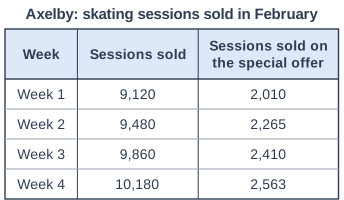
The table shows the number of skating sessions sold in each week of February, and how many of them were sold as part of the special offer.

Using the information in the table, calculate, to 2 decimal places, the percentage of all skating sessions sold in February that were sold as part of the special offer.

Axelby: skating sessions sold in February. Table with columns "Week", "Sessions sold", "Sessions sold on the special offer". Week: Week 1; Sessions sold: 9,120; Sessions sold on the special offer: 2,010 | Week: Week 2; Sessions sold: 9,480; Sessions sold on the special offer: 2,265 | Week: Week 3; Sessions sold: 9,860; Sessions sold on the special offer: 2,410 | Week: Week 4; Sessions sold: 10,180; Sessions sold on the special offer: 2,563.

Model answer

Total sessions sold = 9,120 + 9,480 + 9,860 + 10,180 = 38,640
Sessions sold on the special offer = 2,010 + 2,265 + 2,410 + 2,563 = 9,248
Percentage = (9,248 ÷ 38,640) × 100 = 23.93%

Explanation

Both columns are added up for the whole month, then the special offer sessions are divided by all sessions and multiplied by 100. Working out each week's percentage and averaging them gives 23.89%, which is wrong because the weeks had different numbers of sessions. The prices in the case are not needed.

Mark scheme
  1. 1 mark

    Fully correct working, e.g. (2,010 + 2,265 + 2,410 + 2,563) ÷ (9,120 + 9,480 + 9,860 + 10,180) × 100 = 9,248 ÷ 38,640 × 100; or a correct final answer of 23.93% with no working

    An answer of 23.93% with no working scores 2 marks. If the final answer is wrong, award this mark only for fully correct working; a formula alone or partly correct working scores 0. If several different final answers are given, award 0. Max 1 if the answer is not given to 2 decimal places (e.g. 23.9% or 24%).

  2. 1 mark

    23.93%

    Accept 23.93 without the % sign. Do not accept 23.88% or 23.89% (the average of the four weekly percentages), 31.46% (special offer sessions divided by the other sessions instead of by all sessions), 25.17% or 25.18% (week 4 only) or 0.24 (not multiplied by 100).

Question 3

3 marks

Explain one benefit to a business of using targeted online advertising.

Model answer

Targeted online adverts are shown only to people whose searches or interests suggest they want the product. This means less of the advertising budget is spent on people who will never buy. As a result, the business gains each new customer at a lower cost than it would with an advert in a newspaper.

Explanation

The benefit must come from the targeting or from the advert being online, such as reaching likely buyers or being able to measure results, not from advertising in general. One mark is for the benefit and two are for linked strands that follow on from it, joined with words such as 'this means' or 'as a result'. Defining targeted advertising first gains nothing.

Mark scheme
  1. 1 mark

    Award 1 mark for identification of a benefit to a business of using targeted online advertising.

    Answers that list more than one benefit with no explanation will be awarded a maximum of 1 mark. Accept any other appropriate response. Valid benefits include: the adverts are shown only to people whose searches, interests, age or location suggest they are likely to buy; less of the advertising budget is wasted on people who will never buy; the cost of gaining each new customer can be lower than with traditional advertising; the business can measure how many people see, click on and buy from each advert; adverts can be changed or stopped quickly; the business can set a budget and often pays only when someone clicks; different adverts can be shown to different market segments. Do not accept benefits of any advertising that are not linked to targeting or to being online (e.g. 'more people will know about the product'), or 'it is free'.

  2. 2 marks

    Award up to 2 further marks for explaining this benefit (1 mark for each linked strand of development).

    Examples: Targeted online adverts are shown only to people whose searches or interests suggest they want the product (1). This means less of the advertising budget is spent on people who will never buy (1). As a result, the business gains each new customer at a lower cost than with an advert in a newspaper (1). / The business can see how many people click on each advert and then go on to buy (1). This means it can quickly stop adverts that are not working and move the money to those that are (1). Therefore its promotion budget brings in more sales for the same amount of spending (1). A restatement of the benefit, a definition of targeted advertising or an example of a website is not a strand. Vague endings such as 'the business will be more successful' are not credited.

Question 4

6 marks

Batterbrook Ltd runs 14 brunch cafés in Bristol, Bath, Cardiff and Exeter. Its menu of pancakes, waffles and egg dishes is popular with people in their twenties and thirties, especially at weekends. Batterbrook spends about £4,000 a month on promotion, mainly on targeted adverts on social media.

In March, a customer filmed a member of staff pouring hot maple syrup over Batterbrook's new 'tower stack' of six pancakes. The video was shared on social media and viewed 3.2 million times in a week. Batterbrook did not pay anything for it.

Since then, weekend sales have risen by 35%. Queues of up to an hour have formed outside the cafés on Saturday and Sunday mornings, and several cafés have run out of pancake batter before midday. Some online reviews now complain about the long waits.

Analyse the impact on Batterbrook of the video going viral on social media.

Model answer

The video was viewed 3.2 million times in a week, and Batterbrook did not pay for it. Because viral advertising spreads when people share it with friends, many people in their twenties and thirties in Bristol, Bath, Cardiff and Exeter now know about the tower stack. Therefore more new customers are visiting the cafés, which is why weekend sales have risen by 35%. As a result, revenue has increased without any extra promotion spending, so Batterbrook may even be able to cut its £4,000 a month on targeted adverts, which would lower its costs and increase its profit.

However, the cafés cannot cope with the extra demand at weekends. Queues of up to an hour have formed and several cafés have run out of pancake batter before midday. This means some customers leave without eating, so Batterbrook loses sales it could have made. These disappointed customers are posting reviews about long waits, which could put off people who were thinking of visiting, so the rise in sales may not last once the video is forgotten.

Explanation

A top answer uses the case throughout (the 3.2 million views, the £4,000 a month, the 35% rise, the queues and the batter running out) and builds about five linked strands from one or two impacts. Impacts can be good or bad, so analysing both the free promotion and the problems it caused is fine. A generic answer about viral advertising cannot score more than 3 marks, and a final judgement earns nothing in an 'Analyse' question.

Mark scheme
  1. 6 marks

    Levels of response (6 marks).
    Level 3 (5-6 marks): Detailed application of knowledge and understanding of business concepts and issues to the business context throughout (AO2). Deconstructs business information and/or issues, finding detailed interconnected points with logical chains of reasoning (AO3a).
    Level 2 (3-4 marks): Sound application of knowledge and understanding of business concepts and issues to the business context although there may be some inconsistencies (AO2). Deconstructs business information and/or issues, finding interconnected points with chains of reasoning, although there may be some logical inconsistencies (AO3a).
    Level 1 (1-2 marks): Limited application of knowledge and understanding of business concepts and issues to the business context (AO2). Attempts to deconstruct business information and/or issues, finding limited connections between points (AO3a).
    0 marks: No rewardable material.

    Indicative content (not a checklist; credit other valid points):
    - The video reached 3.2 million views in a week at no cost, far more people than Batterbrook's £4,000 a month of paid adverts are likely to reach (AO2).
    - Weekend sales have risen by 35%, but there are queues of up to an hour, cafés are running out of pancake batter before midday and some reviews complain about waiting (AO2).
    - Viral advertising spreads because people share it, so many people in their twenties and thirties in Bristol, Bath, Cardiff and Exeter now know about the tower stack. Therefore more new customers visit the cafés, which increases revenue, and Batterbrook may be able to spend less than £4,000 a month on paid adverts, which reduces costs and increases profit (AO3a).
    - However, the cafés cannot serve everyone at weekends. Customers who wait an hour or find the pancakes have run out may leave poor online reviews, which could put off future customers, so the extra sales may not last; Batterbrook may also need extra staff and ingredients, which raise its costs (AO3a).
    Marking notes: only the best two points are credited; Level 3 for AO3a needs about five linked strands from one or two points. An impact can be positive, negative or both. Context only counts inside a valid point, and copying the case or using the business name or words from the question is not application. A generic answer with no application to Batterbrook cannot score more than 3 marks. Evaluation (a judgement on whether the impact is good overall) is not required and is not credited.

Ready to try the rest? Every answer you write is marked against the mark scheme, so you can see exactly where the marks are.

Study Helper Hints first, answers after you try

Stuck on this one? Ask for a hint and I’ll point you in the right direction, without giving the answer away. Once you’ve checked your answer, I’ll show you how the marks are awarded.