Level:
Correct: 0
Incorrect: 0
Marks: 0/0
Exam Practice
Course:
Topics:
Edexcel GCSE Business (Paper 2) Smart practice A mixed round aimed at your weak spots
Unit 1
Growing the business
Unit 2
Making marketing decisions
Unit 3
Making operational decisions
Unit 4
Making financial decisions
Business calculations
Understanding business performance
Unit 5
Making human resource decisions
Avg
score:
–
Topics
done:
0/24

Methods of business growth

Practise 20 exam-style questions on Methods of business growth for Edexcel GCSE Business (Paper 2). Write your answer as you would in the exam and get it marked in seconds against the mark scheme, point by point, with the Study Helper on hand if you get stuck.

  • 20 questions
  • 1–12 marks each
  • Instant marking
  • No sign-up needed
20 questions, marked as you go

Sample questions with model answers

Here are 4 of the questions in this topic, each with a model answer, an explanation of why it earns the marks and the mark scheme an examiner would use.

Question 1

1 mark

Define the term 'research and development'.

Model answer

Research and development is the scientific and technical work a business does to investigate new ideas, test them and turn them into new or improved products or production processes.

Explanation

Research and development (R&D) is how a business innovates: it investigates ideas, builds and tests prototypes, and develops the ones that work into products it can sell. It is not the same as market research, which collects information about customers and markets. Simply repeating 'researching and developing' does not show understanding.

Mark scheme
  1. 1 mark

    A definition showing that research and development is the scientific or technical work a business carries out to investigate new ideas and turn them into new (or improved) products or processes.

    Award 1 mark for a correct definition. The answer must include both the idea of investigation, testing or scientific/technical work AND the aim of creating new products or processes, or improving existing ones. Accept e.g. 'investigating and testing new ideas so that they can be turned into new products to sell'; 'spending time and money on research to design and test new or improved products'. Do not accept market research ('finding out what customers want') as research and development. Do not accept 'making a new product' with no idea of investigation or testing, or an answer that only repeats the words of the term (e.g. 'when a business researches and develops things') with no reference to new or improved products or processes.

Question 2

2 marks

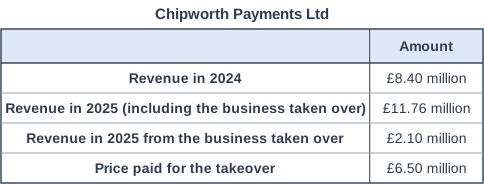
Chipworth Payments Ltd designs and makes card payment terminals for shops and cafes. In early 2025 it took over a smaller business that makes self-service ordering screens for restaurants. The table shows information about Chipworth Payments Ltd.

Using the information in the table, calculate the percentage increase in Chipworth Payments Ltd's revenue from 2024 to 2025 from organic growth alone, leaving out the revenue from the business it took over. You are advised to show your workings.

Chipworth Payments Ltd. Table with columns (row headings), "Amount". Revenue in 2024; Amount: £8.40 million | Revenue in 2025 (including the business taken over); Amount: £11.76 million | Revenue in 2025 from the business taken over; Amount: £2.10 million | Price paid for the takeover; Amount: £6.50 million.

Model answer

Revenue in 2025 without the business taken over = £11.76m - £2.10m = £9.66m
Increase from organic growth = £9.66m - £8.40m = £1.26m
Percentage increase = £1.26m ÷ £8.40m × 100 = 15%

Explanation

Organic growth comes from the business's own activities, so the revenue of the business it took over must be taken out before the increase is worked out. A percentage increase is the change divided by the original (2024) figure, multiplied by 100. Using the total 2025 revenue gives 40%, which mixes organic and inorganic growth; the price paid for the takeover is not needed.

Mark scheme
  1. 1 mark

    Fully correct working, e.g. (£11.76m - £2.10m - £8.40m) ÷ £8.40m × 100; or a correct final answer of 15% with no working

    An answer of 15% with no working scores 2 marks. If the final answer is wrong, award this mark only for fully correct working (revenue without the business taken over £9.66m, organic increase £1.26m, and £1.26m ÷ £8.40m × 100); a formula alone or partly correct working scores 0. If several different final answers are given, award 0.

  2. 1 mark

    15%

    Accept 15 or 15.00 without the % sign. Do not accept 40% (this includes the revenue of the business taken over), 25% (the revenue of the business taken over as a percentage of 2024 revenue), 10.71% or 13.04% (the increase divided by a 2025 revenue figure instead of the 2024 revenue), 37.5% (the organic increase as a percentage of the total increase of £3.36 million) or £1.26 million (the increase in pounds, not a percentage).

Question 3

3 marks

Explain one way a business could change its marketing mix to enter a new market.

Model answer

A business could change its promotion, for example by advertising on the social media sites that younger people use. This means people in that age group who had not heard of the product see adverts aimed at them. Therefore some of them try the product for the first time, so the business starts to sell to an age group that did not buy from it before.

Explanation

This is a 'way' question, so the development must explain how the change helps the business reach new customers, not why more sales would be good for it. Any of the four Ps can be changed: the product, its price, how it is promoted or where it is sold. Answers that end with 'so sales and profit increase' do not earn that strand.

Mark scheme
  1. 1 mark

    Award 1 mark for identification of a way a business could change its marketing mix to enter a new market.

    Answers that list more than one way with no explanation will be awarded a maximum of 1 mark. Accept any other appropriate response. Valid ways include: change the product (adapt its design, size or features to suit the new customers); change the price (for example a lower price or a different pricing strategy that suits what the new customers will pay); change the promotion (advertise in media the new customers use, or with a message aimed at them); change the place (sell through new channels where the new customers shop, such as online, through different retailers or through a distributor abroad). Do not accept a change that is not part of the marketing mix, e.g. 'take over a business in that market' or 'recruit more staff'.

  2. 2 marks

    Award up to 2 further marks for explaining this way (1 mark for each linked strand of development).

    This is a 'way' question, so the strands must explain how the change lets the business reach and sell to the new market. Strands such as 'this increases sales', 'this increases revenue' or 'this increases profit' are not credited, and a strand that only repeats the question (e.g. 'so it enters a new market') is not a strand. Examples: A business could change its promotion, for example by advertising on the social media sites that younger people use (1). This means people in that age group who had not heard of the product see adverts aimed at them (1). Therefore some of them try the product for the first time, so the business starts to sell to an age group that did not buy from it before (1). / A business could change the place element by selling through a distributor in another country (1). The distributor already supplies shops there, so the product appears in the shops where overseas customers buy (1). As a result, the business can sell abroad without opening its own shops or having to deal with every retailer itself (1). A restatement of the way, an example or a definition is not a strand.

Question 4

9 marks

Corbelford Architects Ltd is a practice of 28 architects in Manchester that designs schools, libraries and health centres, mostly for councils. It made a profit of £640,000 last year. Its three directors want the business to grow, but it has been winning fewer new projects from councils, so they want to offer a wider range of design services.

Swalebrook Landscape Ltd is a firm of 20 landscape architects in Leeds that designs parks, playgrounds and school grounds. The two firms often work on the same projects. Swalebrook's directors would like to merge the two businesses. They would want an equal say in running the merged firm, and Swalebrook's staff mainly work from home, while Corbelford's staff work in the office.

Moirette Interiors Ltd is a studio of eight interior designers in Manchester that designs the insides of offices, hotels and restaurants for private companies. Its owner, who holds all of its shares, has offered to sell the business to Corbelford for £1.2 million. Corbelford would need a bank loan for £800,000 of the price. The owner, who wins most of the studio's work, plans to leave a year after the sale.

In order to grow, Corbelford Architects Ltd is considering two options:
Option 1: merge with Swalebrook Landscape Ltd
Option 2: take over Moirette Interiors Ltd.

Justify which one of these two options Corbelford Architects Ltd should choose.

Model answer

Corbelford Architects should choose Option 1, merging with Swalebrook Landscape.

The two firms already work on the same projects, so the merged business could offer councils a complete design for a new school or health centre, covering both the buildings and the grounds. This makes its bids more attractive than those of rivals that only design buildings. Therefore it may win a larger share of the council projects that are still available, even though Corbelford has been winning fewer of them. In addition, no price is paid in a merger, so Corbelford would not need an £800,000 loan. As a result, there would be no interest payments to reduce last year's profit of £640,000, and the merged firm would gain a base in Leeds, a new area in which to win work.

However, Corbelford's three directors would have to share control equally with Swalebrook's directors. Swalebrook's staff mainly work from home, while Corbelford's work in the office, so the two firms may disagree about how the business should be run, which could slow down decisions. Also, both firms rely on public-sector work, so the merger would not protect Corbelford if councils keep giving out fewer new projects.

Overall, the merger is the better option because it lets Corbelford grow without borrowing and builds on work the two firms already do together, while the takeover depends on keeping clients that were won by an owner who is leaving. However, it depends on whether the directors can agree how the merged firm will be run before they merge. If they set out clearly who will make which decisions and agree one policy on home working, the merger is likely to succeed; if they cannot, Corbelford might do better to look for a business to take over whose key people are staying.

Explanation

The strongest answers choose one option, use the case to explain its benefits and its drawbacks, and reach a conclusion that adds a new point, such as the 'it depends' factor about agreeing how the merged firm will be run. Listing the benefits of both options without comparing them gives no evaluation. Either option can score 9 marks if it is justified well, for example the takeover, because it brings a new market of private clients.

Mark scheme
  1. 9 marks

    Levels of response (9 marks).
    Level 3 (7-9 marks): Detailed application of knowledge and understanding of business concepts and issues to the business context throughout (AO2). Deconstructs business information and/or issues, finding detailed interconnected points with logical chains of reasoning (AO3a). Makes a judgement, providing a clear justification based on a thorough evaluation of business information and issues relevant to the choice made (AO3b).
    Level 2 (4-6 marks): Sound application of knowledge and understanding of business concepts and issues to the business context although there may be some inconsistencies (AO2). Deconstructs business information and/or issues, finding interconnected points with chains of reasoning, although there may be some logical inconsistencies (AO3a). Makes a judgement, providing a justification based on sound evaluation of business information and issues relevant to the choice made (AO3b).
    Level 1 (1-3 marks): Limited application of knowledge and understanding of business concepts and issues to the business context (AO2). Attempts to deconstruct business information and/or issues, finding limited connections between points (AO3a). Makes a judgement, providing a simple justification based on limited evaluation of business information and issues relevant to the choice made (AO3b).
    0 marks: No rewardable material.

    Indicative content (not a checklist; credit other valid points):
    - Option 1: Swalebrook's 20 landscape architects design parks, playgrounds and school grounds, and the two firms already work on the same projects, so the merged firm could design both the buildings and the grounds of schools and health centres; no purchase price has to be paid (AO2).
    - Option 2: Corbelford would own all of Moirette Interiors and control every decision, and it would gain eight interior designers who work for private companies (offices, hotels and restaurants); the price is £1.2 million, including an £800,000 bank loan (AO2).
    - Option 1: because no price is paid, Corbelford does not need a loan, so there is no interest to reduce last year's £640,000 profit. A merged firm of 48 designers that can offer a complete design for school projects may win more of the council projects that are still available, and it gains a base in Leeds, so revenue can grow in a new area (AO3a).
    - Option 2: Moirette's private clients are a new market, so Corbelford would rely less on councils, which are giving it fewer new projects. Therefore its revenue would be protected if council work keeps falling, and because it controls the whole business it can make decisions quickly and keep all of the profit from the new work (AO3a).
    - However, with Option 1 Corbelford's directors would have to share control equally with Swalebrook's directors, and the different ways of working (Swalebrook's staff mainly work from home) could cause disagreements and slow decisions. Both firms also depend on public-sector projects, so the merger does little to reduce the risk of falling council work (AO3b).
    - However, with Option 2 the £800,000 loan adds interest and repayments, and the owner who wins most of Moirette's work plans to leave after a year. If clients follow the owner, Corbelford may have paid £1.2 million for a business whose revenue falls; it depends on whether Corbelford can keep these clients, for example by agreeing that part of the price is paid only if sales are kept up (AO3b).
    Marking notes: either option can score full marks. Only the best two points are credited; Level 3 for AO3a needs about five linked strands. Context only counts inside a valid point; copying the case or using the business names or words from the question is not application. The strongest answers choose one option and weigh its benefits and drawbacks. Covering the benefits of both options with no contrast, or only the drawbacks of the rejected option, gives no evaluation (AO3b). A one-sided answer cannot reach Level 2 for AO3b. Level 3 needs a conclusion that adds something new, such as a developed 'it depends' factor (e.g. whether the directors can agree how the merged firm will be run, or whether Moirette's clients will stay after the owner leaves), and uses the context. Do not credit points that say Corbelford pays a price for Swalebrook in a merger, or that confuse merging or taking over with organic growth.

Ready to try the rest? Every answer you write is marked against the mark scheme, so you can see exactly where the marks are.

Study Helper Hints first, answers after you try

Stuck on this one? Ask for a hint and I’ll point you in the right direction, without giving the answer away. Once you’ve checked your answer, I’ll show you how the marks are awarded.