
Level:
Correct: 0
Incorrect: 0
Marks: 0/0
Exam Practice
Course:
Topics:
Edexcel GCSE Business (Paper 2) Smart practice A mixed round aimed at your weak spots
Unit 1
Growing the business
Unit 2
Making marketing decisions
Unit 3
Making operational decisions
Unit 4
Making financial decisions
Business calculations
Understanding business performance
Unit 5
Making human resource decisions
Avg
score:
–
Topics
done:
0/24

Place

Practise 19 exam-style questions on Place for Edexcel GCSE Business (Paper 2). Write your answer as you would in the exam and get it marked in seconds against the mark scheme, point by point, with the Study Helper on hand if you get stuck.

  • 19 questions
  • 1–12 marks each
  • Instant marking
  • No sign-up needed
19 questions, marked as you go

Sample questions with model answers

Here are 4 of the questions in this topic, each with a model answer, an explanation of why it earns the marks and the mark scheme an examiner would use.

Question 1

1 mark

Define the term 'e-tailer'.

Model answer

An e-tailer is a business that sells its products to consumers online, through a website or app, instead of in shops.

Explanation

The key idea is that the e-tailer sells over the internet using e-commerce, then delivers the goods. A business that only advertises on a website is not an e-tailer. Simply expanding the word to 'electronic retailer' does not show what the business actually does.

Mark scheme
  1. 1 mark

    A definition showing that an e-tailer is a business that sells products to consumers online (over the internet), rather than through shops.

    Accept wordings such as: an online retailer; a business that sells to customers through a website or app; a retailer that uses e-commerce to sell its goods; a business that sells over the internet and delivers to customers. The answer must show that the business SELLS online. Do not accept: 'a business that has a website' (it may only use the website for promotion); 'a business that delivers products' with no mention of selling online; 'an electronic retailer' with no explanation of what this means.
Question 2

2 marks

Spiralby Ltd, based in Leicester, makes sketchbooks. They are sold in about 200 art shops and on the company's website, and customers pay the same price for a sketchbook in both. The art shops keep part of the price for themselves. For each sketchbook sold on its website, Spiralby pays for postage and packaging.

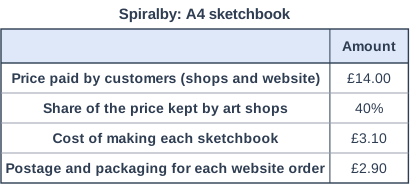
The table shows information about one of its sketchbooks.

Assuming each website order is for one sketchbook, calculate, in pounds, how much more profit Spiralby makes on a sketchbook sold through its website than on one sold through an art shop. You are advised to show your workings.

Spiralby: A4 sketchbook. Table with columns (row headings), "Amount". Price paid by customers (shops and website); Amount: £14.00 | Share of the price kept by art shops; Amount: 40% | Cost of making each sketchbook; Amount: £3.10 | Postage and packaging for each website order; Amount: £2.90.

Model answer

Profit on a website sale = £14.00 - £3.10 - £2.90 = £8.00
Amount received from an art shop = £14.00 × 60% = £8.40
Profit on an art shop sale = £8.40 - £3.10 = £5.30
Difference = £8.00 - £5.30 = £2.70

Explanation

Through an art shop, Spiralby receives only the 60% of the £14 price that the shop does not keep, but it pays no postage; through its website it receives the full £14 but pays £2.90 to post each sketchbook. The cost of making the sketchbook is the same either way, so the difference is simply the shop's £5.60 share minus the £2.90 postage. A common error is to forget the postage, which gives £5.60.

Mark scheme
  1. 1 mark

    Fully correct working, e.g. (£14.00 - £3.10 - £2.90) - ((£14.00 × 60%) - £3.10) = £8.00 - £5.30; or a correct final answer of £2.70 with no working

    An answer of £2.70 with no working scores 2 marks. If the final answer is wrong, award this mark only for fully correct working; a formula alone or partly correct working scores 0. Also accept the short method: the art shop's share (£14.00 × 40% = £5.60) minus the postage and packaging (£2.90). If several different final answers are given, award 0.

  2. 1 mark

    £2.70

    Accept 2.70 or 2.7, with or without the £ sign. Do not accept £8.00 (the profit on a website sale only), £5.30 (the profit on an art shop sale only), £5.60 (the art shop's share, with postage and packaging left out) or £5.50 (the art shops treated as paying only 40% of the price).

Question 3

3 marks

Explain one reason why a growing business might sell its products through retailers rather than only through its own website.

Model answer

A national chain of retailers already has many shops that large numbers of shoppers visit every day. This means the business's products are seen by people who would never have searched for its website. As a result, it can reach customers across the country without paying to open its own shops.

Explanation

The reason should come from what retailers offer that a website does not, such as their shops' footfall, the chance to see products or the advice of staff. One mark is for the reason and two are for linked strands. Saying retailers are 'cheaper' is usually wrong, because they keep part of the selling price.

Mark scheme
  1. 1 mark

    Award 1 mark for identification of a reason why a growing business might sell through retailers rather than only through its own website.

    Answers that list more than one reason with no explanation will be awarded a maximum of 1 mark. Accept any other appropriate response. Valid reasons include: retailers have many shops with high footfall, so the products reach customers who would never visit the business's website; customers can see, touch or try the products in a shop before buying; shop staff can give advice; the business does not need to open or run its own shops; retailers buy in large quantities, so the business makes fewer, larger deliveries; being stocked by a well-known retailer can build trust in a new brand. Do not accept 'it is cheaper' with no explanation (retailers keep part of the price), or reasons for using the business's own website.

  2. 2 marks

    Award up to 2 further marks for explaining this reason (1 mark for each linked strand of development).

    Examples: A national chain of retailers already has many shops that large numbers of shoppers visit every day (1). This means the business's products are seen by people who would never have searched for its website (1). As a result, it can reach customers across the country without paying to open its own shops (1). / In a shop, customers can see and handle the products before they buy them (1). This makes them more confident about buying from a brand they do not know (1). Therefore fewer products are returned than when customers order online without seeing them first (1). A restatement of the reason, a definition of a retailer or a named real shop used as an example is not a strand.

Question 4

6 marks

Garland & Glee Ltd runs 30 party supplies shops in the Midlands and East Anglia, selling balloons, banners, costumes and tableware for birthdays, weddings and festivals. It also sells through its website, delivering orders in three to five days for £4.95. Online sales have grown by 30% a year, but many visitors to the website leave without buying because they need items for a party the same day. Helium-filled balloons cannot be sent by post.

Garland & Glee plans to offer click and collect. Customers will order on the website and collect their order free of charge from their nearest shop two hours later. Shop staff will pick the orders from the shelves, and each shop will fill helium balloons ready for collection.

Analyse the benefit to Garland & Glee of offering click and collect.

Model answer

Many people visit the website but leave without buying because they need balloons or costumes for a party that day, and home delivery takes three to five days. With click and collect they can order online and collect their items from one of the 30 shops two hours later. Therefore more of these visits will turn into orders, adding to online sales that are already growing by 30% a year. As a result, Garland & Glee can also win customers from online-only party sellers that cannot deliver the same day.

Customers who come into a shop to collect an order may also buy extra items they had forgotten, such as candles or tableware. This means the average amount each customer spends rises. In addition, staff pick the orders from stock already on the shelves and customers carry them home, so Garland & Glee has no courier costs. This means it makes more profit on each online order than when it sends parcels by post, and it can now sell helium balloons online, which it could not post before.

Explanation

A top answer uses details from the case, such as same-day party needs, the 30 shops, the £4.95 delivery charge and the helium balloons, in every paragraph and builds about five linked strands from one or two benefits. Click and collect combines e-commerce with the retailer's shops, so good answers explain how each channel helps the other. Drawbacks are not asked for, and a generic answer cannot score more than 3 marks.

Mark scheme
  1. 6 marks

    Levels of response (6 marks).
    Level 3 (5-6 marks): Detailed application of knowledge and understanding of business concepts and issues to the business context throughout (AO2). Deconstructs business information and/or issues, finding detailed interconnected points with logical chains of reasoning (AO3a).
    Level 2 (3-4 marks): Sound application of knowledge and understanding of business concepts and issues to the business context although there may be some inconsistencies (AO2). Deconstructs business information and/or issues, finding interconnected points with chains of reasoning, although there may be some logical inconsistencies (AO3a).
    Level 1 (1-2 marks): Limited application of knowledge and understanding of business concepts and issues to the business context (AO2). Attempts to deconstruct business information and/or issues, finding limited connections between points (AO3a).
    0 marks: No rewardable material.

    Indicative content (not a checklist; credit other valid points):
    - Customers who need balloons, banners or costumes for a party the same day can now order online and collect two hours later, free of the £4.95 delivery charge (AO2).
    - Helium-filled balloons, which cannot be posted, can now be ordered online and collected from any of the 30 shops in the Midlands and East Anglia (AO2).
    - Fewer website visitors will leave without buying because they need items quickly. Therefore more visits turn into orders, which adds to online sales that are already growing by 30% a year, and Garland & Glee can compete with online-only sellers that take days to deliver (AO3a).
    - Customers who come into a shop to collect an order may buy extra items, such as candles or tableware they had forgotten. As a result, the average amount spent per customer rises, and because the orders use stock and staff already in the shops, there are no courier costs, so the profit on each online order can be higher than with home delivery (AO3a).
    Marking notes: only the best two points are credited; Level 3 for AO3a needs about five linked strands from one or two points. Context only counts inside a valid point, and copying the case or using the business name or words from the question is not application. A generic answer with no application to Garland & Glee cannot score more than 3 marks. Drawbacks (e.g. extra work for shop staff) are not asked for and are not credited unless used to develop a benefit; evaluation is not credited.

Ready to try the rest? Every answer you write is marked against the mark scheme, so you can see exactly where the marks are.

Study Helper Hints first, answers after you try

Stuck on this one? Ask for a hint and I’ll point you in the right direction, without giving the answer away. Once you’ve checked your answer, I’ll show you how the marks are awarded.