
Level:
Correct: 0
Incorrect: 0
Marks: 0/0
Exam Practice
Course:
Topics:
Edexcel GCSE Business (Paper 2) Smart practice A mixed round aimed at your weak spots
Unit 1
Growing the business
Unit 2
Making marketing decisions
Unit 3
Making operational decisions
Unit 4
Making financial decisions
Business calculations
Understanding business performance
Unit 5
Making human resource decisions
Avg
score:
–
Topics
done:
0/24

Organisational structures

Practise 18 exam-style questions on Organisational structures for Edexcel GCSE Business (Paper 2). Write your answer as you would in the exam and get it marked in seconds against the mark scheme, point by point, with the Study Helper on hand if you get stuck.

  • 18 questions
  • 1–12 marks each
  • Instant marking
  • No sign-up needed
18 questions, marked as you go

Sample questions with model answers

Here are 4 of the questions in this topic, each with a model answer, an explanation of why it earns the marks and the mark scheme an examiner would use.

Question 1

1 mark

Define the term 'flat organisational structure'.

Model answer

An organisational structure with only a few levels of hierarchy between the top and the bottom of the business.

Explanation

The mark needs the idea of few levels (layers) of management. A wide span of control usually follows from this, but on its own it does not define the structure. A flat structure still has managers, and it is not the same as a decentralised structure, which is about who makes the decisions.

Mark scheme
  1. 1 mark

    A definition showing that a flat organisational structure has few levels of hierarchy (layers of management) between the top and the bottom of the business.

    Award 1 mark for a correct definition, e.g. 'An organisational structure with only a few levels of hierarchy' (1). Accept 'few layers of management', 'a short chain of command' or 'few levels, so each manager has a wide span of control'. A wide span of control on its own is a feature of a flat structure, not a definition: award it only if few levels or a short chain of command is also given. Do not accept 'everyone is equal', 'there are no managers' or 'decisions are made by all employees' (this confuses a flat structure with a decentralised one).
Question 2

2 marks

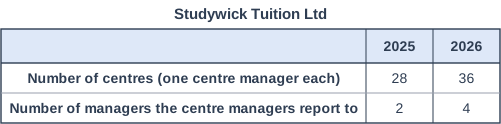
Studywick Tuition Ltd runs tuition centres where qualified teachers give small-group lessons in maths and English to children aged 7 to 16. Each centre is run by a centre manager. The table shows the number of centres in 2025 and 2026, and the number of managers that the centre managers reported to. In each year, these managers were each responsible for the same number of centre managers.

Using the information in the table, calculate the decrease in the span of control of each manager responsible for the centre managers between 2025 and 2026. You are advised to show your workings.

Studywick Tuition Ltd. Table with columns (row headings), "2025", "2026". Number of centres (one centre manager each); 2025: 28; 2026: 36 | Number of managers the centre managers report to; 2025: 2; 2026: 4.

Model answer

Span of control in 2025 = 28 ÷ 2 = 14 centre managers
Span of control in 2026 = 36 ÷ 4 = 9 centre managers
Decrease = 14 - 9 = 5 centre managers

Explanation

Span of control is the number of people who report directly to one manager, so divide the number of centre managers by the number of managers they report to in each year, then find the difference. Although Studywick has more centres, each manager now looks after fewer centre managers. A common slip is to subtract the numbers of managers (4 - 2 = 2), which is not a span of control.

Mark scheme
  1. 1 mark

    Fully correct working, e.g. (28 ÷ 2) - (36 ÷ 4); or a correct final answer of 5 with no working

    An answer of 5 with no working scores 2 marks. If the final answer is wrong, award this mark only for fully correct working (span in 2025 = 28 ÷ 2 = 14; span in 2026 = 36 ÷ 4 = 9; decrease = 14 - 9); a formula alone or partly correct working scores 0. If several different final answers are given, award 0.

  2. 1 mark

    5 (centre managers)

    Accept 5, '5 centre managers', '5 employees', 'a fall of 5' or -5. Do not accept 14 or 9 (the span in one year only), 8 (the increase in the number of centres), 2 (the increase in the number of managers) or 'an increase of 5'.

Question 3

3 marks

Explain one disadvantage to a business of having a centralised organisational structure.

Model answer

Branch managers must wait for head office to make decisions. This slows down the business's response to a local problem, such as a competitor cutting its prices nearby. As a result, the branch may lose customers to the competitor before head office acts.

Explanation

One mark is for a disadvantage of keeping decisions at head office, such as slow decisions or demotivated local managers, and two more are for two linked steps showing the effect on the business. Points about the number of levels describe a tall structure, which is a different idea from centralisation.

Mark scheme
  1. 1 mark

    Award 1 mark for identification of a disadvantage to a business of having a centralised organisational structure.

    Answers that list more than one disadvantage with no explanation will be awarded a maximum of 1 mark. Accept any other appropriate response. Valid disadvantages include: decisions are slow because they must be made or approved by head office; head office decisions may not suit local customers or conditions; branch or local managers have little authority, which can demotivate them; senior managers at head office may be overloaded with decisions. Do not accept 'too many levels of hierarchy' or 'narrow spans of control' (features of a tall structure, not of centralisation) unless linked to decisions being made at the top.

  2. 2 marks

    Award up to 2 further marks for explaining this disadvantage (1 mark for each linked strand of development).

    Examples: Branch managers must wait for head office to make decisions (1). This slows down the business's response to a local problem, such as a competitor cutting its prices nearby (1). As a result, the branch may lose customers to the competitor before head office acts (1). / Local managers have little authority to make decisions (1). They may feel less trusted and less motivated (1). This could lead to good managers leaving, which increases the business's recruitment and training costs (1). A restatement of the disadvantage, a definition or an example is not a strand. Vague endings such as 'the business could fail' are not credited.

Question 4

6 marks

Fiddlemoor Festivals Ltd runs five music festivals in different parts of the UK each summer. Each festival is aimed at a different audience: folk, jazz, dance music, rock, and families with young children. Fiddlemoor has a decentralised organisational structure. Each festival has its own festival director, who decides which acts to book, sets ticket prices and plans how to promote the festival. Head office deals only with finance and legal matters.

The festival directors know their audiences well, and four of the five festivals sold out last year. However, the directors rarely share their plans with each other. Each festival has its own ticket website and its own marketing assistant. Last year the folk and jazz festivals were held on the same weekend, only 40 miles apart, and the jazz festival was the only one that did not sell out.

Analyse the impact on Fiddlemoor Festivals of its decentralised organisational structure.

Model answer

Fiddlemoor's festival directors decide which acts to book, and each knows their own audience, such as folk fans or families with young children. This means they can book the acts that their audience most wants to see, so tickets sell quickly, and four of the five festivals sold out last year. As a result, Fiddlemoor earns the most ticket revenue it can from each festival. Satisfied festival-goers are also more likely to buy tickets again next summer, which makes future sales more secure.

However, because each director makes decisions alone and rarely shares plans, nobody checks that the five festivals fit together. Last year the folk and jazz festivals were held on the same weekend, only 40 miles apart. Therefore the two festivals competed for many of the same customers, and the jazz festival was the only one that did not sell out. This means Fiddlemoor lost ticket revenue. In addition, paying for five separate ticket websites and five marketing assistants duplicates costs, so Fiddlemoor's profit is lower than it could be.

Explanation

A top answer develops two impacts with about five linked strands, using the case throughout: the directors' knowledge of their audiences and the sold-out festivals, and the clash between the folk and jazz festivals or the five separate ticket websites. The impact can be positive or negative, or both. Evaluation is not credited in an 'Analyse' question, and a generic answer cannot score more than 3 marks.

Mark scheme
  1. 6 marks

    Levels of response (6 marks).
    Level 3 (5-6 marks): Detailed application of knowledge and understanding of business concepts and issues to the business context throughout (AO2). Deconstructs business information and/or issues, finding detailed interconnected points with logical chains of reasoning (AO3a).
    Level 2 (3-4 marks): Sound application of knowledge and understanding of business concepts and issues to the business context although there may be some inconsistencies (AO2). Deconstructs business information and/or issues, finding interconnected points with chains of reasoning, although there may be some logical inconsistencies (AO3a).
    Level 1 (1-2 marks): Limited application of knowledge and understanding of business concepts and issues to the business context (AO2). Attempts to deconstruct business information and/or issues, finding limited connections between points (AO3a).
    0 marks: No rewardable material.

    Indicative content (not a checklist; credit other valid points):
    - Each festival director decides which acts to book for an audience they know well, such as folk or jazz fans, and four of the five festivals sold out last year (AO2).
    - The directors rarely share their plans: each festival has its own ticket website and marketing assistant, and the folk and jazz festivals were held on the same weekend, only 40 miles apart (AO2).
    - Because the festival directors book acts that their own audience wants, tickets sell out. Therefore Fiddlemoor earns the most ticket revenue it can from each festival, and satisfied festival-goers are more likely to return next year, so future sales are more secure (AO3a).
    - Because no one coordinates the five festivals, their plans can clash. As a result the folk and jazz festivals competed for many of the same customers, so the jazz festival did not sell out and Fiddlemoor lost ticket revenue; paying for five ticket websites and five marketing assistants also duplicates costs, so profit is lower than it could be (AO3a).
    - Festival directors with authority can make quick decisions, such as adding an act or changing a promotion, and are likely to be more motivated (AO3a).
    Marking notes: an impact can be positive or negative, or both. Only the best two points are credited; Level 3 for AO3a needs about five linked strands from one or two points. Context only counts inside a valid point, and copying the case or using the business name or words from the question is not application. A generic answer with no application to Fiddlemoor Festivals cannot score more than 3 marks. Evaluation is not required and is not credited.

Ready to try the rest? Every answer you write is marked against the mark scheme, so you can see exactly where the marks are.

Study Helper Hints first, answers after you try

Stuck on this one? Ask for a hint and I’ll point you in the right direction, without giving the answer away. Once you’ve checked your answer, I’ll show you how the marks are awarded.