Level:
Correct: 0
Incorrect: 0
Marks: 0/0
Exam Practice
Course:
Topics:
Edexcel GCSE Business (Paper 2) Smart practice A mixed round aimed at your weak spots
Unit 1
Growing the business
Unit 2
Making marketing decisions
Unit 3
Making operational decisions
Unit 4
Making financial decisions
Business calculations
Understanding business performance
Unit 5
Making human resource decisions
Avg
score:
–
Topics
done:
0/24

Understanding business performance

Practise 24 exam-style questions on Understanding business performance for Edexcel GCSE Business (Paper 2). Write your answer as you would in the exam and get it marked in seconds against the mark scheme, point by point, with the Study Helper on hand if you get stuck.

  • 24 questions
  • 1–12 marks each
  • Instant marking
  • No sign-up needed
20 questions, marked as you go

Sample questions with model answers

Here are 4 of the questions in this topic, each with a model answer, an explanation of why it earns the marks and the mark scheme an examiner would use.

Question 1

1 mark

Which one of the following would cause a business's market share to fall?

Choose your answer.

  • A Its sales and total sales in the market both rise by 10%
  • B Its sales rise more slowly than total sales in the market
  • C Its sales rise while total sales in the market stay the same
  • D Its sales stay the same while total sales in the market fall

Model answer

B - Its sales rise more slowly than total sales in the market

Explanation

Market share is a business's sales as a percentage of total market sales, so it depends on the market as well as on the business. A business whose sales are rising can still lose market share if its rivals' sales are rising faster. The other options all leave the share unchanged or make it rise.

Mark scheme
  1. 1 mark

    B - Its sales rise more slowly than total sales in the market

    The only correct answer is B: if the market grows faster than the business's sales, the business's sales become a smaller percentage of the total. A is not correct because if both rise by the same percentage, the market share stays the same; C is not correct because the business's sales become a larger part of an unchanged market, so its share rises; D is not correct because the same sales in a smaller market are a larger percentage of it, so its share rises. Accept the letter or the words of the option. If more than one option is given, award 0.
Question 2

2 marks

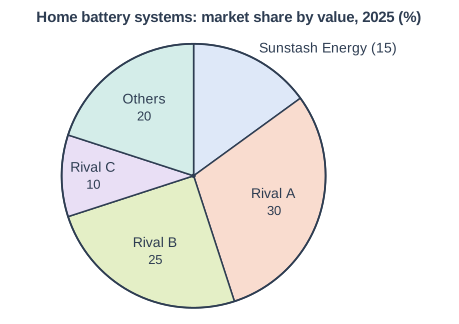
Sunstash Energy Ltd makes battery systems that store electricity from solar panels in people's homes, and sells them through installers. The pie chart shows Sunstash's estimates of the market shares of the businesses selling home battery systems in the UK in 2025, by value of sales. A market research report forecasts that the total value of the market will be £384 million in 2026.

Using the information in the pie chart, calculate the value of Sunstash's sales in 2026 if its market share stays the same as in 2025. Give your answer in pounds. You are advised to show your workings.

Home battery systems: market share by value, 2025 (%). Pie chart. A circle divided into sectors, drawn clockwise from the top (12 o'clock): Sunstash Energy (15 printed in it), 54°; Rival A (30 printed in it), 108°; Rival B (25 printed in it), 90°; Rival C (10 printed in it), 36°; Others (20 printed in it), 72°. (Angles are not printed on the chart; these are the drawn sizes, which can be measured with a protractor.)

Model answer

Sunstash's market share = 15%
Forecast sales = £384 million × 15 ÷ 100
= £57.6 million (£57,600,000)

Explanation

If the market share stays at 15%, Sunstash's sales will be 15% of the forecast market of £384 million, which is £57.6 million. The share must be turned into a fraction of the market (divide by 100) before multiplying. This kind of calculation helps a business plan how many systems to make, but it is only as good as the forecast.

Mark scheme
  1. 1 mark

    Fully correct working, e.g. £384 million × 15 ÷ 100; or a correct final answer of £57.6 million (£57,600,000) with no working

    An answer of £57.6 million (£57,600,000) with no working scores 2 marks. If the final answer is wrong, award this mark only for fully correct working; a formula alone or partly correct working scores 0. If several different final answers are given, award 0.

  2. 1 mark

    £57.6 million / £57,600,000

    Accept 57.6 million, 57,600,000 or £57.6m, with or without the £ sign. Common wrong answers that score 0 here: £25.6 million (£384 million divided by 15); £5,760 million (not divided by 100); £115.2 million (Rival A's 30% share used).

Question 3

2 marks

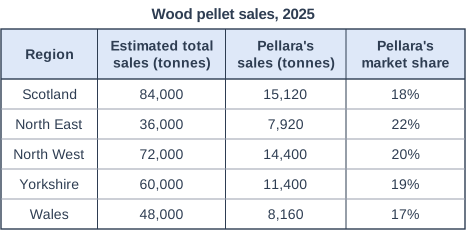
Pellara Fuels Ltd, based in Northumberland, turns sawdust and offcuts from sawmills into wood pellets for biomass heating. Its lorries deliver the pellets in bulk to farms, schools and homes, and it has four sales staff. Each year its sales manager compares Pellara's sales with estimates of the total sales in each region where it delivers, as shown in the table.

Outline one benefit to Pellara of knowing its market share in each region.

Wood pellet sales, 2025. Table with columns "Region", "Estimated total sales (tonnes)", "Pellara's sales (tonnes)", "Pellara's market share". Region: Scotland; Estimated total sales (tonnes): 84,000; Pellara's sales (tonnes): 15,120; Pellara's market share: 18% | Region: North East; Estimated total sales (tonnes): 36,000; Pellara's sales (tonnes): 7,920; Pellara's market share: 22% | Region: North West; Estimated total sales (tonnes): 72,000; Pellara's sales (tonnes): 14,400; Pellara's market share: 20% | Region: Yorkshire; Estimated total sales (tonnes): 60,000; Pellara's sales (tonnes): 11,400; Pellara's market share: 19% | Region: Wales; Estimated total sales (tonnes): 48,000; Pellara's sales (tonnes): 8,160; Pellara's market share: 17%.

Model answer

Pellara can see that its market share is lowest in Wales, at 17%. This means it could focus its sales team and promotion on Wales, where it has the most room to win customers from rival pellet makers.

Explanation

Market share shows how well a business is doing against its rivals in each region, which its sales figures alone do not. Two marks need a benefit, a linked step to a decision and use of the table or case, such as Wales's 17% share. A general statement that it shows performance, with no development, scores at most 1 mark.

Mark scheme
  1. 2 marks

    Award up to 2 marks for linked points outlining one benefit to Pellara of knowing its market share in each region. Award a maximum of 1 mark if points are not linked.

    Max 1 if the answer has no application to the case (a valid point with no application scores 1 mark). 1 mark for a valid benefit and 1 further mark for a linked development of it. To award 2 marks there must be linked development and evidence of application (use of the case or table, e.g. 'Wales', '17%', 'Scotland', 'the North East', 'wood pellets', 'biomass heating', 'the four sales staff', 'lorries', 'Northumberland'). The name of the business and the words 'market share' and 'region' do not count as application because they are in the question. Award any other valid answer. Examples: Pellara can see that its market share is lowest in Wales, at 17% (1), so it could focus its sales team and promotion there, where it has the most room to win customers from rival pellet makers (1). / In Scotland Pellara sells the most pellets but has only 18% of the market (1), so the share shows that rivals are strong there and Pellara can set targets for winning more of that large market rather than judging itself only on its sales (1). / Its 22% share in the North East, near its Northumberland plant, shows where it is strongest (1), so it can protect these customers, for example with fast delivery, while it grows in other regions (1). Do not accept a generic 'to see how well it is doing' with no development.

Question 4

6 marks

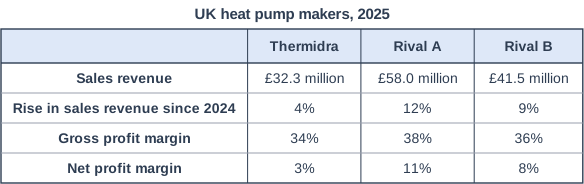
Thermidra Heat Pumps Ltd, based in Telford, assembles air-source heat pumps and sells them to heating installers across the UK. Its heat pumps come with the longest warranty in the market, and it spends a larger share of its revenue on research and development than its rivals do. In 2025 the prices of the parts it buys from suppliers rose.

The directors are preparing a plan to increase Thermidra's profit in 2026. They have bought an industry report that shows the 2025 financial results of the three largest UK heat pump makers, as shown in the table.

Analyse the benefit to Thermidra of comparing its financial information with that of its rivals.

UK heat pump makers, 2025. Table with columns (row headings), "Thermidra", "Rival A", "Rival B". Sales revenue; Thermidra: £32.3 million; Rival A: £58.0 million; Rival B: £41.5 million | Rise in sales revenue since 2024; Thermidra: 4%; Rival A: 12%; Rival B: 9% | Gross profit margin; Thermidra: 34%; Rival A: 38%; Rival B: 36% | Net profit margin; Thermidra: 3%; Rival A: 11%; Rival B: 8%.

Model answer

Comparing its results with its rivals shows the directors exactly where Thermidra is weaker. Its gross profit margin is 34%, compared with 38% for Rival A and 36% for Rival B, so it keeps less gross profit from each £1 of sales. This suggests that its cost of sales is too high, especially since the prices of the parts it buys rose in 2025. Therefore the directors can focus their 2026 plan on cutting the cost of making each heat pump, for example by finding cheaper suppliers of parts or buying them in larger quantities. As a result, its gross profit, and so its net profit, would rise.

The comparison also shows that Thermidra's net profit margin of 3% is far below its rivals' 11% and 8%. The gap between its gross and net profit margins is 31 percentage points, wider than its rivals' 27 and 28, which means its other operating expenses, such as research and development, take a larger share of its revenue. This means the directors can check whether the extra research and the long warranty are paying off, as its revenue rose by only 4% while its rivals' rose by 12% and 9%, and they can set a realistic target, such as reaching Rival B's 8% net profit margin, to measure progress in 2026.

Explanation

A top answer uses the table to show where Thermidra is behind its rivals, such as its lower gross profit margin and much lower net profit margin, and follows about five linked steps to how this helps the directors plan, such as targeting the cost of parts or setting a margin target. Context must be used throughout, and a generic answer about comparing with competitors cannot score more than 3 marks. Limitations of the comparison are evaluation, which is not credited in an 'Analyse' question.

Mark scheme
  1. 6 marks

    Levels of response (6 marks).
    Level 3 (5-6 marks): Detailed application of knowledge and understanding of business concepts and issues to the business context throughout (AO2). Deconstructs business information and/or issues, finding detailed interconnected points with logical chains of reasoning (AO3a).
    Level 2 (3-4 marks): Sound application of knowledge and understanding of business concepts and issues to the business context although there may be some inconsistencies (AO2). Deconstructs business information and/or issues, finding interconnected points with chains of reasoning, although there may be some logical inconsistencies (AO3a).
    Level 1 (1-2 marks): Limited application of knowledge and understanding of business concepts and issues to the business context (AO2). Attempts to deconstruct business information and/or issues, finding limited connections between points (AO3a).
    0 marks: No rewardable material.

    Indicative content (not a checklist; credit other valid points):
    - Thermidra's gross profit margin of 34% is below Rival A's 38% and Rival B's 36%, so it keeps less gross profit from each £1 of sales after paying for parts and its other costs of sales (AO2).
    - Its net profit margin of 3% is far below its rivals' 11% and 8%, and its sales revenue rose by only 4% since 2024, against 12% and 9% (AO2).
    - The comparison shows where Thermidra is weaker. The gap in gross profit margin suggests that its cost of sales is too high, for example after the rise in the price of parts, so the directors can focus the 2026 plan on cutting the cost of each heat pump, such as by finding cheaper suppliers or buying parts in larger quantities. Therefore gross profit, and so net profit, would rise (AO3a).
    - The gap between the gross and net profit margins is 31 percentage points for Thermidra, wider than its rivals' 27 and 28, which shows that its other operating expenses, such as research and development, take a larger share of its revenue. As a result, the directors can judge whether the extra research and the long warranty are paying off in sales, and set a realistic target, such as reaching Rival B's 8% net profit margin, to measure progress during 2026 (AO3a).
    Marking notes: only the best two points are credited; Level 3 for AO3a needs about five linked strands from one or two points. Context, including figures from the table, only counts inside a valid point; copying the case or using the business name or words from the question is not application. A generic answer with no application to Thermidra cannot score more than 3 marks. Evaluation (for example the limitations of comparing with rivals, such as different products or customers) is not credited. Do not credit answers that compare sales revenue alone as if it showed profit.

Ready to try the rest? Every answer you write is marked against the mark scheme, so you can see exactly where the marks are.

Study Helper Hints first, answers after you try

Stuck on this one? Ask for a hint and I’ll point you in the right direction, without giving the answer away. Once you’ve checked your answer, I’ll show you how the marks are awarded.