
Level:
Correct: 0
Incorrect: 0
Marks: 0/0
Exam Practice
Course:
Topics:
Avg
score:
–
Topics
done:
0/26

Relative formula mass and empirical formulae

Practise 16 exam-style questions on Relative formula mass and empirical formulae for Edexcel GCSE Combined Science (Chemistry Paper 1). Write your answer as you would in the exam and get it marked in seconds against the mark scheme, point by point, with the Study Helper on hand if you get stuck.

  • 16 questions
  • 1–6 marks each
  • Instant marking
  • No sign-up needed
16 questions, marked as you go

Sample questions with model answers

Here are 4 of the questions in this topic, each with a model answer, an explanation of why it earns the marks and the mark scheme an examiner would use.

Question 1

1 mark

Which pair of compounds have the same empirical formula?

Choose your answer.

  • A NO₂ and N₂O₄
  • B CO and CO₂
  • C H₂O and H₂O₂
  • D SO₂ and SO₃

Model answer

A - NO₂ and N₂O₄ (both have the empirical formula NO₂)

Explanation

The empirical formula is the simplest whole-number ratio of atoms of each element in a compound. N₂O₄ simplifies to NO₂ by dividing by 2, so the two compounds share an empirical formula even though their molecules are different. Compounds of the same elements, such as CO and CO₂, only share an empirical formula if their ratio of atoms is the same.

Mark scheme
  1. 1 mark

    A / NO₂ and N₂O₄ (1)

    The only correct answer is A: dividing the numbers of atoms in N₂O₄ by 2 gives NO₂, so both have the empirical formula NO₂. B is not correct because CO has a 1 : 1 ratio of carbon to oxygen atoms but CO₂ has 1 : 2; C is not correct because the empirical formula of H₂O₂ is HO, not H₂O; D is not correct because SO₂ has a 1 : 2 ratio and SO₃ has a 1 : 3 ratio. Accept the letter or the option. If more than one option is given, do not award the mark.
Question 2

2 marks

Glucose has the molecular formula C₆H₁₂O₆.

Give the empirical formula of glucose and explain why it is different from the molecular formula.

Model answer

The empirical formula of glucose is CH₂O. The empirical formula shows the simplest whole-number ratio of atoms of each element, whereas the molecular formula shows the actual number of atoms of each element in one molecule. In C₆H₁₂O₆ the numbers 6, 12 and 6 can all be divided by 6, giving CH₂O.

Explanation

To get an empirical formula from a molecular formula, divide all the numbers of atoms by their highest common factor - here 6. A common error is to add up the atoms or simply list the elements and their numbers instead of writing a formula. The two formulae are only the same when the numbers of atoms have no common factor, as in H₂O.

Mark scheme
  1. 1 mark

    CH₂O (1)

    accept CH2O; allow the elements in any order (e.g. H₂CO); do not accept C₆H₁₂O₆ (the molecular formula) or a list such as 'C 1, H 2, O 1' without a formula.

  2. 1 mark

    the empirical formula shows the simplest whole-number ratio of atoms (of each element) but the molecular formula shows the actual number of atoms (of each element) in one molecule (1)

    allow 'the empirical formula is the simplest (whole-number) ratio of atoms' alone; allow 'the numbers of atoms in C₆H₁₂O₆ can all be divided by 6 / have a common factor of 6'; ignore 'it has the same elements'; do not accept 'the empirical formula is a smaller molecule'.

Question 3

3 marks

A white salt contains sodium, sulfur and oxygen only. Analysis shows that the salt contains 32.4% sodium, 22.5% sulfur and 45.1% oxygen by mass.

(relative atomic masses: O = 16, Na = 23, S = 32)

Calculate the empirical formula of the salt.

You must show your working.

Model answer

Na: 32.4 ÷ 23 = 1.41
S: 22.5 ÷ 32 = 0.703
O: 45.1 ÷ 16 = 2.82
Divide each by the smallest (0.703): Na = 2.00, S = 1, O = 4.01
Ratio Na : S : O = 2 : 1 : 4
Empirical formula = Na₂SO₄

Explanation

With percentage composition, treat each percentage as the mass in grams in 100 g of the compound, divide by the relative atomic mass, then divide every answer by the smallest. The ratio 2 : 1 : 4 gives Na₂SO₄ (sodium sulfate). Common errors are dividing the relative atomic mass by the percentage and dividing the percentages by each other.

Mark scheme
  1. 1 mark

    Na 32.4 ÷ 23 = 1.41 and S 22.5 ÷ 32 = 0.703 and O 45.1 ÷ 16 = 2.82 (1)

    Marks are only awarded for working that uses the percentages from the question: Na₂SO₄ with no working scores 0. Allow values correctly rounded to 2 or more significant figures (e.g. 1.4, 0.70, 2.8). Elements may be in any order. Inverted divisions do not score MP1.

  2. 1 mark

    (dividing by the smallest value, 0.703) Na : S : O = 2 : 1 : 4 (1)

    allow 2.00 : 1 : 4.01 or values that round to 2 : 1 : 4; allow ECF from MP1.

  3. 1 mark

    Na₂SO₄ (1)

    accept Na2SO4; allow the elements in any order (e.g. Na₂O₄S); allow ECF from the student's whole-number ratio.

Question 4

4 marks

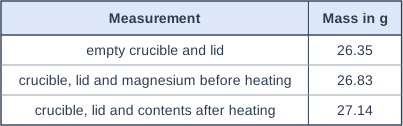
A student heated magnesium ribbon in a crucible with a lid to find the empirical formula of magnesium oxide. She heated, cooled and reweighed the crucible until its mass stopped changing.

The table shows her results.

(relative atomic masses: O = 16, Mg = 24)

Calculate the empirical formula of magnesium oxide from her results.

You must show your working.

Table with columns "Measurement", "Mass in g". Measurement: empty crucible and lid; Mass in g: 26.35 | Measurement: crucible, lid and magnesium before heating; Mass in g: 26.83 | Measurement: crucible, lid and contents after heating; Mass in g: 27.14.

Model answer

Mass of magnesium = 26.83 − 26.35 = 0.48 g
Mass of oxygen = 27.14 − 26.83 = 0.31 g
Moles: Mg = 0.48 ÷ 24 = 0.020; O = 0.31 ÷ 16 = 0.0194
Ratio Mg : O = 0.020 : 0.0194 = 1 : 0.97, which is 1 : 1 to the nearest whole number
Empirical formula = MgO

Explanation

The mass of magnesium comes from the first two readings and the mass of oxygen is the gain in mass on heating. Real results rarely give an exact whole-number ratio, so 1 : 0.97 is rounded to 1 : 1; a small shortfall in oxygen is typical when a little magnesium oxide escapes. A common error is to use the mass of magnesium oxide (0.79 g) as the mass of oxygen.

Mark scheme
  1. 1 mark

    (mass of magnesium =) 26.83 − 26.35 = 0.48 (g) and (mass of oxygen =) 27.14 − 26.83 = 0.31 (g) (1)

    Marks are only awarded for working that uses the results in the table: MgO with no working scores 0. Allow ECF throughout. Using 27.14 − 26.35 = 0.79 g (the mass of magnesium oxide) as the mass of oxygen does not score MP1.

  2. 1 mark

    (moles) Mg = 0.48 ÷ 24 = 0.020 and O = 0.31 ÷ 16 = 0.019(4) (1)

    allow 0.0194 / 0.019 / 0.01938; allow ECF from MP1; inverted divisions do not score MP2.

  3. 1 mark

    (ratio Mg : O =) 0.020 : 0.0194 = 1 : 0.97 / 1.03 : 1 / 1 : 1 (1)

    allow ECF from MP2.

  4. 1 mark

    MgO (1)

    allow OMg; do not accept Mg₂O₂ or a formula containing decimals (e.g. MgO₀.₉₇); allow ECF from the student's ratio rounded to whole numbers.

Ready to try the rest? Every answer you write is marked against the mark scheme, so you can see exactly where the marks are.

Study Helper Hints first, answers after you try

Stuck on this one? Ask for a hint and I’ll point you in the right direction, without giving the answer away. Once you’ve checked your answer, I’ll show you how the marks are awarded.