
Level:
Correct: 0
Incorrect: 0
Marks: 0/0
Exam Practice
Course:
Topics:
Avg
score:
–
Topics
done:
0/26

Giant covalent substances, polymers and metals

Practise 13 exam-style questions on Giant covalent substances, polymers and metals for Edexcel GCSE Combined Science (Chemistry Paper 1). Write your answer as you would in the exam and get it marked in seconds against the mark scheme, point by point, with the Study Helper on hand if you get stuck.

  • 13 questions
  • 1–6 marks each
  • Instant marking
  • No sign-up needed
13 questions, marked as you go

Sample questions with model answers

Here are 4 of the questions in this topic, each with a model answer, an explanation of why it earns the marks and the mark scheme an examiner would use.

Question 1

1 mark

Buckminsterfullerene, C₆₀, is a form of carbon.

Which statement about C₆₀ is correct?

Choose your answer.

  • A its molecules are flat sheets
  • B each atom bonds to four others
  • C it conducts well as a solid
  • D its molecules are hollow spheres

Model answer

D its molecules are hollow spheres

Explanation

C₆₀ is a fullerene: each molecule is a hollow cage of 60 carbon atoms, with each carbon atom bonded to three others. Because it is made of separate molecules held together by weak intermolecular forces, it is simple molecular and a poor conductor. Students often confuse it with graphene, which is a flat sheet one atom thick, or with diamond, in which each atom bonds to four others.

Mark scheme
  1. 1 mark

    D / its molecules are hollow spheres (1)

    The only correct answer is D: C₆₀ is a fullerene made of separate molecules, each a hollow sphere (cage) of 60 carbon atoms. A is not correct because a flat sheet one atom thick describes graphene; each C₆₀ molecule is a closed, hollow ball; B is not correct because each carbon atom in C₆₀ is covalently bonded to three other carbon atoms (being bonded to four others describes diamond); C is not correct because solid C₆₀ is a poor conductor - the delocalised electrons cannot move from one molecule to the next. Accept the letter or the option. If more than one option is given, do not award the mark.
Question 2

2 marks

Mercury is a metal and bromine is a non-metal. They are the only two elements that are liquids at room temperature.

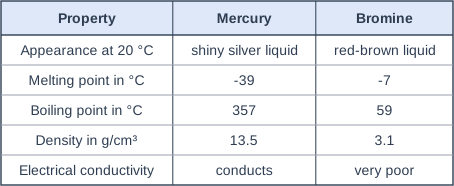
The table shows some properties of mercury and bromine.

Mercury does not have the high melting point that most metals have. Use the table to give two other differences between mercury and bromine that are typical of a metal and a non-metal.

Table with columns "Property", "Mercury", "Bromine". Property: Appearance at 20 °C; Mercury: shiny silver liquid; Bromine: red-brown liquid | Property: Melting point in °C; Mercury: -39; Bromine: -7 | Property: Boiling point in °C; Mercury: 357; Bromine: 59 | Property: Density in g/cm³; Mercury: 13.5; Bromine: 3.1 | Property: Electrical conductivity; Mercury: conducts; Bromine: very poor.

Model answer

Mercury conducts electricity, but bromine is a very poor conductor. Mercury also has a much higher density (13.5 g/cm³) than bromine (3.1 g/cm³).

Explanation

Typical metals are shiny, dense, good conductors with high melting points; typical non-metals have low boiling points and are poor conductors. Mercury is unusual because it melts at -39 °C, but it still has the other properties of a metal. The question rules out the melting point, so any answer about melting points scores nothing.

Mark scheme
  1. 1 mark

    mercury is shiny but bromine is not (1)

    Any two from the four points; max 2. Each point must be a difference between the two elements (a comparison may be implied, e.g. 'mercury is shiny, bromine is red-brown'). ignore any point about melting point (the question excludes it) and colour alone.

  2. 1 mark

    mercury conducts electricity but bromine is a (very) poor conductor (1)

    accept bromine does not conduct electricity.

  3. 1 mark

    mercury has a (much) higher density than bromine (13.5 compared with 3.1 g/cm³) (1)

    accept mercury is (about four times) denser. ORA.

  4. 1 mark

    bromine has a low boiling point (59 °C) / mercury has a much higher boiling point (357 °C) (1)

    ORA.

Question 3

3 marks

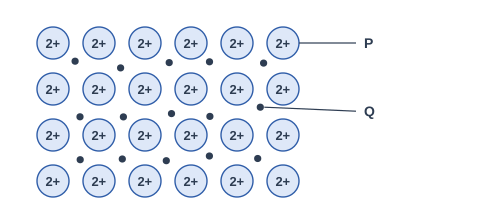
Figure 1 shows a model of the structure of magnesium, a metal. The electronic configuration of a magnesium atom is 2.8.2.

Explain why the particle labelled P has a charge of 2+, and how the particles labelled Q allow magnesium to conduct electricity.

Metallic structure: a regular grid of positive metal ions (circles marked "2+") with small dots (electrons) scattered between them. Label P points to one of the circles. Label Q points to one of the small dots.

Model answer

A magnesium atom has two electrons in its outer shell. In the metal, each magnesium atom gives up these two outer electrons, so particle P is a magnesium ion, Mg²⁺, with a charge of 2+. The electrons that were given up are the delocalised electrons, Q. They are not attached to any one ion and are free to move through the whole structure, so when a voltage is applied they flow through the metal and carry the electric current.

Explanation

A metal is a giant lattice of positive ions surrounded by delocalised electrons: each magnesium atom releases its two outer electrons, so there are two delocalised electrons for every Mg²⁺ ion. Metals conduct because the delocalised electrons can move through the structure. A common error is to say that the ions move or carry the current - the ions stay in their positions.

Mark scheme
  1. 1 mark

    a magnesium atom has two outer (shell) electrons (1)

    An explanation linking. accept magnesium is in group 2.

  2. 1 mark

    each magnesium atom loses / gives up its two outer electrons (into the structure), so P is a magnesium ion with a 2+ charge (1)

    accept the ion has two more protons than electrons / 12 protons and 10 electrons. reject P is an atom / a nucleus / a proton. reject the electrons are transferred to another (non-metal) atom.

  3. 1 mark

    Q are delocalised electrons, which can move through the structure (and carry the charge / current) (1)

    accept free electrons / a sea of electrons that can flow through the metal. 'carry charge' without movement does not score. reject ions move / P moves.

Question 4

4 marks

Scrap steel is recycled by melting it in an electric arc furnace. A very large electric current passes through graphite electrodes, and the temperature inside the furnace reaches about 1800 °C.

Explain, in terms of structure and bonding, two properties of graphite that make it suitable for these electrodes.

Model answer

Graphite conducts electricity. Each carbon atom is covalently bonded to only three other carbon atoms, so one outer electron from each atom is delocalised. These delocalised electrons can move through the layers, so graphite can carry the large current.

Graphite also has a very high melting point. It is a giant covalent structure with very many strong covalent bonds between the carbon atoms, and a lot of energy is needed to break them, so the electrodes do not melt at 1800 °C.

Explanation

Graphite is unusual: it is a non-metal that conducts, because each carbon atom uses only three of its four outer electrons in bonding, leaving delocalised electrons that move. Its giant covalent structure also gives it a very high melting point. Students often wrongly say that ions carry the current in graphite, or explain its high melting point with the weak forces between layers.

Mark scheme
  1. 1 mark

    each carbon atom is (covalently) bonded to (only) three other carbon atoms / three of its four outer electrons are used in bonding (1)

    An explanation linking any four from the five points; max 3 for conductivity (the first three points) and max 2 for the melting point (the last two points), so to score 4 marks both properties must be explained. allow each carbon atom has one (outer) electron not used in bonding.

  2. 1 mark

    so one (outer) electron from each carbon atom is delocalised / graphite has delocalised electrons (1)

    accept free electrons / a sea of electrons between the layers.

  3. 1 mark

    the delocalised electrons can move (through the structure / along the layers), so graphite conducts electricity (1)

    accept the electrons flow / are mobile. ignore 'carry the charge / current' unless movement of the electrons is stated. reject ions move.

  4. 1 mark

    graphite has a giant covalent structure with many strong covalent bonds (between the carbon atoms) (1)

    accept strong covalent bonds between the carbon atoms within the layers. reject ionic / metallic bonds. reject weak intermolecular forces / weak forces between the layers as the reason for the high melting point.

  5. 1 mark

    a lot of (heat) energy is needed to break these (covalent) bonds, so graphite has a very high melting point / does not melt at 1800 °C (1)

    accept graphite stays solid at furnace temperatures. ignore 'needs a high temperature' without reference to energy or bonds. Do not award if the energy is said to be needed to overcome the forces between the layers.

Ready to try the rest? Every answer you write is marked against the mark scheme, so you can see exactly where the marks are.

Study Helper Hints first, answers after you try

Stuck on this one? Ask for a hint and I’ll point you in the right direction, without giving the answer away. Once you’ve checked your answer, I’ll show you how the marks are awarded.