
Level:
Correct: 0
Incorrect: 0
Marks: 0/0
Exam Practice
Course:
Topics:
Avg
score:
–
Topics
done:
0/26

Making water potable

Practise 13 exam-style questions on Making water potable for Edexcel GCSE Combined Science (Chemistry Paper 1). Write your answer as you would in the exam and get it marked in seconds against the mark scheme, point by point, with the Study Helper on hand if you get stuck.

  • 13 questions
  • 1–6 marks each
  • Instant marking
  • No sign-up needed
13 questions, marked as you go

Sample questions with model answers

Here are 4 of the questions in this topic, each with a model answer, an explanation of why it earns the marks and the mark scheme an examiner would use.

Question 1

1 mark

Chlorine is added to drinking water at water treatment works in the UK.

What is the reason for adding chlorine?

Choose your answer.

  • A to remove dissolved salts
  • B to kill microorganisms
  • C to make solids settle out
  • D to neutralise acids in it

Model answer

B - to kill microorganisms.

Explanation

Chlorination is the final stage in making fresh water potable: it kills harmful microorganisms such as bacteria. A small amount of chlorine is left in the water so that it stays safe as it travels through the pipes to homes.

Mark scheme
  1. 1 mark

    B / to kill microorganisms (1)

    The only correct answer is B: chlorine kills bacteria and other microorganisms that could cause disease, making the water safe to drink. A is not correct because chlorination does not remove dissolved salts (only a method such as distillation does); C is not correct because solids settle out during sedimentation, which does not need chlorine; D is not correct because chlorine is not a base and does not neutralise acids (it forms acidic substances when it reacts with water). Accept the letter or the option. If more than one option is given, do not award the mark.
Question 2

2 marks

Some drinking water in the UK comes from ground water. The water is pumped up from boreholes after it has soaked slowly down through layers of rock.

Ground water is usually clear, so it often needs little or no sedimentation and filtration.

Explain why chlorine is still added to ground water before it is supplied to homes.

Model answer

Even though ground water looks clear, it may still contain harmful microorganisms such as bacteria, which cannot be seen. Chlorine kills these microorganisms, so the water is safe to drink (potable), and a little chlorine stays in the water to keep it safe in the pipes to homes.

Explanation

Sedimentation and filtration remove insoluble solids, but clear water can still contain microorganisms that cause disease. Chlorination kills them. Water that looks clean is not necessarily safe to drink.

Mark scheme
  1. 1 mark

    the water may still contain (harmful) microorganisms / bacteria (that cannot be seen) (1)

    Any two from the three points; max 2. Allow 'clear water can still contain germs / pathogens'. Do not accept 'the water contains dissolved salts'.

  2. 1 mark

    chlorine kills (the) microorganisms, so the water is safe to drink / potable (1)

    Allow 'chlorine sterilises / disinfects the water'. Do not accept 'chlorine removes impurities' with no reference to microorganisms.

  3. 1 mark

    some chlorine remains in the water and kills microorganisms that get into it in the pipes / on the way to homes (1)

    Allow 'it keeps the water safe in the pipes'.

Question 3

3 marks

In some dry countries, waste water from homes is treated so that it can be used again as drinking water.

Suggest why waste water needs more treatment than ground water before it is potable.

Model answer

Waste water from homes contains sewage, so it has many more harmful microorganisms than ground water and needs more thorough disinfection, for example more chlorine. It also contains much more suspended solid, including organic matter, so it needs more sedimentation and filtration. It may also contain dissolved substances such as detergents and medicines, which are not removed by sedimentation, filtration or chlorination, so extra treatment stages are needed. Ground water, by contrast, has already been filtered naturally as it soaked slowly through the rock, so it usually contains few solids or microorganisms.

Explanation

Making water potable means removing insoluble solids (sedimentation and filtration) and killing microorganisms (chlorination), so the more of these the water contains, the more treatment it needs. Waste water is much more contaminated than ground water, which has been filtered naturally by rock. Ground water is not pure, though - it still contains dissolved salts and may contain microorganisms, so it is still chlorinated.

Mark scheme
  1. 1 mark

    waste water contains (many) more microorganisms / pathogens (from sewage / human waste), so it needs more disinfection / chlorination (1)

    Any three from the four points; max 3. Allow 'waste water contains far more bacteria'. Do not accept 'ground water contains no microorganisms'.

  2. 1 mark

    waste water contains much more solid / suspended material (e.g. organic matter), so more sedimentation and filtration are needed (1)

    Allow 'waste water is much dirtier / contains more insoluble solids'.

  3. 1 mark

    waste water may contain dissolved substances (e.g. detergents, medicines, dissolved chemicals) that sedimentation, filtration and chlorination do not remove, so extra stages are needed (1)

    Allow 'dissolved substances pass through the filters'. Ignore 'it contains chemicals' with no idea of dissolved substances or extra treatment.

  4. 1 mark

    ground water has already been (naturally) filtered as it soaked through the rock, so it contains few solids / microorganisms (1)

    Allow 'ground water is usually clear / clean before treatment'. Do not accept 'ground water is pure'.

Question 4

4 marks

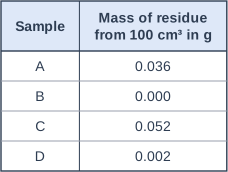
A student has four samples of water, A, B, C and D. She wants to find out which sample is suitable for making up solutions for a chemical analysis.

She evaporates 100 cm³ of each sample to dryness in an evaporating basin. She weighs the solid residue on a balance that reads to the nearest 0.001 g.

The table shows her results.

Explain which sample is suitable for making up solutions for a chemical analysis, and suggest how she could improve her experiment so that she can be more confident in her choice.

Table with columns "Sample", "Mass of residue from 100 cm³ in g". Sample: A; Mass of residue from 100 cm³ in g: 0.036 | Sample: B; Mass of residue from 100 cm³ in g: 0.000 | Sample: C; Mass of residue from 100 cm³ in g: 0.052 | Sample: D; Mass of residue from 100 cm³ in g: 0.002.

Model answer

Sample B is suitable, because it left no residue (0.000 g), which shows that it contains no dissolved solids that could react with or contaminate the substances being analysed. Samples A, C and D all left a residue, so they contain dissolved salts - even D left 0.002 g. However, a mass of less than 0.001 g would not show on this balance, so to be more confident she could evaporate a much larger volume of each sample, so that any dissolved solid would give a larger mass of residue, or use a balance that reads to 0.0001 g.

Explanation

Water used in analysis must not contain any dissolved salts, so the suitable sample is the one that leaves no residue when it is evaporated. Because the balance only reads to 0.001 g, a reading of 0.000 g does not prove that there is nothing dissolved; evaporating a larger volume or using a more precise balance makes the test more sensitive. 'Repeat it' on its own is not an improvement that makes the test more sensitive.

Mark scheme
  1. 1 mark

    B (1)

    Any four from the five points; max 4. Max 3 if no improvement is suggested. Do not accept any other sample.

  2. 1 mark

    B left no (measurable) residue, so it contains no dissolved solids / salts (that could react with or contaminate the substances being analysed) (1)

    Allow 'B has 0.000 g of residue, so nothing is dissolved in it'. This point can be awarded independently of the identification if the reasoning is about the sample with no residue.

  3. 1 mark

    A, C and D left a residue, so they contain dissolved solids / salts, which could change the results of the analysis (1)

    Allow 'even D contains a small amount of dissolved solid (0.002 g)'. Allow 'A and C contain the most dissolved salts'.

  4. 1 mark

    evaporate a larger volume of each sample (so any dissolved solid gives a larger, measurable mass of residue) (1)

    Allow 'use more water, e.g. 1 dm³'. Ignore 'repeat the experiment' unless linked to calculating a mean or checking the results.

  5. 1 mark

    use a more precise balance / a balance with a higher resolution (e.g. one that reads to 0.0001 g) (1)

    Allow 'a more sensitive balance'. Do not accept 'a more accurate balance' on its own.

Ready to try the rest? Every answer you write is marked against the mark scheme, so you can see exactly where the marks are.

Study Helper Hints first, answers after you try

Stuck on this one? Ask for a hint and I’ll point you in the right direction, without giving the answer away. Once you’ve checked your answer, I’ll show you how the marks are awarded.