
Level:
Correct: 0
Incorrect: 0
Marks: 0/0
Exam Practice
Course:
Topics:
Avg
score:
–
Topics
done:
0/26

Isotopes and relative atomic mass

Practise 15 exam-style questions on Isotopes and relative atomic mass for Edexcel GCSE Combined Science (Chemistry Paper 1). Write your answer as you would in the exam and get it marked in seconds against the mark scheme, point by point, with the Study Helper on hand if you get stuck.

  • 15 questions
  • 1–6 marks each
  • Instant marking
  • No sign-up needed
15 questions, marked as you go

Sample questions with model answers

Here are 4 of the questions in this topic, each with a model answer, an explanation of why it earns the marks and the mark scheme an examiner would use.

Question 1

1 mark

An atom has a mass number of 35. Its nucleus contains 18 neutrons.

What is the atomic number of this atom?

Choose your answer.

  • A 17
  • B 18
  • C 35
  • D 53

Model answer

A 17

Explanation

The mass number is the number of protons plus neutrons, so the number of protons (the atomic number) is 35 - 18 = 17. Confusing the atomic number with the mass number or with the number of neutrons is a common error.

Mark scheme
  1. 1 mark

    A / 17 (1)

    The only correct answer is A: atomic number = number of protons = mass number - number of neutrons = 35 - 18 = 17. B is not correct because 18 is the number of neutrons, not protons; C is not correct because 35 is the mass number (protons + neutrons); D is not correct because 53 comes from adding the neutrons to the mass number instead of subtracting them. Accept the letter or the number. If more than one option is given, do not award the mark.
Question 2

2 marks

Lithium is used in rechargeable batteries. A sample of lithium contains 7.6% lithium-6 atoms and 92.4% lithium-7 atoms.

Calculate the relative atomic mass of lithium in this sample.

Model answer

Total = (6 × 7.6) + (7 × 92.4) = 45.6 + 646.8 = 692.4
Relative atomic mass = 692.4 ÷ 100 = 6.92

Explanation

Multiply the mass of each isotope by its percentage abundance, add the results and divide by 100. The answer must lie between 6 and 7 and close to 7, because lithium-7 is far more abundant; common errors are taking the simple mean (6.5) or forgetting to divide by 100.

Mark scheme
  1. 1 mark

    (6 × 7.6) + (7 × 92.4) = 45.6 + 646.8 = 692.4 (1)

    6.92 / 6.924 / 6.9 with or without working scores 2. A final answer of 7 with no working scores 0; 7 rounded from correct working scores 2. MP1: allow the products unevaluated, or (6 × 0.076) + (7 × 0.924). allow ECF for MP2 from an arithmetic error in MP1 if the method is correct. Dividing by 2 or by 13 (the sum of the mass numbers), or finding the simple mean of 6 and 7 (6.5), is a wrong method and scores 0.

  2. 1 mark

    692.4 ÷ 100 = 6.92 (1)

    allow 6.924 or 6.9; do not accept 6.93 or 6.9 rounded from an incorrect value.

Question 3

3 marks

Lead is extracted from ores mined in different parts of the world. Lead from different mines contains slightly different percentages of its isotopes.

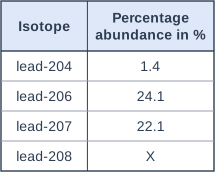
The table shows the percentage abundances of the isotopes of lead in a sample from one mine.

Calculate the relative atomic mass of lead in this sample.

Table with columns "Isotope", "Percentage abundance in %". Isotope: lead-204; Percentage abundance in %: 1.4 | Isotope: lead-206; Percentage abundance in %: 24.1 | Isotope: lead-207; Percentage abundance in %: 22.1 | Isotope: lead-208; Percentage abundance in %: X.

Model answer

Abundance of lead-208 = 100 - (1.4 + 24.1 + 22.1) = 52.4%
Total = (204 × 1.4) + (206 × 24.1) + (207 × 22.1) + (208 × 52.4)
= 285.6 + 4964.6 + 4574.7 + 10 899.2 = 20 724.1
Relative atomic mass = 20 724.1 ÷ 100 = 207.2

Explanation

The percentages must add up to 100, so first find the missing abundance X; then multiply each mass number by its abundance, add the four results and divide by 100. Common errors are forgetting to find X, dividing by the number of isotopes and rounding too early.

Mark scheme
  1. 1 mark

    (abundance of lead-208 =) 100 - (1.4 + 24.1 + 22.1) = 52.4 (%) (1)

    207.2 / 207.24 / 207.241 with or without working scores 3. A final answer of 207 with no working scores 0; 207 rounded from correct working scores 3. allow ECF throughout, e.g. from an incorrect value of X in MP1.

  2. 1 mark

    (204 × 1.4) + (206 × 24.1) + (207 × 22.1) + (208 × 52.4) = 20 724.1 (1)

    allow the products unevaluated, or each abundance written as a decimal fraction (e.g. 208 × 0.524); allow ECF from the student's value for the abundance of lead-208.

  3. 1 mark

    20 724.1 ÷ 100 = 207.2 (1)

    allow 207.24 or 207.241; dividing by 4 (the number of isotopes) or leaving out the lead-208 term are wrong methods and do not score MP3.

Question 4

4 marks

Natural boron contains 19.9% boron-10 atoms and 80.1% boron-11 atoms. Its relative atomic mass is 10.8.

The control rods in some nuclear reactors contain boron that has been enriched so that 90.0% of its atoms are boron-10. The rest of its atoms are boron-11.

Calculate the relative atomic mass of the enriched boron, and explain why it is lower than the relative atomic mass of natural boron.

Model answer

Total = (10 × 90.0) + (11 × 10.0) = 900 + 110 = 1010
Relative atomic mass = 1010 ÷ 100 = 10.1

The enriched boron has a much greater proportion of the lighter isotope, boron-10 (90.0% instead of 19.9%). The relative atomic mass is the mean mass of the atoms weighted by their abundance, so it is now much closer to 10 than to 11, and lower than the 10.8 of natural boron.

Explanation

First work out the abundance of boron-11 (100 - 90.0 = 10.0%), then calculate the weighted mean as usual. The explanation must link the higher proportion of the lighter isotope to the weighted mean; saying only that 'there is more boron-10' without linking it to the average mass of the atoms gains less credit.

Mark scheme
  1. 1 mark

    (10 × 90.0) + (11 × 10.0) = 1010 (1)

    10.1 with or without working scores MP1 and MP2. MP1 needs the abundance of boron-11 as 10.0%; allow ECF for MP2 from an arithmetic slip.

  2. 1 mark

    1010 ÷ 100 = 10.1 (1)

    Using 80.1% for boron-11 (from natural boron) is a wrong method and scores 0 for MP1 and MP2.

  3. 1 mark

    the enriched boron contains a greater proportion of the lighter isotope / boron-10 (1)

    MP3 and MP4 are marked independently of the calculation. allow ORA (natural boron has more boron-11); do not accept 'boron-10 has fewer protons'.

  4. 1 mark

    relative atomic mass is a (weighted) mean of the masses of the isotopes, so it moves closer to 10 / it is closer to the mass of the more abundant isotope (1)

    allow so the average mass of the atoms is lower; ignore 'there are more lighter atoms' if already credited in MP3 without a link to the mean.

Ready to try the rest? Every answer you write is marked against the mark scheme, so you can see exactly where the marks are.

Study Helper Hints first, answers after you try

Stuck on this one? Ask for a hint and I’ll point you in the right direction, without giving the answer away. Once you’ve checked your answer, I’ll show you how the marks are awarded.