
Level:
Correct: 0
Incorrect: 0
Marks: 0/0
Exam Practice
Course:
Topics:
Avg
score:
–
Topics
done:
0/26

Extracting metals from their ores

Practise 16 exam-style questions on Extracting metals from their ores for Edexcel GCSE Combined Science (Chemistry Paper 1). Write your answer as you would in the exam and get it marked in seconds against the mark scheme, point by point, with the Study Helper on hand if you get stuck.

  • 16 questions
  • 1–6 marks each
  • Instant marking
  • No sign-up needed
16 questions, marked as you go

Sample questions with model answers

Here are 4 of the questions in this topic, each with a model answer, an explanation of why it earns the marks and the mark scheme an examiner would use.

Question 1

1 mark

The method used to extract a metal from its ore depends on the position of the metal in the reactivity series.

Which metal is too reactive to be extracted by heating its oxide with carbon?

Choose your answer.

  • A copper
  • B iron
  • C lead
  • D magnesium

Model answer

D - magnesium.

Explanation

Metals below carbon in the reactivity series can be extracted by heating their oxides with carbon, which is cheaper. Metals above carbon, such as magnesium and aluminium, form oxides that carbon cannot reduce, so they must be extracted by electrolysis of a molten compound, which uses a lot of electricity.

Mark scheme
  1. 1 mark

    D / magnesium (1)

    The only correct answer is D: magnesium is above carbon in the reactivity series, so carbon cannot remove oxygen from magnesium oxide; reactive metals like this are extracted by electrolysis of a molten compound instead. A is not correct because copper is below carbon, so its oxide can be reduced by heating with carbon. B is not correct because iron is below carbon and is extracted by heating its oxide with carbon. C is not correct because lead is below carbon, so its oxide can be reduced by heating with carbon. Accept the letter or the option. If more than one option is given, do not award the mark.
Question 2

2 marks

Tin is extracted by heating tin(IV) oxide with carbon.

SnO₂ + C → Sn + CO₂

Explain which substance is oxidised and which substance is reduced in this reaction.

Model answer

Tin(IV) oxide is reduced because it loses oxygen to form tin. Carbon is oxidised because it gains oxygen to form carbon dioxide.

Explanation

Oxidation is the gain of oxygen and reduction is the loss of oxygen, and the two happen together. Here the oxygen moves from the tin(IV) oxide to the carbon, which is why carbon can be used to extract metals below it in the reactivity series. Each mark needs both the substance and the reason.

Mark scheme
  1. 1 mark

    tin(IV) oxide / SnO₂ is reduced because it loses oxygen (1)

    An explanation linking each substance to a reason. Allow 'tin is reduced because it loses oxygen'. If both substances are correctly identified but no reasons are given, award 1 mark only. Ignore references to electrons if correct; do not award a mark for a substance whose reason is wrong (e.g. 'tin oxide is reduced because it gains oxygen').

  2. 1 mark

    carbon is oxidised because it gains oxygen (1)

    Do not accept 'carbon dioxide is oxidised' or 'carbon is reduced'.

Question 3

3 marks

Aluminium is extracted by the electrolysis of molten aluminium oxide. This uses a very large amount of electricity.

An aluminium smelter uses 14 000 kWh of electricity to produce 1 tonne of aluminium. The smelter pays 4.0 pence for each kWh of electricity. It sells the aluminium for £1800 per tonne.

Calculate the cost of the electricity as a percentage of the selling price of the aluminium.

Model answer

Cost of electricity for 1 tonne = 14 000 × 4.0 = 56 000 pence = £560
Fraction of the selling price = 560 ÷ 1800 = 0.311
Percentage = 0.311 × 100 = 31.1%

Explanation

Work out the cost of the electricity for one tonne, convert pence to pounds so that both amounts are in the same unit, then divide by the selling price and multiply by 100. About a third of the price of the aluminium goes on electricity, which is why extraction by electrolysis is expensive and why smelters are often built where electricity is cheap, for example near hydroelectric power stations. Forgetting to convert pence to pounds gives an impossible answer of over 3000%.

Mark scheme
  1. 1 mark

    (cost of electricity for 1 tonne =) 14 000 × 4.0 = 56 000 (pence) / £560 (1)

    31(.1) (%) with or without working scores 3. Allow ECF throughout. The steps may be done in a different order, e.g. 56 000 ÷ 180 000 × 100 (both amounts in pence).

  2. 1 mark

    (fraction of selling price =) 560 ÷ 1800 = 0.311 (1)

    Pounds and pence must not be mixed: 56 000 ÷ 1800 does not score MP2. 0.311 (not multiplied by 100) with working scores 2. Allow ECF from an incorrect cost in MP1 if it is in pounds.

  3. 1 mark

    (× 100 =) 31(.1) (%) (1)

    Accept values that round to 31, e.g. 31.11. Award 2 marks for 3110 or 3111 (%) with working (pence not converted to pounds - a power of ten error in an otherwise correct method).

Question 4

4 marks

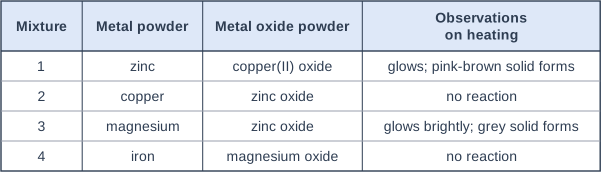
A teacher heats small amounts of mixtures of a metal powder and a metal oxide powder. The table shows the results.

Explain, in terms of oxygen, what happens in mixture 1 and why there is no reaction in mixture 2.

Table with columns "Mixture", "Metal powder", "Metal oxide powder", "Observations on heating". Mixture: 1; Metal powder: zinc; Metal oxide powder: copper(II) oxide; Observations on heating: glows; pink-brown solid forms | Mixture: 2; Metal powder: copper; Metal oxide powder: zinc oxide; Observations on heating: no reaction | Mixture: 3; Metal powder: magnesium; Metal oxide powder: zinc oxide; Observations on heating: glows brightly; grey solid forms | Mixture: 4; Metal powder: iron; Metal oxide powder: magnesium oxide; Observations on heating: no reaction.

Model answer

In mixture 1, zinc is more reactive than copper, so zinc takes the oxygen from the copper(II) oxide. The zinc gains oxygen and is oxidised to zinc oxide, and the copper(II) oxide loses oxygen and is reduced to copper, which is the pink-brown solid. In mixture 2, copper is less reactive than zinc, so copper cannot remove the oxygen from zinc oxide and there is no reaction.

Explanation

In a competition reaction the more reactive element ends up combined with the oxygen: the more reactive metal is oxidised and the oxide of the less reactive metal is reduced. This is the same idea as extracting metals with carbon, which works only for metals below carbon. Answers must explain both mixtures, using reactivity, not just describe the observations.

Mark scheme
  1. 1 mark

    (in mixture 1) zinc gains oxygen / is oxidised (to zinc oxide) (1)

    An explanation linking. Accept 'zinc takes the oxygen from the copper(II) oxide'. Ignore references to electrons if correct.

  2. 1 mark

    copper(II) oxide loses oxygen / is reduced (to copper) (1)

    Accept 'copper oxide is reduced (to copper)', 'oxygen is removed from the copper(II) oxide'. 'The pink-brown solid is copper' alone does not score (it does not say what happens to the oxygen).

  3. 1 mark

    because zinc is more reactive than copper (1)

    Accept 'zinc is higher in the reactivity series than copper', 'zinc has a greater tendency to combine with oxygen'.

  4. 1 mark

    (in mixture 2) copper is less reactive than zinc so it cannot remove oxygen from zinc oxide (1)

    Both the idea of lower reactivity and of not removing oxygen (not reducing zinc oxide) are needed. Do not accept 'copper is less reactive' alone or 'zinc oxide is not reactive'.

Ready to try the rest? Every answer you write is marked against the mark scheme, so you can see exactly where the marks are.

Study Helper Hints first, answers after you try

Stuck on this one? Ask for a hint and I’ll point you in the right direction, without giving the answer away. Once you’ve checked your answer, I’ll show you how the marks are awarded.