Maya wants to make potassium chloride. She puts 25.0 cm³ of potassium hydroxide solution and a few drops of phenolphthalein into a conical flask. She adds dilute hydrochloric acid from a burette and records the colour of the mixture after each addition.
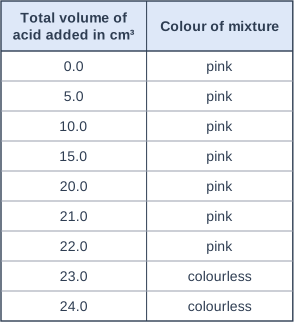
The table shows her results.
Maya concludes that exactly 23.0 cm³ of acid is needed to neutralise the potassium hydroxide solution.
Evaluate Maya's conclusion and describe how she could find the volume of acid needed more precisely.
Model answer
Maya's conclusion is not justified. The phenolphthalein was still pink at 22.0 cm³ and had turned colourless at 23.0 cm³, so the end point is somewhere between 22.0 and 23.0 cm³. 23.0 cm³ may be more acid than is needed, so the mixture may contain excess acid.
To find the volume more precisely, she should repeat the titration with a fresh 25.0 cm³ of alkali, adding the acid quickly up to about 21 cm³ and then one drop at a time, swirling the flask on a white tile after each drop. She should stop as soon as the pink colour just disappears and read the burette at eye level. She should repeat the titration to check that the volumes agree.
Explanation
The results only show that the colour change happened somewhere in the last 1 cm³ addition, so 23.0 cm³ is an upper limit, not the exact volume. Adding the acid drop by drop near the end point, with swirling, finds the volume to within one drop. This matters for making a salt, because any excess acid would contaminate the potassium chloride.