
Level:
Correct: 0
Incorrect: 0
Marks: 0/0
Exam Practice
Course:
Topics:
Avg
score:
–
Topics
done:
0/26

Electrolysis

Practise 20 exam-style questions on Electrolysis for Edexcel GCSE Combined Science (Chemistry Paper 1). Write your answer as you would in the exam and get it marked in seconds against the mark scheme, point by point, with the Study Helper on hand if you get stuck.

  • 20 questions
  • 1–6 marks each
  • Instant marking
  • No sign-up needed
20 questions, marked as you go

Sample questions with model answers

Here are 4 of the questions in this topic, each with a model answer, an explanation of why it earns the marks and the mark scheme an examiner would use.

Question 1

1 mark

Sodium chloride solution is electrolysed using inert electrodes.

Which half equation shows the reaction at the anode?

Choose your answer.

  • A 2Cl⁻ + 2e⁻ → Cl₂
  • B Na⁺ + e⁻ → Na
  • C 2Cl⁻ → Cl₂ + 2e⁻
  • D 2H⁺ + 2e⁻ → H₂

Model answer

C - 2Cl⁻ → Cl₂ + 2e⁻

Explanation

Oxidation (loss of electrons) happens at the anode, so the electrons appear on the right-hand side of an anode half equation. Two chloride ions each lose one electron to make one Cl₂ molecule, so the charges balance (-2 on each side). Option D is a correct half equation, but for the cathode.

Mark scheme
  1. 1 mark

    C / 2Cl⁻ → Cl₂ + 2e⁻ (1)

    The only correct answer is C: chloride ions lose electrons at the positive anode to form chlorine. A is not correct because it shows chloride ions gaining electrons, so the charges do not balance (-4 on the left, 0 on the right); B is not correct because sodium is not formed from the solution (hydrogen forms instead) and gain of electrons happens at the cathode, not the anode; D is not correct because it is the reaction at the cathode (a reduction). Accept the letter or the option. If more than one option is given, do not award the mark.
Question 2

2 marks

In a school laboratory, sodium chloride solution is electrolysed using graphite electrodes rather than iron electrodes. Chlorine forms at the anode.

Suggest why graphite electrodes are used rather than iron electrodes.

Model answer

Graphite is inert, so it does not react with the chlorine produced or with the electrolyte. Iron is more reactive: an iron anode would react with the chlorine (or be oxidised itself), so it would wear away and contaminate the solution.

Explanation

Electrodes for electrolysis must conduct electricity, but they should also be inert so that they are not changed by the products. Chlorine is very reactive and an iron anode would be attacked, so inert graphite is used. Saying 'graphite conducts' does not answer the question, because iron conducts too.

Mark scheme
  1. 1 mark

    graphite is inert / unreactive / does not react with the chlorine (or the electrolyte) (1)

    Ignore 'graphite conducts electricity' on its own (iron also conducts). Ignore 'graphite is cheap'.

  2. 1 mark

    iron (at the anode) would react with the chlorine / be oxidised (lose electrons) and dissolve / wear away / contaminate the solution (1)

    Accept 'iron is reactive so the iron anode would be used up'. Accept 'iron would corrode'. Ignore 'iron would rust' unless linked to reacting / being used up.

Question 3

3 marks

Copper(II) chloride solution is electrolysed using graphite electrodes. The solution contains copper(II) ions, Cu²⁺, chloride ions, Cl⁻, and hydrogen ions, H⁺, and hydroxide ions, OH⁻, from the water.

Copper forms at the cathode and chlorine forms at the anode.

Explain why these products form.

Model answer

The positive copper(II) ions and hydrogen ions are attracted to the negative cathode. Copper is less reactive than hydrogen, so the copper(II) ions gain electrons and form copper atoms (Cu²⁺ + 2e⁻ → Cu), while the hydrogen ions stay in solution. The negative chloride ions and hydroxide ions are attracted to the positive anode, where the chloride ions lose electrons to form chlorine molecules (2Cl⁻ → Cl₂ + 2e⁻).

Explanation

At the cathode of an aqueous electrolysis, the metal forms if it is less reactive than hydrogen; otherwise hydrogen forms. At the anode, a halide ion such as chloride is discharged to form the halogen. Use 'ions' and 'atoms' correctly: ions move and gain or lose electrons; atoms or molecules are the products.

Mark scheme
  1. 1 mark

    copper(II) ions are (positive so they are) attracted to the cathode and gain electrons (to form copper atoms) (1)

    An explanation linking. Accept 'copper ions are reduced at the cathode'. Accept Cu2+ + 2e- → Cu. Do not accept 'copper atoms are attracted to the cathode'.

  2. 1 mark

    copper is less reactive than hydrogen, so copper ions are discharged instead of hydrogen ions (1)

    Accept 'hydrogen is more reactive than copper so hydrogen ions stay in solution'. Do not accept 'copper is more reactive than hydrogen'.

  3. 1 mark

    chloride ions are attracted to the anode and lose electrons (to form chlorine molecules) (1)

    Accept 'chloride ions are oxidised / discharged (in preference to hydroxide ions) at the anode'. Accept 2Cl- → Cl2 + 2e- as the explanation. (2Cl- - 2e- → Cl2 is not credited where a half equation is asked for in a 1SC0 question, but here it shows the loss of electrons, so it may score this explanation mark.) Do not accept 'chlorine ions' for chloride ions. Do not accept 'chloride ions gain electrons'.

Question 4

4 marks

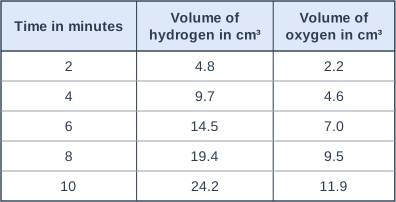
Water acidified with sulfuric acid is electrolysed using inert electrodes. Hydrogen is collected above the cathode and oxygen above the anode. The table shows the volumes of gas collected.

Explain, in terms of electrons, why the volume of hydrogen is about twice the volume of oxygen.

Suggest why the volume of oxygen is slightly less than half the volume of hydrogen.

Table with columns "Time in minutes", "Volume of hydrogen in cm³", "Volume of oxygen in cm³". Time in minutes: 2; Volume of hydrogen in cm³: 4.8; Volume of oxygen in cm³: 2.2 | Time in minutes: 4; Volume of hydrogen in cm³: 9.7; Volume of oxygen in cm³: 4.6 | Time in minutes: 6; Volume of hydrogen in cm³: 14.5; Volume of oxygen in cm³: 7.0 | Time in minutes: 8; Volume of hydrogen in cm³: 19.4; Volume of oxygen in cm³: 9.5 | Time in minutes: 10; Volume of hydrogen in cm³: 24.2; Volume of oxygen in cm³: 11.9.

Model answer

At the cathode, each hydrogen molecule needs 2 electrons: 2H⁺ + 2e⁻ → H₂. At the anode, 4 electrons are released for each oxygen molecule: 4OH⁻ → O₂ + 2H₂O + 4e⁻. The same number of electrons flows round the circuit, so for every 4 electrons, 2 hydrogen molecules but only 1 oxygen molecule form, so the volume of hydrogen is twice the volume of oxygen. The volume of oxygen is slightly less than half because oxygen is more soluble in water than hydrogen, so a little of it dissolves in the solution.

Explanation

Balance the electrons in the two half equations: 4e⁻ make 2H₂ at the cathode and are released when 1 O₂ forms at the anode, giving a 2 : 1 ratio of molecules and so of volumes. The small shortfall in oxygen (most noticeable at the start) is because oxygen dissolves in water more than hydrogen does. Answers based only on the formula H₂O miss the 'in terms of electrons' part of the question.

Mark scheme
  1. 1 mark

    at the cathode, 2 electrons are gained to form each hydrogen molecule / 2H⁺ + 2e⁻ → H₂ (1)

    Accept 4H+ + 4e- → 2H2. Ignore state symbols. Accept plain-text typing (H+, 2e-, ->).

  2. 1 mark

    at the anode, 4 electrons are lost for each oxygen molecule formed / 4OH⁻ → O₂ + 2H₂O + 4e⁻ (1)

    Accept 2H2O → O2 + 4H+ + 4e-. (4OH- - 4e- → O2 + 2H2O is not accepted as a written half equation in 1SC0, but here it shows that 4 electrons are lost for each O2, so it may score this explanation mark.)

  3. 1 mark

    the same number of electrons is lost at the anode as is gained at the cathode, so twice as many hydrogen molecules as oxygen molecules form (1)

    Accept 'for every 4 electrons, 2 molecules of H2 and 1 molecule of O2 form' / 'mole ratio H2 : O2 = 2 : 1'. If no electron explanation is given, allow this mark for 2H2O → 2H2 + O2 showing twice as many hydrogen molecules.

  4. 1 mark

    oxygen is more soluble in water than hydrogen / some oxygen dissolves in the solution (1)

    Accept 'some oxygen stays dissolved in the solution'. Ignore 'gas escapes' / 'experimental error' unless it explains why only the volume of oxygen is lower. Do not accept 'oxygen is heavier / denser' or 'oxygen reacts with the electrode' (the electrodes are inert).

Ready to try the rest? Every answer you write is marked against the mark scheme, so you can see exactly where the marks are.

Study Helper Hints first, answers after you try

Stuck on this one? Ask for a hint and I’ll point you in the right direction, without giving the answer away. Once you’ve checked your answer, I’ll show you how the marks are awarded.