
Level:
Correct: 0
Incorrect: 0
Marks: 0/0
Exam Practice
Course:
Topics:
Avg
score:
–
Topics
done:
0/26

Reactivity series and displacement reactions

Practise 15 exam-style questions on Reactivity series and displacement reactions for Edexcel GCSE Combined Science (Chemistry Paper 1). Write your answer as you would in the exam and get it marked in seconds against the mark scheme, point by point, with the Study Helper on hand if you get stuck.

  • 15 questions
  • 1–6 marks each
  • Instant marking
  • No sign-up needed
15 questions, marked as you go

Sample questions with model answers

Here are 4 of the questions in this topic, each with a model answer, an explanation of why it earns the marks and the mark scheme an examiner would use.

Question 1

1 mark

A student adds a piece of a metal to a solution of a metal salt.

Which mixture gives a displacement reaction?

Choose your answer.

  • A copper + iron(II) sulfate
  • B silver + copper(II) nitrate
  • C zinc + magnesium sulfate
  • D iron + copper(II) sulfate

Model answer

D - iron + copper(II) sulfate.

Explanation

A metal displaces another metal from a solution of its salt only if it is more reactive (higher in the reactivity series) than the metal in the salt. Iron is above copper, so iron displaces copper, forming iron(II) sulfate solution and copper. In each of the other mixtures the added metal is below the metal in the salt, so there is no reaction.

Mark scheme
  1. 1 mark

    D / iron + copper(II) sulfate (1)

    The only correct answer is D: iron is more reactive than copper, so iron displaces copper from copper(II) sulfate solution. A is not correct because copper is less reactive than iron, so copper cannot displace iron. B is not correct because silver is less reactive than copper, so silver cannot displace copper. C is not correct because zinc is less reactive than magnesium, so zinc cannot displace magnesium. Accept the letter or the option. If more than one option is given, do not award the mark.
Question 2

2 marks

In a school laboratory, students compare the reactivity of metals by adding small pieces of each metal to dilute hydrochloric acid.

The teacher does not allow sodium or potassium to be tested in this way.

Explain why.

Model answer

Sodium and potassium are at the top of the reactivity series - they react vigorously even with cold water. With dilute acid the reaction would be violent or even explosive, and the hydrogen produced could ignite, so the test would be dangerous.

Explanation

Potassium and sodium are the two most reactive metals in the series, so their reactions with dilute acids would be far more violent than their already vigorous reactions with water. Both marks need detail: what would happen (a violent or explosive reaction) and why (very high reactivity); 'it is dangerous' alone is too vague.

Mark scheme
  1. 1 mark

    the reaction would be (dangerously) violent / explosive (1)

    An explanation linking the danger to the reactivity of the metals. Accept 'reaction too vigorous / too fast to be safe', 'the hydrogen could ignite / catch fire', 'acid could spray out'. Ignore 'dangerous' or 'unsafe' alone.

  2. 1 mark

    because sodium and potassium are (very) reactive / are at the top of the reactivity series / react vigorously even with (cold) water (1)

    Accept 'they are much more reactive than magnesium', 'they are alkali metals, which are very reactive'. Do not accept 'they are unreactive'.

Question 3

3 marks

A piece of magnesium ribbon is placed in iron(II) chloride solution. A displacement reaction takes place:

Mg + Fe²⁺ → Mg²⁺ + Fe

Explain why this reaction is described as a redox reaction. Refer to electrons in your answer.

Model answer

A redox reaction is one in which both oxidation and reduction take place. Each magnesium atom loses two electrons to form a magnesium ion (Mg → Mg²⁺ + 2e⁻), so magnesium is oxidised. Each iron(II) ion gains two electrons to form an iron atom (Fe²⁺ + 2e⁻ → Fe), so the iron(II) ions are reduced.

Explanation

Oxidation is loss of electrons and reduction is gain of electrons, and in a displacement reaction both happen at the same time. Examiners' reports note that answers often lose a mark by saying 'iron is reduced' instead of 'iron(II) ions are reduced', so name the particles. The chloride ions do not change: they are spectator ions and are neither oxidised nor reduced.

Mark scheme
  1. 1 mark

    (redox involves both) oxidation and reduction (1)

    An explanation linking. MP1 can be awarded even if the particles are wrongly identified. Ignore references to gain or loss of oxygen. Half equations may be given for MP2 and MP3: Mg → Mg²⁺ + 2e⁻ and Fe²⁺ + 2e⁻ → Fe (accept 2e- written in plain text). Any half equation must show the electrons as a species added to the correct side (e.g. Mg → Mg²⁺ + 2e⁻, not Mg − 2e⁻ → Mg²⁺); the subtracted-electron form is not credited as a half equation (course rule, based on Pearson's 1SC0 mark schemes 2022-2025 and the SAMs, which show electrons only as an added species, e.g. 1CH June 2024 Q4(a)(iii) 'allow 1 mark for + 4e on RHS'). Because these marks are for the idea of losing or gaining electrons, a subtracted form can still earn the mark if it shows the right particle losing or gaining electrons.

  2. 1 mark

    magnesium (atoms) lose electrons and are oxidised (1)

    Both ideas are needed: loss of electrons and oxidised. Do not accept 'magnesium ions lose electrons'.

  3. 1 mark

    iron(II) ions / Fe²⁺ (ions) gain electrons and are reduced (1)

    Both ideas are needed, and the particles must be ions. Do not accept 'iron gains electrons' or 'iron atoms gain electrons' (iron atoms are formed, not reduced). If neither MP2 nor MP3 is awarded, award 1 mark for 'magnesium loses electrons and iron gains electrons' or 'magnesium is oxidised and iron is reduced'. Ignore chloride ions (spectator ions); do not award MP3 for 'chloride ions are reduced'.

Question 4

4 marks

A student investigates the reactivity of magnesium, zinc, iron and an unknown metal, Q.

The student adds 1.0 g of a powdered metal (an excess) to 25 cm³ of copper(II) sulfate solution in a polystyrene cup and records the temperature rise. Each experiment is done three times.

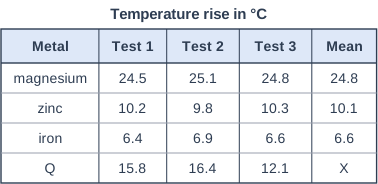
The table shows the results.

Identify the anomalous result. Calculate the mean temperature rise, X, for metal Q, ignoring the anomalous result. Use your mean to deduce the position of metal Q in the reactivity series compared with the other three metals.

Temperature rise in °C. Table with columns "Metal", "Test 1", "Test 2", "Test 3", "Mean". Metal: magnesium; Test 1: 24.5; Test 2: 25.1; Test 3: 24.8; Mean: 24.8 | Metal: zinc; Test 1: 10.2; Test 2: 9.8; Test 3: 10.3; Mean: 10.1 | Metal: iron; Test 1: 6.4; Test 2: 6.9; Test 3: 6.6; Mean: 6.6 | Metal: Q; Test 1: 15.8; Test 2: 16.4; Test 3: 12.1; Mean: X.

Model answer

The anomalous result is 12.1 °C (the third result for Q).
X = (15.8 + 16.4) ÷ 2 = 16.1 °C
The mean temperature rise for Q (16.1 °C) is smaller than for magnesium (24.8 °C) but larger than for zinc (10.1 °C), so Q is less reactive than magnesium but more reactive than zinc. The order is magnesium, Q, zinc, iron.

Explanation

An anomalous result does not fit the pattern of the repeats, so it is left out when the mean is calculated. The more reactive the metal is compared with copper, the more energy is released when it displaces copper, so the larger the temperature rise. Including 12.1 gives 14.8 °C - the wrong method, even though it still places Q between magnesium and zinc.

Mark scheme
  1. 1 mark

    12.1 (°C) / the third result for Q (1)

    Accept 'the 12.1 for metal Q'. Do not accept any other value.

  2. 1 mark

    (X =) (15.8 + 16.4) ÷ 2 (1)

    16.1 with or without working scores MP2 and MP3. A mean that includes the anomalous result, (15.8 + 16.4 + 12.1) ÷ 3 = 14.8, is the wrong method and scores 0 for MP2 and MP3.

  3. 1 mark

    16.1 (°C) (1)

    Accept 16.10.

  4. 1 mark

    Q is between magnesium and zinc / Q is less reactive than magnesium but more reactive than zinc (1)

    Allow ecf from the candidate's mean (a mean of 14.8 also places Q between magnesium and zinc). Accept 'order: magnesium, Q, zinc, iron'. The answer must compare Q with both magnesium and zinc; 'Q is more reactive than iron' alone does not score.

Ready to try the rest? Every answer you write is marked against the mark scheme, so you can see exactly where the marks are.

Study Helper Hints first, answers after you try

Stuck on this one? Ask for a hint and I’ll point you in the right direction, without giving the answer away. Once you’ve checked your answer, I’ll show you how the marks are awarded.