Practise 22 exam-style questions on Warming up and cooling down for AQA GCSE Physical Education (Paper 1). Write your answer as you would in the exam and get it marked in seconds against the mark scheme, point by point, with the Study Helper on hand if you get stuck.
22 questions
1–9 marks each
Instant marking
No sign-up needed
20 questions, marked as you go
Sample questions with model answers
Here are 4 of the questions in this topic, each with a model answer, an explanation of why it earns the marks and the mark scheme an examiner would use.
Question 1
1 mark
Which one of these should be included in a cool down?
Choose your answer.
Skill-based practices
Mental preparation
Gradual reduction in intensity
Gradual pulse-raising activity
Model answer
Gradual reduction in intensity
Explanation
A cool down should gradually reduce the intensity of exercise (for example jogging, then walking) while keeping the breathing and heart rate elevated, and finish with stretching. Skill-based practices, mental preparation and a gradual pulse-raising activity are all parts of a warm up. Students often mix up 'gradual increase' (warm up) with 'gradual reduction' (cool down).
Mark scheme
1 mark
Gradual reduction in intensity
Accept 'gradual reduction'. If more than one option is given, 0 marks.
Question 2
2 marks
Explain why the warm up of a 400 m runner should increase gradually in effort, building up to full pace.
Model answer
Building up gradually lets the runner's heart rate and breathing rise steadily, so oxygen supply to the muscles increases without the muscles being suddenly overloaded and injured. Finishing with strides at full pace means the runner has rehearsed race speed and can run hard from the start of the race.
Explanation
A gradual increase of effort to full pace is a benefit of warming up: the body systems adapt step by step and the muscles are not suddenly strained. Ending at full pace prepares the runner for the speed of the race. Starting the warm up with sprints risks injury.
Mark scheme
1 mark
Heart rate and breathing rate rise steadily / the body is prepared gradually, so the supply of oxygen to the muscles can increase to meet demand
1 mark
Muscles are not suddenly put under full load, so the risk of injury (e.g. a pulled hamstring) is reduced
1 mark
Reaching full pace means the runner has practised race speed and is ready to run at full effort from the start of the race / avoids early fatigue
Max 2. Must explain why the increase is gradual or why it reaches full pace; 'to warm up' alone scores 0.
Question 3
3 marks
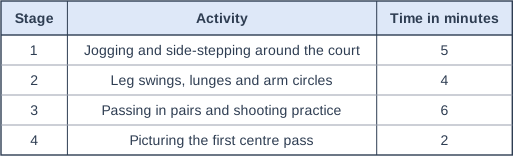
The table shows the warm up that a netball team completes before a match.
Identify the part of a warm up shown by Stage 1, Stage 3 and Stage 4.
Model answer
Stage 1 is a gradual pulse-raising activity. Stage 3 is skill-based practices (familiarisation). Stage 4 is mental preparation.
Explanation
Jogging and side-stepping raise the heart rate gradually (pulse raiser), stage 2 is stretching, passing and shooting practise the skills of the game, and picturing the first centre pass is mental preparation. A common mistake is to call stage 3 a pulse raiser because the players are moving; its purpose is to rehearse the skills.
Mark scheme
1 mark
Stage 1: (gradual) pulse-raising activity
Accept 'pulse raiser', 'raising the heart rate gradually'. Do not accept 'cardio' alone.
1 mark
Stage 3: skill-based practices / familiarisation
Accept 'skills practice', 'practice of movement skills'.
1 mark
Stage 4: mental preparation
Accept 'psychological preparation', 'mental rehearsal', 'visualisation' or 'imagery'. Answers must be matched to the correct stage.
Question 4
6 marks
Justify the parts of a warm up that a long jumper should complete before a competition.
Model answer
A long jumper should start with a gradual pulse raiser, such as jogging laps of the track, building up to strides. This raises body temperature and increases the amount of oxygen getting to the working muscles. It is justified because warm, elastic leg muscles are less likely to be strained during the explosive take-off.
Next he should do dynamic stretches such as leg swings and high knees. This increases the range of movement at the hip and knee, allowing a powerful knee drive at take-off and an extended leg position on landing, which adds distance.
Skill-based practices are vital. He should practise his run-up several times, building up to full pace, to check his stride pattern so that he hits the take-off board without overstepping. A foul jump scores nothing, so this may be the most important part of the warm up. He can also practise take-offs from a short run.
Finally, mental preparation such as visualising a perfect run-up and jump helps him focus and reach the high arousal an explosive gross skill needs. Overall, every part matters, but the run-up practice and a gradual build-up to full pace are most important, because long jump distance depends on approach speed and an accurate take-off.
Explanation
A top answer names each part of the warm up, applies it to long jump (run-up, take-off, landing) and justifies it with a reason linked to performance or injury prevention, ending with a judgement. Approach speed and an accurate take-off decide long jump distance, so build-up to full pace and run-up practice are especially important. A common weakness is a general list of warm-up parts with no link to the long jumper.
Mark scheme
6 marks
Levels of response (6 marks). AO1 = 1, AO2 = 2, AO3 = 3. Level 3 (5-6 marks): Knowledge of the parts of a warm up is accurate and generally well detailed. Application to a long jumper is mostly appropriate, clear and effective. Justification is thorough, reaching valid and well-reasoned conclusions about why each part is needed. The answer is generally clear, coherent and focused, with appropriate use of terminology throughout. Level 2 (3-4 marks): Knowledge of the parts of a warm up is evident but is more detailed for some parts than others. There is some appropriate and effective application to a long jumper, although not always balanced and presented with clarity. Any justification is clear but reaches valid conclusions for some parts more than others. The answer lacks coherence in places, although terminology is used appropriately on occasions. Level 1 (1-2 marks): Knowledge of the parts of a warm up is limited. Application to a long jumper is either absent or inappropriate. Justification is poorly focused or absent, with few or no reasoned conclusions. The answer as a whole lacks clarity and has inaccuracies. Terminology is either absent or inappropriately used. 0 marks: no relevant content.
Possible content may include: AO1 - the parts of a warm up: gradual pulse-raising activity; stretching; skill-based practices/familiarisation; mental preparation; increasing the amount of oxygen to the working muscles; benefits: raised body temperature, increased range of movement, gradual increase of effort to full pace, psychological preparation, practice of movement skills through the whole range of movement, injury prevention. AO2 - application to a long jumper: light jogging and strides on the track, building up to sprints at full pace; dynamic stretches of the hamstrings, quadriceps, hip flexors and calves (leg swings, high knees, bounding); practice run-ups to check the stride pattern and take-off board, practice take-offs and short jumps into the pit; visualising the run-up, take-off and landing, focusing, controlling arousal. AO3 - justification: raising body temperature makes the leg muscles more elastic, reducing the risk of a hamstring strain in the explosive take-off; increased range of movement at the hip allows a full knee drive at take-off and an extended landing position for extra distance; building up to full pace means the jumper can sprint at full speed down the runway, as approach speed largely determines distance; practising the run-up checks the stride pattern so the jumper hits the board without fouling, which wastes a jump; mental preparation raises arousal to the optimal level for an explosive gross skill and builds confidence; judgement, e.g. skill-based practice of the run-up may be the most important part, because a foul means no distance is recorded. Credit other suitable responses relevant to the question.
Ready to try the rest? Every answer you write is marked against the mark scheme, so you can see exactly where the marks are.
Ctrl + Enter to check
Study HelperHints first, answers after you try
Stuck on this one? Ask for a hint and I’ll point you in the right direction, without giving the answer away. Once you’ve checked your answer, I’ll show you how the marks are awarded.