Antagonistic muscle action and muscle contractions
Practise 22 exam-style questions on Antagonistic muscle action and muscle contractions for AQA GCSE Physical Education (Paper 1). Write your answer as you would in the exam and get it marked in seconds against the mark scheme, point by point, with the Study Helper on hand if you get stuck.
22 questions
1–9 marks each
Instant marking
No sign-up needed
20 questions, marked as you go
Sample questions with model answers
Here are 4 of the questions in this topic, each with a model answer, an explanation of why it earns the marks and the mark scheme an examiner would use.
Question 1
1 mark
Which one of these muscles is the antagonist when the knee extends?
Choose your answer.
Gastrocnemius
Gluteals
Hamstrings
Quadriceps
Model answer
Hamstrings
Explanation
At the knee the quadriceps and hamstrings form an antagonistic pair. When the knee extends, the quadriceps are the agonist and the hamstrings are the antagonist, relaxing to allow the movement. Choosing the quadriceps confuses the agonist with the antagonist; the gluteals act at the hip and the gastrocnemius at the ankle.
Mark scheme
1 mark
Hamstrings
If more than one option is given, 0 marks.
Question 2
2 marks
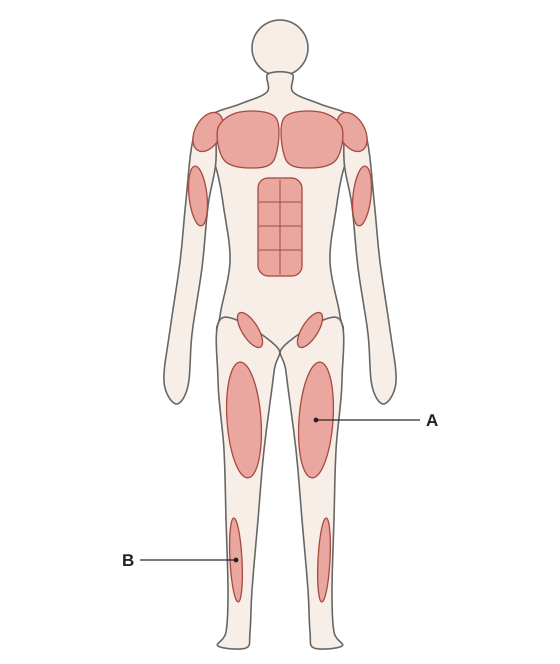
Figure 1 shows a front view of the human body. Muscles A and B each work as part of an antagonistic pair.
Name the muscle that is the antagonistic partner of muscle A and the muscle that is the antagonistic partner of muscle B.
Model answer
Muscle A is the quadriceps, so its partner is the hamstrings. Muscle B is the tibialis anterior, so its partner is the gastrocnemius.
Explanation
The quadriceps (front of the thigh) and hamstrings (back of the thigh) form the pair at the knee. The tibialis anterior (front of the lower leg) and gastrocnemius (calf) form the pair at the ankle. Antagonistic partners are on opposite sides of the joint, which is why their partners cannot be seen from the front.
Mark scheme
1 mark
Partner of A (quadriceps): hamstrings
Accept hamstring group. Do not accept quadriceps (that is muscle A itself).
1 mark
Partner of B (tibialis anterior): gastrocnemius
Accept soleus. Do not accept tibialis anterior (that is muscle B itself).
Question 3
3 marks
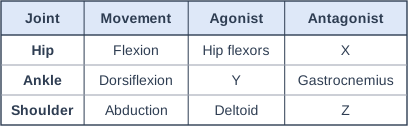
The table shows the agonist and antagonist for movements at three joints.
State the muscles that should replace X, Y and Z in the table.
Model answer
X is the gluteals, Y is the tibialis anterior and Z is the latissimus dorsi.
Explanation
At the hip the hip flexors and gluteals work as a pair; at the ankle the tibialis anterior (dorsiflexion) and gastrocnemius (plantar flexion) work as a pair; at the shoulder the deltoid (abduction) works against the latissimus dorsi (adduction). Learn each pair together so you can give either muscle when the other is named.
Mark scheme
1 mark
X = gluteals
Do not accept 'glutes'. Do not accept hamstrings.
1 mark
Y = tibialis anterior
Accept recognisable misspellings.
1 mark
Z = latissimus dorsi
Accept pectorals. Do not accept 'lats'.
Question 4
4 marks
A basketball player lands from a rebound and immediately jumps again to shoot.
Analyse the muscle action at the knee during the landing and the jump.
Model answer
On landing, the knees flex. The quadriceps are the agonist and contract eccentrically, lengthening under tension to cushion the landing and slow the player down safely. In the jump, the knees extend as the quadriceps contract concentrically, shortening to produce the power to jump up for the shot, while the hamstrings relax as the antagonist. The quadriceps switch quickly from eccentric to concentric, so the player can jump again straight away.
Explanation
The quadriceps work in both phases: eccentrically to control the landing and concentrically to power the jump. The hamstrings act as the antagonist. To analyse, explain the effect of each contraction on performance (a safe, controlled landing; a powerful jump), not just name it.
Mark scheme
1 mark
Landing: the knee flexes and the quadriceps (agonist) contract eccentrically / lengthen under tension to control or cushion the landing
max 4.
1 mark
Jump: the knee extends and the quadriceps (agonist) contract concentrically / shorten
Do not accept hamstrings as the agonist for the jump.
1 mark
The hamstrings are the antagonist / relax and lengthen as the knee extends
Accept as the antagonist in either phase.
1 mark
The eccentric contraction slows the player down safely / reduces the impact, helping to prevent injury
Must be linked to the landing.
1 mark
The concentric contraction of the quadriceps produces the force / power to jump high quickly for the shot
Must be linked to the jump.
Ready to try the rest? Every answer you write is marked against the mark scheme, so you can see exactly where the marks are.
Ctrl + Enter to check
Study HelperHints first, answers after you try
Stuck on this one? Ask for a hint and I’ll point you in the right direction, without giving the answer away. Once you’ve checked your answer, I’ll show you how the marks are awarded.