Level:
Correct: 0
Incorrect: 0
Marks: 0/0
Exam Practice
Course:
Topics:
Avg
score:
–
Topics
done:
0/27

Cardiac output, stroke volume and heart rate

Practise 22 exam-style questions on Cardiac output, stroke volume and heart rate for AQA GCSE Physical Education (Paper 1). Write your answer as you would in the exam and get it marked in seconds against the mark scheme, point by point, with the Study Helper on hand if you get stuck.

  • 22 questions
  • 1–9 marks each
  • Instant marking
  • No sign-up needed
20 questions, marked as you go

Sample questions with model answers

Here are 4 of the questions in this topic, each with a model answer, an explanation of why it earns the marks and the mark scheme an examiner would use.

Question 1

1 mark

What name is given to the increase in heart rate that happens just before exercise starts?

Choose your answer.

  • Anticipatory rise
  • Bradycardia
  • Steady state
  • Hypertrophy

Model answer

Anticipatory rise

Explanation

An anticipatory rise is an increase in heart rate before exercise begins, caused by the release of adrenaline as the performer prepares, for example on the start line. Bradycardia is a low resting heart rate, hypertrophy is an increase in the size of the heart, and steady state is when heart rate levels off during exercise.

Mark scheme
  1. 1 mark

    Anticipatory rise

    If more than one option is given, 0 marks.
Question 2

2 marks

During a 2000 m race, a rower has a cardiac output of 27 litres per minute and a stroke volume of 150 ml.

Calculate the rower's heart rate during the race.

Model answer

Heart rate = cardiac output ÷ stroke volume = 27 000 ml ÷ 150 ml = 180 beats per minute.

Explanation

Rearrange Q = SV × HR to HR = Q ÷ SV. Both volumes must be in the same units, so convert 27 litres to 27 000 ml before dividing.

Mark scheme
  1. 1 mark

    27 000 ÷ 150 / heart rate = cardiac output ÷ stroke volume

    Method mark.

  2. 1 mark

    180 bpm (beats per minute)

    Correct answer with no working scores 2 marks. 0.18 (no conversion of litres to ml): 1 mark.

Question 3

3 marks

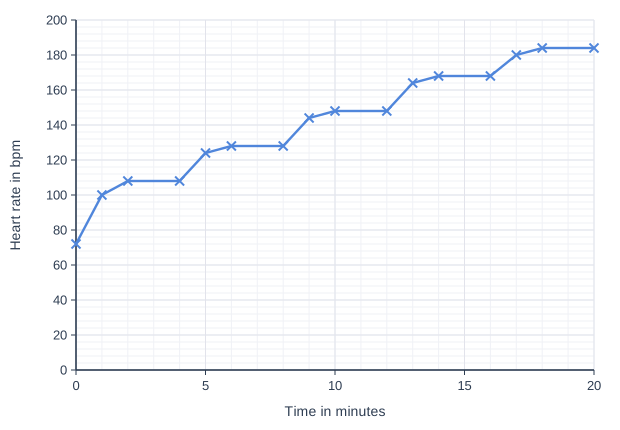
A cyclist completes a fitness test on an exercise bike. The resistance is increased every 4 minutes. Figure 1 shows her heart rate during the test.

Explain the pattern of heart rate shown in Figure 1.

Line graph of heart rate in bpm (y-axis, 0 to 200) against time in minutes (x-axis, 0 to 20). The line joins the points (0, 72), (1, 100), (2, 108), (4, 108), (5, 124), (6, 128), (8, 128), (9, 144), (10, 148), (12, 148), (13, 164), (14, 168), (16, 168), (17, 180), (18, 184), (20, 184).

Model answer

Each time the resistance is increased, every 4 minutes, her heart rate rises - for example from 108 to 128 bpm after 4 minutes. This is because her leg muscles need more oxygen at the higher intensity, so her heart beats faster to increase cardiac output. Within each stage her heart rate then levels off (steady state), because her oxygen supply now meets the demand of her muscles at that intensity.

Explanation

This step pattern shows the two key ideas in heart rate graphs: heart rate rises when intensity increases, and levels off when intensity stays the same. Use values from the graph to support your description.

Mark scheme
  1. 1 mark

    Heart rate increases each time the resistance / intensity increases (at 0, 4, 8, 12 and 16 minutes)

    Accept a correct use of data, e.g. 'rises from 108 to 128 bpm after 4 minutes'.

  2. 1 mark

    Because the muscles need more oxygen at a higher intensity, so heart rate rises to increase cardiac output

  3. 1 mark

    Heart rate then levels off / plateaus within each stage (steady state)

  4. 1 mark

    Because oxygen supply now meets the demand of the muscles at that intensity

    Max 3.

Question 4

4 marks

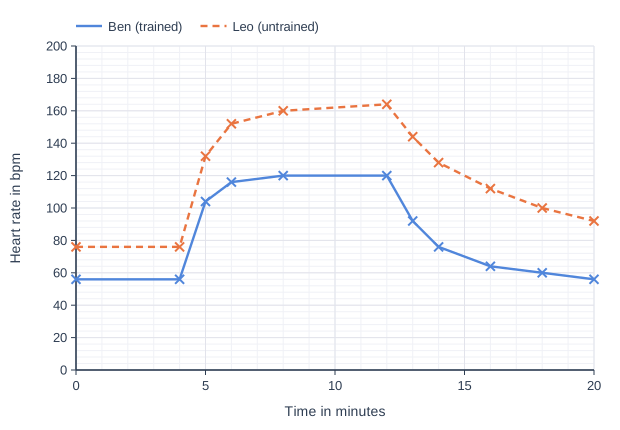
Figure 1 shows the heart rates of Ben, a trained runner, and Leo, who does not train. Both exercised at the same intensity from 4 minutes to 12 minutes.

Using Figure 1, compare the heart rates of Ben and Leo, and explain the differences.

Line graph of heart rate in bpm (y-axis, 0 to 200) against time in minutes (x-axis, 0 to 20). "Ben (trained)" joins the points (0, 56), (4, 56), (5, 104), (6, 116), (8, 120), (12, 120), (13, 92), (14, 76), (16, 64), (18, 60), (20, 56). "Leo (untrained)" (dashed) joins the points (0, 76), (4, 76), (5, 132), (6, 152), (8, 160), (12, 164), (13, 144), (14, 128), (16, 112), (18, 100), (20, 92).

Model answer

Ben's resting heart rate is 56 bpm, lower than Leo's 76 bpm. During the exercise Ben's heart rate levels off at about 120 bpm, while Leo's reaches 160-164 bpm, even though they are working at the same intensity. After the exercise Ben's heart rate returns to 56 bpm by 20 minutes, but Leo's is still 92 bpm. This is because Ben's training has made his heart larger and stronger, so it has a bigger stroke volume and needs fewer beats to pump the same cardiac output; being fitter also means he recovers faster.

Explanation

Compare like with like - resting, exercise and recovery - and quote values for both performers. The explanation comes from Q = SV × HR: a trained heart with a larger stroke volume can supply the same cardiac output at a lower heart rate.

Mark scheme
  1. 1 mark

    Ben has a lower resting heart rate than Leo (56 bpm compared with 76 bpm)

  2. 1 mark

    Ben's heart rate is lower during the exercise at the same intensity (about 120 bpm compared with 160-164 bpm)

  3. 1 mark

    Ben's heart rate recovers / falls back to resting faster (back to 56 bpm by 20 minutes, while Leo's is still 92 bpm, 16 above his resting 76)

    Comparisons: sub-max 3.

  4. 1 mark

    Ben's training has made his heart bigger / stronger (hypertrophy), so his stroke volume is larger

  5. 1 mark

    So he needs fewer beats per minute to give the same cardiac output (bradycardia) / he is fitter so recovers faster

    Explanations: sub-max 2. Max 4. At least one comparison must use data from Figure 1 for full marks.

Ready to try the rest? Every answer you write is marked against the mark scheme, so you can see exactly where the marks are.

Study Helper Hints first, answers after you try

Stuck on this one? Ask for a hint and I’ll point you in the right direction, without giving the answer away. Once you’ve checked your answer, I’ll show you how the marks are awarded.