
Level:
Correct: 0
Incorrect: 0
Marks: 0/0
Exam Practice
Course:
Topics:
Avg
score:
–
Topics
done:
0/27

The pathway of air and gaseous exchange

Practise 21 exam-style questions on The pathway of air and gaseous exchange for AQA GCSE Physical Education (Paper 1). Write your answer as you would in the exam and get it marked in seconds against the mark scheme, point by point, with the Study Helper on hand if you get stuck.

  • 21 questions
  • 1–9 marks each
  • Instant marking
  • No sign-up needed
20 questions, marked as you go

Sample questions with model answers

Here are 4 of the questions in this topic, each with a model answer, an explanation of why it earns the marks and the mark scheme an examiner would use.

Question 1

1 mark

Oxygen moves from the alveoli into the blood by diffusion.

Which one of these describes the movement of a gas by diffusion?

Choose your answer.

  • From high to low concentration
  • From low to high concentration
  • Pumped by the diaphragm
  • Carried by red blood cells

Model answer

From high to low concentration

Explanation

Diffusion is the movement of a gas from an area of high concentration to an area of low concentration. There is more oxygen in the air in the alveoli than in the blood arriving at the lungs, so oxygen diffuses into the blood. Red blood cells carry oxygen once it has diffused into the blood, but that is transport, not diffusion.

Mark scheme
  1. 1 mark

    From high to low concentration

    Accept 'high to low'. If more than one option is given, 0 marks.
Question 2

2 marks

The alveoli have moist, thin walls.

Explain how this helps gaseous exchange.

Model answer

The walls are only one cell thick, so there is a short diffusion pathway between the air and the blood. This means oxygen can diffuse into the blood, and carbon dioxide out of it, quickly. The moisture lets the gases dissolve so they can pass through the wall.

Explanation

The shorter the distance a gas has to travel, the faster it diffuses, so thin walls speed up gaseous exchange. Make sure you explain the effect (faster diffusion) and do not just repeat the feature.

Mark scheme
  1. 1 mark

    Thin walls (one cell thick) give a short distance / short diffusion pathway for the gases

  2. 1 mark

    So oxygen and carbon dioxide can diffuse quickly / easily between the alveoli and the blood

  3. 1 mark

    Moisture allows the gases to dissolve, so they can diffuse across the wall

    Max 2.

Question 3

3 marks

Ade plays hockey. His alveoli are surrounded by lots of capillaries.

Explain how this helps Ade to keep performing during a match.

Model answer

Lots of capillaries give a large surface area for gaseous exchange, so more oxygen can diffuse into Ade's blood and more carbon dioxide can be removed. This means more oxygen is delivered to his leg muscles, so he can keep working aerobically and delay fatigue, letting him keep running into space and tracking back for the whole match.

Explanation

The capillary network increases the area over which gases can diffuse and keeps the blood very close to the air. The best answers go one step further and link the extra oxygen to the performer: delaying fatigue in a long, stop-start hockey match.

Mark scheme
  1. 1 mark

    Gives a large surface area (of contact) for gaseous exchange

  2. 1 mark

    Capillaries lie close to the alveoli with walls one cell thick, giving a short diffusion pathway

  3. 1 mark

    More oxygen can diffuse into the blood (to form oxyhaemoglobin) / more carbon dioxide can be removed

  4. 1 mark

    More oxygen is delivered to Ade's working muscles, e.g. his leg muscles when running or chasing the ball

  5. 1 mark

    So Ade can keep working aerobically / delays fatigue, so he can keep running and tracking back throughout the match

    Max 3. For 3 marks at least one point must be linked to Ade's performance in hockey.

Question 4

4 marks

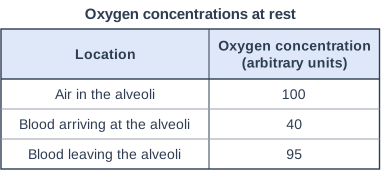
The table shows the oxygen concentration in the alveoli and in the blood of a person at rest.

During exercise, the oxygen concentration of the blood arriving at the alveoli falls to 20 arbitrary units.

Use the data to explain why oxygen moves into the blood at the alveoli, and why more oxygen moves into the blood during exercise.

Oxygen concentrations at rest. Table with columns "Location", "Oxygen concentration (arbitrary units)". Location: Air in the alveoli; Oxygen concentration (arbitrary units): 100 | Location: Blood arriving at the alveoli; Oxygen concentration (arbitrary units): 40 | Location: Blood leaving the alveoli; Oxygen concentration (arbitrary units): 95.

Model answer

At rest the air in the alveoli has an oxygen concentration of 100 units but the blood arriving has only 40, so oxygen diffuses from the high concentration in the alveoli to the low concentration in the blood. During exercise the working muscles use more oxygen, so the blood returning to the lungs has only 20 units. The difference is now 80 units instead of 60, a steeper concentration gradient, so oxygen diffuses into the blood faster.

Explanation

The bigger the difference in concentration, the faster diffusion happens. Exercise makes the muscles take more oxygen out of the blood, so the blood reaching the lungs is lower in oxygen and the gradient at the alveoli is steeper. Use the figures from the table (60 at rest, 80 in exercise) to support the explanation.

Mark scheme
  1. 1 mark

    The oxygen concentration is higher in the alveoli (100) than in the blood arriving at the alveoli (40)

    Accept a difference of 60 units.

  2. 1 mark

    So oxygen diffuses from high to low concentration, into the blood

  3. 1 mark

    During exercise the working muscles take / use more oxygen from the blood, so blood returning to the lungs has less oxygen

  4. 1 mark

    The concentration gradient is larger (100 - 20 = 80 compared with 60 at rest), so oxygen diffuses into the blood faster / more oxygen diffuses

    Accept 'steeper concentration gradient'. Do not accept 'the gradient doubles'.

Ready to try the rest? Every answer you write is marked against the mark scheme, so you can see exactly where the marks are.

Study Helper Hints first, answers after you try

Stuck on this one? Ask for a hint and I’ll point you in the right direction, without giving the answer away. Once you’ve checked your answer, I’ll show you how the marks are awarded.