Practise 22 exam-style questions on Mechanics of breathing and spirometer traces for AQA GCSE Physical Education (Paper 1). Write your answer as you would in the exam and get it marked in seconds against the mark scheme, point by point, with the Study Helper on hand if you get stuck.
22 questions
1–9 marks each
Instant marking
No sign-up needed
20 questions, marked as you go
Sample questions with model answers
Here are 4 of the questions in this topic, each with a model answer, an explanation of why it earns the marks and the mark scheme an examiner would use.
Question 1
1 mark
Which one of these describes residual volume?
Choose your answer.
The air breathed in or out in a normal breath
The air left in the lungs after a maximal breath out
The extra air that can be forcibly breathed in after a normal breath
The extra air that can be forcibly breathed out after a normal breath
Model answer
The air left in the lungs after a maximal breath out
Explanation
Residual volume is the volume of air left in the lungs after a maximal expiration; it can never be breathed out. The other options describe tidal volume, inspiratory reserve volume and expiratory reserve volume, in that order.
Mark scheme
1 mark
The air left in the lungs after a maximal breath out
Accept a clear shortened form, e.g. 'air left after maximal expiration'. If more than one option is given, 0 marks.
Question 2
3 marks
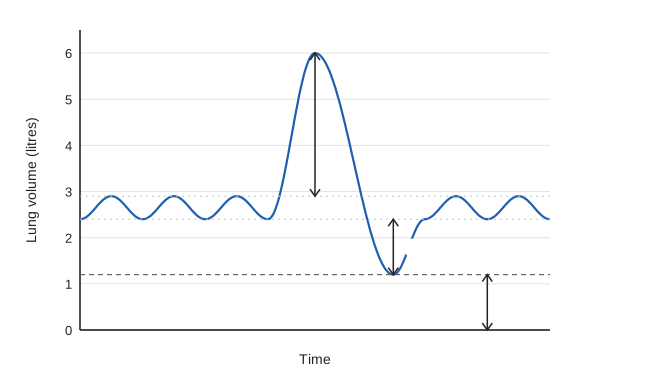
Figure 1 shows a spirometer trace for a person at rest.
Identify the lung volumes labelled X, Y and Z in Figure 1.
Model answer
X is the inspiratory reserve volume, Y is the expiratory reserve volume and Z is the residual volume.
Explanation
On a spirometer trace, the inspiratory reserve volume is the extra air that can be breathed in above a normal breath, the expiratory reserve volume is the extra air that can be breathed out below a normal breath, and the residual volume is the air that always stays in the lungs. Students often confuse 'residual' with 'reserve'.
Mark scheme
1 mark
X = inspiratory reserve volume
Accept 'inspiratory reserve' / IRV.
1 mark
Y = expiratory reserve volume
Accept 'expiratory reserve' / ERV.
1 mark
Z = residual volume
Accept RV. Do not accept 'reserve volume'.
Question 3
3 marks
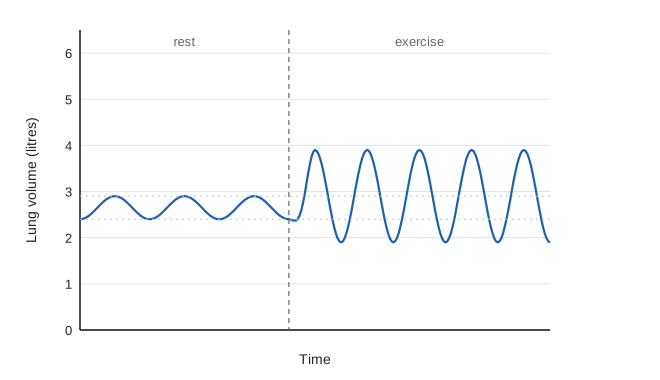
Figure 1 shows a spirometer trace for a performer at rest and then at the onset of exercise (after the dashed line).
Describe two differences between the trace at rest and the trace during exercise, and explain why one of these changes happens.
Model answer
During exercise each breath is much deeper than at rest - the tidal volume increases from 0.5 to 2.0 litres. The breaths are also more frequent, so the waves on the trace are closer together. Breathing becomes deeper because the working muscles need more oxygen and more carbon dioxide has to be removed, so the performer uses the pectorals and sternocleidomastoid to breathe in more deeply.
Explanation
When interpreting a spirometer trace, the height of each wave shows the depth of breathing (tidal volume) and how close together the waves are shows the breathing rate. At the onset of exercise both increase, to supply more oxygen and remove carbon dioxide.
Mark scheme
1 mark
Breaths are deeper / bigger during exercise / tidal volume increases (from 0.5 to 2.0 litres)
1 mark
Breaths are more frequent / faster / closer together during exercise (breathing rate increases)
1 mark
The peaks are higher and the troughs lower during exercise / the reserve volumes are smaller
Differences: sub-max 2.
1 mark
Explanation: the working muscles need more oxygen / more carbon dioxide must be removed / the pectorals, sternocleidomastoid and abdominals are used to breathe more deeply
Explanation: sub-max 1. Max 3.
Question 4
4 marks
A coach says that using the pectorals and sternocleidomastoid to breathe in is only important for endurance performers.
Discuss this view.
Model answer
I partly agree. Endurance performers such as marathon runners rely on aerobic respiration for a long time, so they need a constant, large oxygen supply; the pectorals and sternocleidomastoid lift the rib cage further, making each breath deeper, which helps them delay fatigue. In a 100 m sprint, by contrast, the energy is anaerobic and the sprinter takes very few breaths, so these muscles matter little during the race. However, the view goes too far. Games players such as footballers also work hard for long periods and need deeper breaths, and after an anaerobic event like a 400 m race, deep breathing using these muscles is needed to repay the oxygen debt and remove lactic acid.
Explanation
'Discuss' needs justified points on both sides. The pectorals and sternocleidomastoid are used whenever a performer needs to breathe more deeply, which includes games players and recovery after anaerobic work, not just endurance events. Good answers reach a balanced judgement.
Mark scheme
1 mark
Agree: endurance events (e.g. a marathon or long-distance cycling) last a long time and rely on aerobic respiration, so a constant large oxygen supply is needed, which these muscles help provide by making breaths deeper
1 mark
Agree: a larger tidal volume sustained over a long period removes carbon dioxide and delays fatigue for endurance performers
1 mark
Agree: in a very short event such as a 100 m sprint, energy is anaerobic and the performer takes few breaths, so these muscles matter little during the event
Agree: sub-max 2.
1 mark
Disagree: games players (e.g. in football or netball) also work at high intensity for long periods and need deeper breaths to supply oxygen
1 mark
Disagree: after anaerobic events (e.g. a 400 m race) deep breathing using these muscles is needed to repay the oxygen debt / EPOC and remove lactic acid
1 mark
Disagree: any performer whose oxygen demand rises during exercise uses them to expand the lungs more / they are used whenever exercise intensity increases
Disagree: sub-max 2. Max 4. Points must be justified, not a bare 'agree' or 'disagree'.
Ready to try the rest? Every answer you write is marked against the mark scheme, so you can see exactly where the marks are.
Ctrl + Enter to check
Study HelperHints first, answers after you try
Stuck on this one? Ask for a hint and I’ll point you in the right direction, without giving the answer away. Once you’ve checked your answer, I’ll show you how the marks are awarded.