Level:
Correct: 0
Incorrect: 0
Marks: 0/0
Exam Practice
Course:
Topics:
Avg
score:
–
Topics
done:
0/27

Aerobic and anaerobic exercise

Practise 20 exam-style questions on Aerobic and anaerobic exercise for AQA GCSE Physical Education (Paper 1). Write your answer as you would in the exam and get it marked in seconds against the mark scheme, point by point, with the Study Helper on hand if you get stuck.

  • 20 questions
  • 1–9 marks each
  • Instant marking
  • No sign-up needed
20 questions, marked as you go

Sample questions with model answers

Here are 4 of the questions in this topic, each with a model answer, an explanation of why it earns the marks and the mark scheme an examiner would use.

Question 1

1 mark

Which one of these statements about aerobic exercise is correct?

Choose your answer.

  • It produces lactic acid
  • It is used for short, maximal efforts
  • It produces carbon dioxide and water
  • It takes place without any oxygen

Model answer

It produces carbon dioxide and water

Explanation

Aerobic exercise is summarised as glucose + oxygen → energy + carbon dioxide + water. The other three statements describe anaerobic exercise, which produces lactic acid, is used for short maximal efforts and takes place in the absence of enough oxygen.

Mark scheme
  1. 1 mark

    It produces carbon dioxide and water

    If more than one option is given, 0 marks.

Question 2

2 marks

Define anaerobic exercise.

Use an example of a sporting action in your answer.

Model answer

Anaerobic exercise is exercise in the absence of enough oxygen, when the heart and lungs cannot supply oxygen to the muscles as quickly as it is needed. An example is a volleyball player jumping explosively to block a spike.

Explanation

Anaerobic exercise happens when the intensity is so high that the oxygen supply cannot meet the demand, so glucose is broken down into energy and lactic acid. The example must be short and high intensity. A common mistake is to give a long event, such as a 10 km run, as the example.

Mark scheme
  1. 1 mark

    Definition: exercise in the absence of enough oxygen / without (enough) oxygen / when the heart and lungs cannot supply oxygen to the muscles as fast as it is needed

    Definition: sub-max 1 mark. Do not accept 'exercise with no breathing'.

  2. 1 mark

    Example: any short, high-intensity sporting action, e.g. a 100 m sprint / a shot put / a tackle in rugby / a smash in badminton / a jump to block in volleyball / a sprint to a loose ball

    Example: sub-max 1 mark. Only one example can be credited. Do not accept long-duration activities, e.g. a marathon or a long-distance swim.

Question 3

3 marks

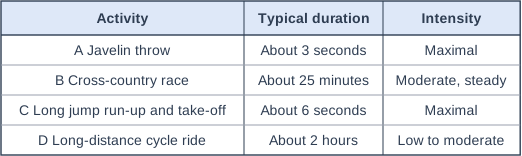
The table shows four activities.

Identify the two activities that are mainly anaerobic. Justify your choice using the data in the table.

Table with columns "Activity", "Typical duration", "Intensity". Activity: A  Javelin throw; Typical duration: About 3 seconds; Intensity: Maximal | Activity: B  Cross-country race; Typical duration: About 25 minutes; Intensity: Moderate, steady | Activity: C  Long jump run-up and take-off; Typical duration: About 6 seconds; Intensity: Maximal | Activity: D  Long-distance cycle ride; Typical duration: About 2 hours; Intensity: Low to moderate.

Model answer

A (javelin throw) and C (long jump run-up and take-off) are mainly anaerobic. They last only about 3 and 6 seconds and are performed at maximal intensity, so the heart and lungs cannot supply enough oxygen to the muscles in that time and energy is released without enough oxygen.

Explanation

Use both columns of the table: short duration plus maximal intensity means anaerobic; long duration plus moderate or low intensity (B and D) means aerobic. The justification mark needs the data, not just the event names.

Mark scheme
  1. 1 mark

    A / javelin throw

    If B or D is also given as anaerobic, award a maximum of 1 mark for identifying the activities.

  2. 1 mark

    C / long jump run-up and take-off

  3. 1 mark

    Justification using the data: they last only a few seconds (3 s / 6 s) at maximal intensity, so there is not enough oxygen supplied / the oxygen demand is greater than the supply

    The justification must use the duration and/or intensity from the table. Accept 'short duration and high intensity so lactic acid is produced'. Do not accept 'they are field events' or 'they are fast'.

Question 4

6 marks

Nadia is a heptathlete. Over two days she competes in seven events: the 100 m hurdles, high jump, shot put, 200 m, long jump, javelin and 800 m.

Analyse the importance of aerobic and anaerobic exercise to Nadia's performance across the competition.

Model answer

Aerobic exercise takes place in the presence of oxygen and releases energy from glucose with carbon dioxide and water as waste, so it suits long periods of low to moderate intensity. Anaerobic exercise takes place without enough oxygen and produces lactic acid, so it suits short, high-intensity efforts.

Most of Nadia's events are anaerobic. The 100 m hurdles and the 200 m are maximal sprints lasting under 30 seconds, and the high jump, long jump, shot put and javelin are explosive efforts lasting only a few seconds. At this intensity her heart and lungs cannot supply oxygen fast enough, so the energy is released anaerobically. This makes anaerobic exercise the most important type for her score, because it decides her times, heights and distances in six of the seven events.

However, the sprints produce lactic acid, which causes fatigue. Between events Nadia walks, jogs lightly and rests, which is aerobic, and her raised breathing and heart rate help remove the lactic acid so she can start the next event fresh. Over two days this recovery matters a great deal.

The 800 m, the final event, lasts over two minutes at high intensity. It is long enough for aerobic exercise to supply much of the energy, with anaerobic work in the sprint finish. Because she is already tired by then, poor aerobic fitness could cost her a lot of points.

Overall, anaerobic exercise wins Nadia most of her points, but aerobic exercise is essential for the 800 m and for recovering between events, so she needs to be good at both.

Explanation

Top answers define both types of exercise, use duration and intensity to classify Nadia's events (six short, maximal events are anaerobic; the 800 m uses both), and analyse why each matters - anaerobic exercise for the points-scoring efforts, aerobic exercise for the 800 m and for recovery between events. Common mistakes are calling the 800 m purely aerobic or purely anaerobic, and listing events without explaining their effect on performance.

Mark scheme
  1. 6 marks

    Levels of response (6 marks). AO1 = 1, AO2 = 2, AO3 = 3.
    Level 3 (5-6 marks): Knowledge of aerobic and anaerobic exercise is accurate and generally well detailed. Application to a heptathlete and her events is mostly appropriate, clear and effective. Analysis is thorough, reaching valid and well-reasoned conclusions about the importance of both types of exercise. The answer is generally clear, coherent and focused, with appropriate use of terminology throughout.
    Level 2 (3-4 marks): Knowledge of aerobic and anaerobic exercise is evident but is more detailed for one than the other. There is some appropriate and effective application to a heptathlete, although not always balanced and presented with clarity. Any analysis is clear but reaches valid and well-reasoned conclusions for one type of exercise more than the other. The answer lacks coherence in places, although terminology is used appropriately on occasions.
    Level 1 (1-2 marks): Knowledge of aerobic and anaerobic exercise is limited. Application to a heptathlete is either absent or inappropriate. Analysis is poorly focused or absent, with few or no reasoned conclusions. The answer as a whole lacks clarity and has inaccuracies. Terminology is either absent or inappropriately used.
    0 marks: no relevant content.

    Possible content may include: AO1 - aerobic exercise is exercise in the presence of oxygen (glucose + oxygen → energy + carbon dioxide + water), used for low to moderate intensity over a long period; anaerobic exercise is exercise in the absence of enough oxygen (glucose → energy + lactic acid), used for short, high-intensity efforts; duration and intensity decide which is used. AO2 - anaerobic: the 100 m hurdles (about 15 seconds) and the 200 m (about 25-30 seconds), the run-up and take-off in the high jump and long jump, and the shot put and javelin throws are all short, maximal efforts; the 800 m (over two minutes) is run at high intensity but lasts long enough for aerobic exercise to supply much of the energy, with an anaerobic sprint finish; aerobic: walking and light jogging between attempts and events, and recovering between events over the two days. AO3 - six of the seven events are short and maximal, so most of Nadia's points depend on anaerobic exercise: it decides her sprint times, jump heights and distances, and throws; the hurdles, 200 m and 800 m produce lactic acid, which causes fatigue, so it must be removed before the next event; aerobic exercise (keeping breathing and heart rate raised, a light jog) helps her recover between attempts, between events and from day one to day two; the 800 m comes last, when she is already tired, and relies on both, so poor aerobic fitness could cost her many points; however, aerobic exercise wins few points directly in the other six events; conclusion: anaerobic exercise is the more important for most events, but aerobic exercise is essential for the 800 m and for recovery across the competition, so both matter. Credit other suitable responses relevant to the question.

Ready to try the rest? Every answer you write is marked against the mark scheme, so you can see exactly where the marks are.

Study Helper Hints first, answers after you try

Stuck on this one? Ask for a hint and I’ll point you in the right direction, without giving the answer away. Once you’ve checked your answer, I’ll show you how the marks are awarded.