
Level:
Correct: 0
Incorrect: 0
Marks: 0/0
Exam Practice
Course:
Topics:
Avg
score:
–
Topics
done:
0/27

Bones of the skeleton

Practise 22 exam-style questions on Bones of the skeleton for AQA GCSE Physical Education (Paper 1). Write your answer as you would in the exam and get it marked in seconds against the mark scheme, point by point, with the Study Helper on hand if you get stuck.

  • 22 questions
  • 1–6 marks each
  • Instant marking
  • No sign-up needed
20 questions, marked as you go

Sample questions with model answers

Here are 4 of the questions in this topic, each with a model answer, an explanation of why it earns the marks and the mark scheme an examiner would use.

Question 1

1 mark

Which one of these bones sits in front of the knee joint?

Choose your answer.

  • Femur
  • Fibula
  • Patella
  • Talus

Model answer

Patella

Explanation

The knee joint is formed by the femur and the tibia, and the patella sits in front of the joint. The femur forms the joint itself rather than sitting in front of it. The fibula is in the lower leg but is found at the ankle, not the knee, and the talus is an ankle bone.

Mark scheme
  1. 1 mark

    Patella

    If more than one option is given, 0 marks.
Question 2

2 marks

The tibia and the fibula are both bones of the lower leg.

Describe two differences between the tibia and the fibula.

Model answer

The tibia is a thicker, stronger bone than the fibula. The tibia is on the inside of the lower leg, nearer the midline of the body, while the fibula is on the outside.

Explanation

The tibia is the thick shin bone on the inside of the lower leg; the fibula is the thin bone on the outside. Another difference is that the tibia is located at both the knee and the ankle, while the fibula is only located at the ankle. Swapping the positions of the two bones is the most common mistake.

Mark scheme
  1. 1 mark

    The tibia is thicker / larger / stronger than the fibula (or the fibula is thinner / smaller)

    max 2 marks from the three points. The comparison may be implied, e.g. 'the tibia is the thicker bone' = 1.

  2. 1 mark

    The tibia is on the inside of the lower leg / nearer the midline / at the front (shin) and the fibula is on the outside

    Do not accept the positions reversed.

  3. 1 mark

    The tibia is located at the knee (with the femur) as well as the ankle, but the fibula is only located at the ankle / is not part of the knee joint

    Do not accept 'the fibula is part of the knee'.

Question 3

3 marks

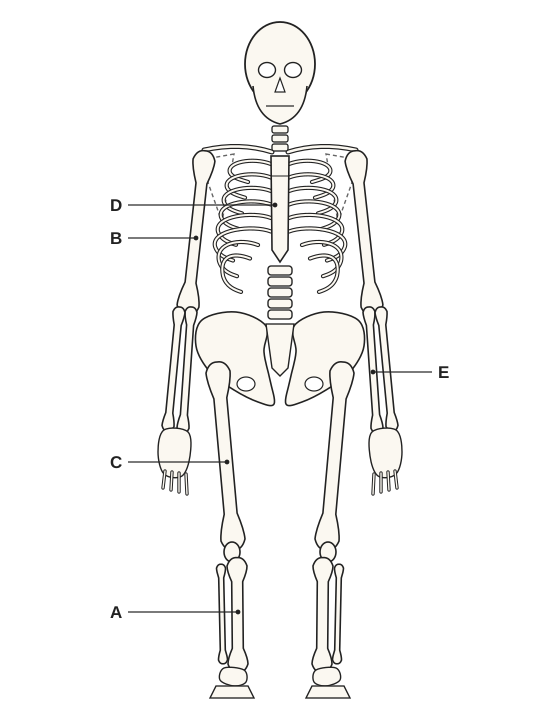
Figure 1 shows a front view of the human skeleton with five bones labelled A to E.

Some bones are found at more than one joint. Using the letters in Figure 1, identify:

the bone found at both the shoulder and the elbow
the bone found at both the hip and the knee
the bone found at both the knee and the ankle.

Front view of a human skeleton, standing with the arms by the sides and the palms facing forward. Label A points to the thicker bone of the lower leg, nearer the middle of the body (the shin bone); Label B points to the long bone between the shoulder and the elbow; Label C points to the long bone of the thigh, between the hip and the knee; Label D points to the flat bone down the centre of the chest; and Label E points to the forearm bone on the little-finger side (on the inside of the forearm, nearer the body).

Model answer

Shoulder and elbow: B, the humerus.
Hip and knee: C, the femur.
Knee and ankle: A, the tibia.

Explanation

The humerus runs from the shoulder (where it meets the scapula) to the elbow (where it meets the radius and ulna). The femur runs from the hip (pelvis) to the knee, and the tibia runs from the knee to the ankle. A common error is to choose the fibula for the knee and ankle: the fibula is found only at the ankle.

Mark scheme
  1. 1 mark

    Shoulder and elbow: B / humerus

    Accept the letter or the correct bone name. If a letter and a name are both given and they do not match (e.g. 'B - femur'), 0 for this point.

  2. 1 mark

    Hip and knee: C / femur

    Accept the letter or the correct bone name. A mismatched letter and name scores 0 for this point.

  3. 1 mark

    Knee and ankle: A / tibia

    Accept the letter or the correct bone name. Do not accept E (ulna) or fibula.

Question 4

4 marks

A tennis player injures her right arm. A scan shows damage at both her shoulder joint and her elbow joint.

Name all four bones located at these two joints.

Model answer

At the shoulder the bones are the scapula and the humerus. At the elbow the bones are the humerus, the radius and the ulna. So the four bones are the scapula, humerus, radius and ulna.

Explanation

The shoulder is formed by the scapula and the humerus, and the elbow by the humerus, radius and ulna. The humerus links the two joints, so it is only one bone even though it appears in both lists. Do not add the femur or tibia - they belong to the leg.

Mark scheme
  1. 1 mark

    scapula

    Bones may be given in any order. Ignore clavicle (not one of the bones the specification lists at the shoulder), but it does not score.

  2. 1 mark

    humerus

    The humerus is located at both joints but scores only once.

  3. 1 mark

    radius

    Accept recognisable misspellings.

  4. 1 mark

    ulna

    Accept recognisable misspellings.

Ready to try the rest? Every answer you write is marked against the mark scheme, so you can see exactly where the marks are.

Study Helper Hints first, answers after you try

Stuck on this one? Ask for a hint and I’ll point you in the right direction, without giving the answer away. Once you’ve checked your answer, I’ll show you how the marks are awarded.