
Level:
Correct: 0
Incorrect: 0
Marks: 0/0
Exam Practice
Course:
Topics:
Avg
score:
–
Topics
done:
0/27

Lever systems and mechanical advantage

Practise 22 exam-style questions on Lever systems and mechanical advantage for AQA GCSE Physical Education (Paper 1). Write your answer as you would in the exam and get it marked in seconds against the mark scheme, point by point, with the Study Helper on hand if you get stuck.

  • 22 questions
  • 1–9 marks each
  • Instant marking
  • No sign-up needed
20 questions, marked as you go

Sample questions with model answers

Here are 4 of the questions in this topic, each with a model answer, an explanation of why it earns the marks and the mark scheme an examiner would use.

Question 1

1 mark

Which one of these statements about a third class lever is correct?

Choose your answer.

  • The load is between the effort and the fulcrum
  • It always has a mechanical advantage greater than 1
  • It allows a large range of movement and speed
  • The fulcrum is between the effort and the load

Model answer

It allows a large range of movement and speed

Explanation

In a third class lever the effort is between the fulcrum and the load, so the effort arm is shorter than the load arm and the mechanical advantage is less than 1. This means a large effort is needed, but the load moves quickly through a large range of movement. Load in the middle is a second class lever; fulcrum in the middle is a first class lever.

Mark scheme
  1. 1 mark

    It allows a large range of movement and speed

    If more than one option is given, 0 marks.
Question 2

2 marks

Most lever systems in the body are third class levers.

Explain one advantage and one disadvantage of a third class lever for a performer.

Model answer

Advantage: a third class lever lets the end of the limb move quickly through a large range of movement, which helps a performer to kick or throw with speed.
Disadvantage: it has a mechanical advantage of less than 1, so the muscle has to produce a large effort to move even a small load.

Explanation

Third class levers trade force for speed: the effort is close to the fulcrum, so a large effort is needed, but the load at the end of the limb moves fast and far. This suits most sporting actions, where speed matters more than lifting heavy loads.

Mark scheme
  1. 1 mark

    Advantage: it gives a large range of movement / a fast movement (at the end of the limb), e.g. for throwing, kicking or striking

    Advantage: 1 mark.

  2. 1 mark

    Disadvantage: it has a low mechanical advantage (less than 1), so the muscle must produce a large effort to move the load / it cannot move heavy loads easily

    Disadvantage: 1 mark. Do not accept 'it is weak' without explanation.

Question 3

3 marks

A footballer takes a throw-in. As the ball is released, the elbows extend.

Identify the class of lever operating at the elbow as it extends. State where the fulcrum, effort and load are in this lever.

Model answer

The elbow is working as a first class lever. The fulcrum is the elbow joint, the effort comes from the triceps pulling on the back of the elbow, and the load is the ball held in the hands.

Explanation

Extension of the elbow is a first class lever: the triceps attaches behind the elbow joint, so the fulcrum (elbow) lies between the effort (triceps) and the load (ball and forearm). A common mistake is to call every elbow action third class - only flexion, such as a bicep curl, is third class.

Mark scheme
  1. 1 mark

    First class (lever)

    If the class is wrong, the position marks can still be awarded if they are correct.

  2. 1 mark

    Fulcrum: the elbow (joint)

    Positions: sub-max 2 marks.

  3. 1 mark

    Effort: the triceps / where the triceps attaches at the back of the elbow (on the ulna)

  4. 1 mark

    Load: the ball / the weight of the forearm, hand and ball

    Max 3 marks. Do not accept 'biceps' for the effort.

Question 4

4 marks

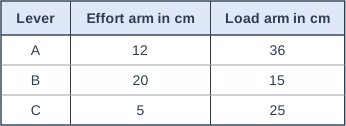
The table shows the effort arm and load arm of three levers, A, B and C.

Mechanical advantage = effort arm ÷ load arm

Calculate the mechanical advantage of each lever. Identify the lever that would need the least effort to move the same load.

Table with columns "Lever", "Effort arm in cm", "Load arm in cm". Lever: A; Effort arm in cm: 12; Load arm in cm: 36 | Lever: B; Effort arm in cm: 20; Load arm in cm: 15 | Lever: C; Effort arm in cm: 5; Load arm in cm: 25.

Model answer

A: 12 ÷ 36 = 0.33
B: 20 ÷ 15 = 1.33
C: 5 ÷ 25 = 0.2
Lever B would need the least effort, because it has the highest mechanical advantage - the only one greater than 1.

Explanation

Divide the effort arm by the load arm for each lever. The higher the mechanical advantage, the smaller the effort needed to move a given load, so B is the most efficient. A common mistake is to divide the other way round, which would make C look best.

Mark scheme
  1. 1 mark

    A: 12 ÷ 36 = 0.33

    Accept 1/3, 0.3 or 0.333.

  2. 1 mark

    B: 20 ÷ 15 = 1.33

    Accept 4/3, 1.3 or 1.333.

  3. 1 mark

    C: 5 ÷ 25 = 0.2

    Accept 1/5.

  4. 1 mark

    B (because it has the highest mechanical advantage / the only one greater than 1)

    Allow follow through: credit the lever with the highest of the student's calculated values.

Ready to try the rest? Every answer you write is marked against the mark scheme, so you can see exactly where the marks are.

Study Helper Hints first, answers after you try

Stuck on this one? Ask for a hint and I’ll point you in the right direction, without giving the answer away. Once you’ve checked your answer, I’ll show you how the marks are awarded.