
Level:
Correct: 0
Incorrect: 0
Marks: 0/0
Exam Practice
Course:
Topics:
Avg
score:
–
Topics
done:
0/27

Blood vessels

Practise 21 exam-style questions on Blood vessels for AQA GCSE Physical Education (Paper 1). Write your answer as you would in the exam and get it marked in seconds against the mark scheme, point by point, with the Study Helper on hand if you get stuck.

  • 21 questions
  • 1–9 marks each
  • Instant marking
  • No sign-up needed
20 questions, marked as you go

Sample questions with model answers

Here are 4 of the questions in this topic, each with a model answer, an explanation of why it earns the marks and the mark scheme an examiner would use.

Question 1

1 mark

Which one of these blood vessels carries deoxygenated blood away from the heart?

Choose your answer.

  • Aorta
  • Pulmonary artery
  • Pulmonary vein
  • Vena cava

Model answer

Pulmonary artery

Explanation

The pulmonary artery carries deoxygenated blood from the right ventricle to the lungs. It is an artery because it carries blood away from the heart, even though the blood is deoxygenated. The aorta carries oxygenated blood away from the heart, and the vena cava and pulmonary vein bring blood back to the heart.

Mark scheme
  1. 1 mark

    Pulmonary artery

    If more than one option is given, 0 marks.
Question 2

2 marks

Name the type of blood vessel that carries blood towards the heart, and state whether this blood is usually oxygenated or deoxygenated.

Model answer

Veins carry blood towards the heart, and this blood is usually deoxygenated. The exception is the pulmonary vein, which carries oxygenated blood from the lungs.

Explanation

Veins return blood to the heart after the muscles and organs have taken oxygen from it, so it is usually deoxygenated. The pulmonary vein is the exception because it carries blood that has just been oxygenated in the lungs.

Mark scheme
  1. 1 mark

    Veins

    Accept vein / vena cava.

  2. 1 mark

    (Usually) deoxygenated

    Accept 'deoxygenated, except the pulmonary vein'.

Question 3

3 marks

Explain how blood pressure differs in arteries, capillaries and veins.

Model answer

Blood pressure is highest in the arteries, because the blood has just been forced out of the ventricles. It falls in the capillaries, where the blood moves slowly, giving time for gas exchange. It is lowest in the veins, which is why veins have valves and a wide lumen to keep the blood flowing back to the heart.

Explanation

Pressure falls as blood moves further from the heart. The structure of each vessel matches its pressure: thick walls for high pressure in arteries, valves for low pressure in veins. 'Explain' needs a reason for each, not just the order.

Mark scheme
  1. 1 mark

    Pressure is highest in the arteries because blood has just been pumped out of the heart / ventricles

  2. 1 mark

    Pressure falls in the capillaries / is low, so blood flows slowly, allowing time for gas exchange

  3. 1 mark

    Pressure is lowest in the veins, so veins have valves (and a large lumen) to keep blood flowing back to the heart

    Each mark needs the pressure level and a reason or consequence. A correct order (arteries highest, then capillaries, veins lowest) with no explanation scores 1 mark in total.

Question 4

4 marks

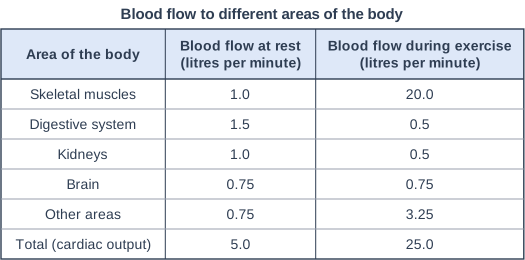
The table shows the blood flow to different areas of the body of an athlete at rest and during exercise.

Calculate the percentage of the athlete's cardiac output that goes to the skeletal muscles during exercise.

Explain how the increase in blood flow to the skeletal muscles is brought about.

Blood flow to different areas of the body. Table with columns "Area of the body", "Blood flow at rest (litres per minute)", "Blood flow during exercise (litres per minute)". Area of the body: Skeletal muscles; Blood flow at rest (litres per minute): 1.0; Blood flow during exercise (litres per minute): 20.0 | Area of the body: Digestive system; Blood flow at rest (litres per minute): 1.5; Blood flow during exercise (litres per minute): 0.5 | Area of the body: Kidneys; Blood flow at rest (litres per minute): 1.0; Blood flow during exercise (litres per minute): 0.5 | Area of the body: Brain; Blood flow at rest (litres per minute): 0.75; Blood flow during exercise (litres per minute): 0.75 | Area of the body: Other areas; Blood flow at rest (litres per minute): 0.75; Blood flow during exercise (litres per minute): 3.25 | Area of the body: Total (cardiac output); Blood flow at rest (litres per minute): 5.0; Blood flow during exercise (litres per minute): 25.0.

Model answer

20.0 ÷ 25.0 × 100 = 80%. The blood vessels supplying the skeletal muscles widen (vasodilation), so more blood flows to them. At the same time, vasoconstriction narrows the vessels supplying areas such as the digestive system and kidneys, so blood is diverted away from them to the working muscles.

Explanation

Divide the muscles' blood flow by the total (the cardiac output) and multiply by 100. At rest the muscles get only 20% (1.0 out of 5.0 litres per minute); during exercise both the total and the share rise. Redistribution uses vasodilation to the muscles and vasoconstriction to inactive organs.

Mark scheme
  1. 1 mark

    20.0 ÷ 25.0 (× 100)

    Method mark.

  2. 1 mark

    80%

    Correct answer with no working scores both marks. Do not accept 20% (the resting figure).

  3. 1 mark

    Vasodilation / widening of the blood vessels supplying the skeletal muscles

  4. 1 mark

    Vasoconstriction / narrowing of the blood vessels to other areas, e.g. the digestive system or kidneys, diverts blood to the muscles

    Accept 'blood is redistributed from the digestive system (1.5 to 0.5) to the muscles'.

Ready to try the rest? Every answer you write is marked against the mark scheme, so you can see exactly where the marks are.

Study Helper Hints first, answers after you try

Stuck on this one? Ask for a hint and I’ll point you in the right direction, without giving the answer away. Once you’ve checked your answer, I’ll show you how the marks are awarded.