Level:
Correct: 0
Incorrect: 0
Marks: 0/0
Exam Practice
Course:
Topics:
AQA GCSE Sociology (Paper 1) Smart practice A mixed round aimed at your weak spots
Unit 1
The sociological approach
The sociological approach; social structures, social processes and social issues
The sociological approach: socialisation and culture
Unit 2
Families
Functions of families
Family forms
Family forms
Conjugal role relationships
Changing relationships within families
Criticisms of families
Divorce
Divorce
Unit 3
Education
Unit 4
Sociological research methods
Avg
score:
–
Topics
done:
0/14

The sociological approach: socialisation and culture

Practise 31 exam-style questions on The sociological approach: socialisation and culture for AQA GCSE Sociology (Paper 1). Write your answer as you would in the exam and get it marked in seconds against the mark scheme, point by point, with the Study Helper on hand if you get stuck.

  • 31 questions
  • 1–12 marks each
  • Instant marking
  • No sign-up needed
20 questions, marked as you go

Sample questions with model answers

Here are 4 of the questions in this topic, each with a model answer, an explanation of why it earns the marks and the mark scheme an examiner would use.

Question 1

1 mark

What term is commonly used by sociologists to describe the rewards and punishments that are used to encourage people to keep to the norms of a group or society?

Choose your answer.

  • Conformity
  • Expectations
  • Sanctions
  • Values

Model answer

Sanctions

Explanation

Sanctions are the means of social control: positive sanctions reward conformity (praise, merit points, a pay rise) and negative sanctions punish deviance (a frown, a detention, a fine). Conformity is the behaviour that sanctions try to produce, not the rewards and punishments themselves. Students sometimes think sanctions are only punishments, but sociologists use the term for rewards as well.

Mark scheme
  1. 1 mark

    Sanctions

    If more than one option is given, 0 marks.

Question 2

2 marks

Item D
In 1972 the British sociologist Ann Oakley published Sex, Gender and Society. Rather than collecting new data, she reviewed existing research from biology, psychology, medicine and anthropology, including studies of societies very different from Britain. Oakley distinguished between 'sex', the biological differences between males and females, and 'gender', the socially learned ideas of masculinity and femininity. She argued that the behaviour expected of men and women varies from one culture to another, so it cannot simply be explained by biology. At the time, the functionalist view that the different roles of husbands and wives in the family were rooted in biology was influential.
Source: based on Oakley, A, Sex, Gender and Society, 1972.

From Item D, examine one strength of Oakley's research.

Model answer

One strength is that Oakley drew on studies of societies very different from Britain. Comparing cultures in this way can show that the behaviour expected of men and women varies from one society to another, which is strong evidence that gender roles are socially learned rather than fixed by biology.

Explanation

The first mark is for a strength taken from the item, such as the range of existing research or the cross-cultural evidence; the second is for explaining why that makes the research stronger. Simply repeating Oakley's argument without saying why the method is a strength gains only one mark.

Mark scheme
  1. 1 mark

    1 mark for an analysis of the item: a possible strength of Oakley's research identified from Item D, relating to its methods or findings, eg use of existing research from several subjects, evidence from many different societies, the sex/gender distinction. (AO3)

    Indicative content (AO3; not exhaustive, credit other valid points): Oakley reviewed existing research from biology, psychology, medicine and anthropology, so her conclusions were based on a wide range of evidence rather than a single study; it included studies of very different societies, so cross-cultural comparisons could show that the behaviour expected of men and women varies and is therefore socially learned rather than fixed by biology; using secondary data was quicker and cheaper than collecting new data across many societies; using existing research avoided the ethical problems of experimenting on how children are raised; the sex/gender distinction gave sociologists a clear concept for separating biological from social differences.

  2. 1 mark

    1 mark for evaluation: a reason why this is a strength, eg so the conclusions rest on a wide range of evidence; so cross-cultural comparison can show that gender roles vary and are therefore learned; quick and cheap with no ethical problems. (AO3)

    Only for a reason that explains why the point identified is a strength (a judgement or conclusion about it); restating the point is not enough.

Question 3

4 marks

Item B
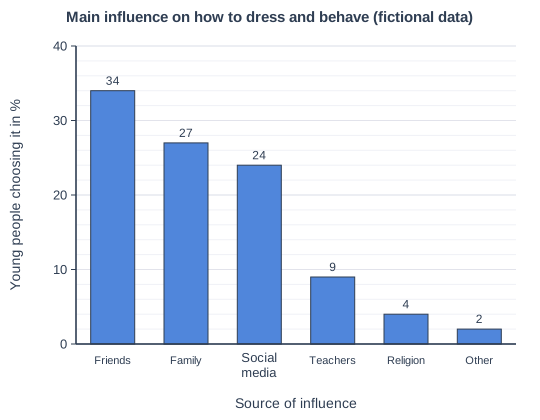
A team of sociologists gave a questionnaire to 1,500 young people aged 13 to 16 in 30 schools across England (fictional study). Each young person was asked to choose the one source that had most influenced their views about how to dress and behave. The bar chart in Item B shows the results (fictional data).

Identify and explain one reason why the peer group may be an important agency of socialisation for young people, as shown in Item B.

Main influence on how to dress and behave (fictional data). Bar chart of young people choosing it in % for each source of influence: Friends 34, Family 27, Social media 24, Teachers 9, Religion 4, Other 2.

Model answer

One reason is that peer groups use informal sanctions to make young people conform. Item B shows that friends were chosen by 34% of young people as the main influence on how they dress and behave, the largest of any source and more than family at 27%. During adolescence young people seek independence from their parents and want to be accepted by people of their own age. Peer groups reward those who fit in, for example by including them and approving of their clothes or slang, and punish those who do not through teasing or leaving them out. Because young people fear being excluded, they adopt the group's norms. The 24% choosing social media suggests this peer pressure now continues online, outside school hours.

Explanation

Top-level answers give one reason, explain the process (such as informal sanctions and the wish to fit in) and refer to the data in Item B. Answers that simply restate the chart, or explain the family's influence instead of the peer group's, are limited to the lower levels.

Mark scheme
  1. 4 marks

    Levels of response (4 marks). AO1 = 1 mark, AO2 = 3 marks. 'Context' here refers to the importance of the peer group as an agency of socialisation for young people aged 13 to 16, as shown in Item B.
    Level 4 (4 marks): Relevant reason identified (AO1) and an appropriate, detailed and well-developed explanation of relevant sociological theories, concepts, evidence and methods offered with a good application to the context. (AO2)
    Level 3 (3 marks): Relevant reason identified (AO1) with an explanation of relevant sociological theories, concepts, evidence and methods containing some inaccuracies or omissions but which has some application to the context. (AO2)
    Level 2 (2 marks): Relevant reason identified (AO1) with a largely inaccurate or irrelevant explanation of relevant sociological theories, concepts, evidence and methods that is only weakly applied to the context. (AO2)
    Level 1 (1 mark): Relevant reason identified. (AO1)
    0 marks: Nothing worthy of credit.

    Indicative content AO1 (not exhaustive, credit other valid points): Desire to fit in / peer pressure and conformity; informal sanctions (approval, teasing, exclusion); youth culture and subcultures; time spent with friends at school and online; adolescence as a time of growing independence from parents; social media extending peer influence. Indicative content AO2: Item B shows friends chosen by the largest share (34%) as the main influence on how to dress and behave, more than family (27%); during adolescence young people seek independence and an identity of their own, so they look to people of the same age; peer groups use informal sanctions - approval and inclusion for wearing the 'right' clothes or using the same slang, teasing or exclusion for not fitting in - so young people conform; young people spend much of the day with peers at school and online, and social media (24% in Item B) extends this influence; peer groups create youth culture with its own norms; interactionists stress how identities are negotiated in peer interaction; but the family (27%) remains important, showing primary socialisation still matters. NB: an answer that does not link the reason to the influence of the peer group on young people as shown in Item B cannot gain more than 2 marks.

Question 4

12 marks

Discuss how far sociologists would agree that families and schools mainly pass on norms and values that are shared by everyone in society.

Model answer

Functionalists would largely agree with this claim. Parsons argued that the family performs primary socialisation, teaching children the basic norms and values of their society, such as honesty, politeness and respect for others. The school then acts as a bridge between the family and wider society: through the formal and hidden curriculum, children learn to follow rules, be punctual and be judged by universal standards. Durkheim similarly saw education as passing on society's norms and values, for example through teaching history, so that children feel part of something larger than themselves. For functionalists, this creates a value consensus that holds society together and maintains social order.

However, conflict theorists argue that the values passed on are not shared by everyone but serve powerful groups. Marxists claim that families and schools transmit ruling-class ideology. Bowles and Gintis argued, through the correspondence principle, that the hidden curriculum trains working-class pupils to be obedient and to accept hierarchy, preparing them for exploitation at work. Zaretsky saw the family as a prop to capitalism, socialising children as future workers and consumers. From this view, the apparent consensus is really false class consciousness.

Feminists add that families and schools pass on patriarchal values. Oakley described how parents channel children into gender-appropriate toys and activities (canalisation), and children often see mothers doing most of the housework. Schools may reinforce this through a gendered curriculum and teachers' expectations. These values are not shared equally because they benefit men at women's expense.

Interactionists question the idea that values are simply passed on at all. They argue that children actively interpret what they are taught; pupils may resist school values, as Willis's working-class 'lads' rejected the school's emphasis on qualifications, while labels from teachers can shape pupils' self-image in different ways, as Ball found at Beachside Comprehensive. In addition, Britain's cultural, religious and class diversity means families pass on different values, and peer groups and social media also compete with families and schools.

In evaluation, functionalism assumes a consensus rather than proving it and ignores inequality, while Marxism and feminism may overstate how passively people accept ideology, given that values such as gender equality have changed considerably since the 1970s. Some values, such as condemning violence, do appear widely shared.

Overall, most sociologists would agree only partly. Families and schools do pass on some widely shared norms, but the evidence of diversity, conflict and resistance suggests that many of the values they transmit reflect the interests of particular groups, especially the ruling class and men, rather than everyone in society.

Explanation

Level 4 answers apply consensus and conflict views to both families and schools, use named sociologists accurately and evaluate rather than juxtapose perspectives, ending with a reasoned judgement on 'how far'. Weaker answers describe the functions of the family or education in general and never ask whose values are being passed on.

Mark scheme
  1. 12 marks

    Levels of response (12 marks). AO1 = 4 marks, AO2 = 4 marks, AO3 = 4 marks. AQA's AO3 descriptor for each level opens the comments; judge AO1, AO2 and AO3 together (best fit).
    Level 4 (10-12 marks): Detailed knowledge and understanding of relevant theories, concepts, evidence and methods presented in a well-developed answer. A wide range of specialist terms used with precision. (AO1) Sustained application of relevant theories, concepts, evidence and methods to the issues raised by the question. Few if any inaccuracies or omissions. (AO2) AO3: see Level 4 in the comments.
    Level 3 (7-9 marks): Good evidence of relevant knowledge and understanding of theories, concepts, evidence and methods but elements lacking detail and development. A good range of specialist terms used appropriately. (AO1) Good application of relevant theories, concepts, evidence and methods to the issues raised by the question. Some inaccuracies or omissions. (AO2) AO3: see Level 3 in the comments.
    Level 2 (4-6 marks): Limited evidence of relevant knowledge and understanding of theories, concepts, evidence and methods. A limited range of specialist terms used appropriately. (AO1) Limited application of relevant theories, concepts, evidence and methods to the issues raised by the question. Significant inaccuracies or omissions. (AO2) AO3: see Level 2 in the comments.
    Level 1 (1-3 marks): Fragments of basic knowledge and understanding of theories, concepts, evidence and methods relevant to the topic. Specialist terms generally used inappropriately if at all. (AO1) Little or no application of relevant theories, concepts, evidence and methods to the issues raised by the question. (AO2) AO3: see Level 1 in the comments.
    0 marks: Nothing worthy of credit.

    AO3 descriptors (AQA): Level 4: Developed critical analysis and evaluation of relevant theories, concepts, evidence and methods. Well-constructed arguments with supported judgements and evidence-based conclusions. Level 3: Good evidence of analysis and evaluation of the relevant theories, concepts, evidence and methods. A logical argument, but judgements and conclusions may be indistinct and/or lacking in appropriate development. Level 2: Limited attempt at analysis and evaluation of the relevant theories, concepts, evidence and methods but lacking in appropriate development. There may be inconsistencies in the argument made and reasoning may be inaccurate leading to false or contradictory judgements and conclusions. Level 1: Little or no analysis of the relevant theories, concepts, evidence and methods, assertion rather than evaluation, poorly-constructed argument with little or no evidence of substantiated judgements and only cursory conclusions. AO1, AO2 and AO3 are regarded as interdependent. When deciding on a mark all should be considered together using the best fit approach. For example, a level 3 mark could be awarded for level 3 evidence across each objective, or a mixture of 4, 3 and 2 evidence across different objectives.
    Indicative content (not exhaustive; credit other relevant points): AO1: Functionalism (consensus): Parsons on primary socialisation and the school as a bridge to wider society; Durkheim on education and social solidarity; value consensus. Marxism (conflict): ruling-class ideology; Bowles and Gintis and the hidden curriculum / correspondence principle; Zaretsky on the family as a prop to capitalism. Feminism: patriarchal values, canalisation (Oakley), gendered curriculum. Interactionism: meanings negotiated, labelling (eg Ball). Subcultures and cultural diversity. AO2: Apply the claim to the family (eg teaching manners, honesty, language) and school (eg the formal and hidden curriculum, rules, citizenship); functionalists argue these create value consensus and social order; Marxists argue the values passed on are those of the ruling class (obedience, acceptance of hierarchy), creating false class consciousness; feminists argue families and schools pass on patriarchal values (canalisation, gender stereotypes, the double shift modelled at home); cultural, ethnic, religious and class diversity in families means children learn different values; peer groups and the media may matter more for young people; interactionists show pupils interpret and resist school values (eg Willis's lads, although Willis was a Marxist). AO3: Evaluate each perspective, eg functionalism assumes rather than proves consensus and ignores conflict and inequality; Marxism may exaggerate how far people are passive and ignores gender; feminism shows values benefit men but may overlook changes (eg girls outperforming boys); evidence of diversity of values in Britain (eg ethnic and religious groups, changing attitudes over time); some values (eg laws against violence) are widely shared; evidence-based judgement and conclusion on how far families and schools pass on values shared by everyone. NB: Level 4 requires sustained discussion of both families and schools and of at least one conflict view of whose values are passed on. Answers that only list functions of the family or education without linking them to shared values cannot go beyond Level 2.

Ready to try the rest? Every answer you write is marked against the mark scheme, so you can see exactly where the marks are.

Study Helper Hints first, answers after you try

Stuck on this one? Ask for a hint and I’ll point you in the right direction, without giving the answer away. Once you’ve checked your answer, I’ll show you how the marks are awarded.