Level:
Correct: 0
Incorrect: 0
Marks: 0/0
Exam Practice
Course:
Topics:
AQA GCSE Sociology (Paper 1) Smart practice A mixed round aimed at your weak spots
Unit 1
The sociological approach
The sociological approach; social structures, social processes and social issues
The sociological approach: socialisation and culture
Unit 2
Families
Functions of families
Family forms
Family forms
Conjugal role relationships
Changing relationships within families
Criticisms of families
Divorce
Divorce
Unit 3
Education
Unit 4
Sociological research methods
Avg
score:
–
Topics
done:
0/14

Divorce

Practise 35 exam-style questions on Divorce for AQA GCSE Sociology (Paper 1). Write your answer as you would in the exam and get it marked in seconds against the mark scheme, point by point, with the Study Helper on hand if you get stuck.

  • 35 questions
  • 1–12 marks each
  • Instant marking
  • No sign-up needed
20 questions, marked as you go

Sample questions with model answers

Here are 4 of the questions in this topic, each with a model answer, an explanation of why it earns the marks and the mark scheme an examiner would use.

Question 1

1 mark

What term is commonly used by sociologists to describe shifts over time in what most people in a society see as acceptable, such as the growing acceptance of divorce?

Choose your answer.

  • Changing social attitudes
  • Conformity
  • Continuity
  • Value consensus

Model answer

Changing social attitudes

Explanation

Changing social attitudes refers to changes in what people in a society think is normal or acceptable, such as the declining disapproval of divorce since 1945. Continuity is the opposite idea: things staying the same over time.

Mark scheme
  1. 1 mark

    Changing social attitudes

    If more than one option is given, 0 marks.

Question 2

3 marks

Identify and describe one change in divorce law since 1945 that has made divorce easier to obtain.

Model answer

The Divorce Reform Act 1969, which came into force in England and Wales in 1971, made irretrievable breakdown of the marriage the only ground for divorce. Before this, one partner usually had to prove that the other had committed a matrimonial offence such as adultery, cruelty or desertion. After 1971 a couple could divorce after two years' separation if both agreed, or five years if only one wanted it, so neither partner had to be blamed. This made divorce easier to obtain, and the number of divorces roughly doubled between 1970 and 1972.

Explanation

The best answers name the change accurately, with its approximate date, and explain how it made divorce easier compared with the law before it. Inaccurate dates or claiming that one Act 'introduced divorce' cost marks.

Mark scheme
  1. 3 marks

    Levels of response (3 marks). AO1 = 3 marks.
    Level 3 (3 marks): A coherent description with few inaccuracies. Demonstrates good knowledge and understanding of relevant sociological theories, concepts, evidence and methods. (AO1)
    Level 2 (2 marks): A partial description based on a mix of relevant and irrelevant material with some inaccuracies and omissions. Demonstrates some knowledge and understanding of relevant sociological theories, concepts, evidence and methods. (AO1)
    Level 1 (1 mark): Fragments of knowledge, some inaccurate or irrelevant. Demonstrates limited understanding of relevant sociological theories, concepts, evidence and methods. (AO1)
    0 marks: Nothing worthy of credit.

    Indicative content (AO1; not exhaustive, credit other valid points): The Divorce Reform Act 1969 (in force in England and Wales from 1971): irretrievable breakdown became the only ground, which could be shown by facts including two years' separation if both partners agreed or five years if not, so a partner no longer always had to prove that the other was at fault (eg adultery, cruelty or desertion, the main grounds before 1971); the Matrimonial and Family Proceedings Act 1984: couples could apply for divorce after one year of marriage instead of three; the Divorce, Dissolution and Separation Act 2020 (in force 6 April 2022): no-fault divorce, with a statement of irretrievable breakdown, no need to blame the other partner, joint applications allowed, and a minimum of 20 weeks before applying for a conditional order; credit the Family Law Act 1996 as an attempted reform, but its no-fault provisions were never brought into force. NB: Answers must describe how the change made divorce easier, quicker or less stressful to obtain; naming an Act alone is Level 1.

Question 3

4 marks

Item C
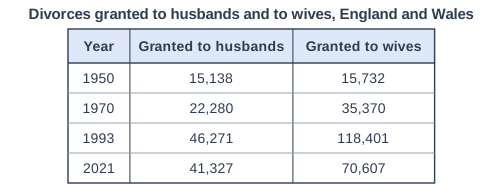
The table in Item C shows the number of opposite-sex divorces in England and Wales granted to husbands and to wives in selected years. Each divorce is counted under the partner who applied to the court for it. Joint applications by both partners only became possible in 2022.
Source: ONS, Divorces in England and Wales: 2023 (Table 2a).

Identify and explain one factor that may account for wives being granted more divorces than husbands, as shown in Item C.

Divorces granted to husbands and to wives, England and Wales. Table with columns "Year", "Granted to husbands", "Granted to wives". Year: 1950; Granted to husbands: 15,138; Granted to wives: 15,732 | Year: 1970; Granted to husbands: 22,280; Granted to wives: 35,370 | Year: 1993; Granted to husbands: 46,271; Granted to wives: 118,401 | Year: 2021; Granted to husbands: 41,327; Granted to wives: 70,607.

Model answer

One factor is women's growing dissatisfaction with unequal marriages, linked to changes in their status. Item C shows that in 1950 the numbers of divorces granted to husbands and wives were almost equal, but by 1993 wives were granted 118,401 divorces compared with 46,271 for husbands, more than two and a half times as many. As more married women took paid work, they gained financial independence, and the feminist movement encouraged them to expect equality. Many women still did most of the housework and childcare on top of paid work, the double shift, so they had more reason to be dissatisfied. Feminists argue that wives applying for most divorces shows women rejecting patriarchal marriages, although the law before 2022, which required the applicant to cite the other partner's behaviour or adultery, may also have influenced who applied.

Explanation

Top answers explain why women in particular would apply for divorce and use figures from Item C, such as the change since 1950. Answers that explain why divorce in general increased, without addressing the difference between wives and husbands, stay in the lower levels.

Mark scheme
  1. 4 marks

    Levels of response (4 marks). AO1 = 1 mark, AO2 = 3 marks. 'Context' here refers to wives being granted more divorces than husbands, as shown in Item C.
    Level 4 (4 marks): Relevant factor identified (AO1) and an appropriate, detailed and well-developed explanation of relevant sociological theories, concepts, evidence and methods offered with a good application to the context. (AO2)
    Level 3 (3 marks): Relevant factor identified (AO1) with an explanation of relevant sociological theories, concepts, evidence and methods containing some inaccuracies or omissions but which has some application to the context. (AO2)
    Level 2 (2 marks): Relevant factor identified (AO1) with a largely inaccurate or irrelevant explanation of relevant sociological theories, concepts, evidence and methods that is only weakly applied to the context. (AO2)
    Level 1 (1 mark): Relevant factor identified. (AO1)
    0 marks: Nothing worthy of credit.

    Indicative content AO1 (not exhaustive, credit other valid points): Changes in the status of women (paid work, financial independence); feminism and rising expectations of equality; women's dissatisfaction with unequal domestic labour (the double shift); the declining stigma of divorce for women; the welfare state; the fault-based law before 2022. Indicative content AO2: Item C: in 1950 the numbers were almost equal (15,138 to husbands and 15,732 to wives), but by 1993 wives were granted 118,401 compared with 46,271 for husbands, more than two and a half times as many; women's paid employment and higher education gave financial independence, so they could leave unhappy marriages; feminism encouraged women to expect equality and reject patriarchal marriages; many wives carried the double shift (eg Oakley; Delphy and Leonard on the exploitation of women's labour), giving more reason for dissatisfaction; divorced women faced less stigma than in the past; welfare benefits and housing made it more possible to live as a lone parent; under the fault-based law before 2022, the applicant had to cite facts such as the other partner's adultery or behaviour, so legal strategy also shaped who applied (credit as a qualification); functionalists may see wives' applications as evidence of women's higher expectations of marriage. NB: For 4 marks the factor must be applied to Item C (eg the change from near equality in 1950 to many more divorces granted to wives from 1970 onwards).

Question 4

12 marks

Discuss how far sociologists would agree that changes in the status of women are the main reason for the rise in divorce since 1945.

Model answer

Feminists and many other sociologists would agree that changes in the status of women have been a major reason for the rise in divorce since 1945. Over this period, far more married women have entered paid employment and higher education, giving them their own income and reducing their economic dependence on husbands. The welfare state also made it more possible for women to support themselves and their children after divorce. At the same time, feminism encouraged women to expect equality in marriage, so many became less willing to accept the double shift of paid work plus most of the housework and childcare. Delphy and Leonard's argument that men exploit women's work in the family helps to explain this dissatisfaction. ONS figures support the claim: in 1950 divorces granted to husbands and wives were almost equal, but in 1993 wives were granted 118,401 divorces compared with 46,271 for husbands.

However, changes in the law were clearly important. The Divorce Reform Act 1969, which came into force in 1971, made irretrievable breakdown the only ground for divorce, and in England and Wales the number of divorces roughly doubled from 58,239 in 1970 to 119,025 in 1972. The Matrimonial and Family Proceedings Act 1984 allowed couples to apply after one year of marriage rather than three. Such sudden jumps suggest that the law released a demand for divorce that already existed, so it may explain the timing of the rise more than its underlying causes.

Changing attitudes and secularisation also played a part. As religion has lost influence, fewer people see marriage as a sacred, lifelong vow: in 2019, religious ceremonies made up only 18.7% of opposite-sex marriages in England and Wales. The stigma attached to divorce has weakened. Functionalists such as Fletcher argue that rising divorce reflects the greater value people place on marriage, as couples expect more fulfilment and are less willing to stay in empty shell marriages, while Marxists point to the economic pressures that capitalism places on couples.

A further problem for the claim is that divorce has generally fallen since its peak of 165,018 in 1993, even though women's status has continued to improve, which suggests that other factors, such as later marriage and the growth of cohabitation, also shape the pattern.

In conclusion, sociologists would largely agree that the changing status of women is one of the most important reasons for the rise in divorce, because it gave women both the means and the motivation to leave unhappy marriages. However, it is not the only reason: changes in the law explain the timing of sharp increases, and secularisation and changing attitudes worked alongside women's changing position. The rise is best explained by several connected factors rather than one main cause.

Explanation

Level 4 answers explain how women's changing status affected divorce, weigh it against the law, secularisation and changing attitudes, and use evidence such as divorce statistics. A common weakness is to list reasons for divorce without judging which is most important.

Mark scheme
  1. 12 marks

    Levels of response (12 marks). AO1 = 4 marks, AO2 = 4 marks, AO3 = 4 marks. AQA's AO3 descriptor for each level opens the comments; judge AO1, AO2 and AO3 together (best fit).
    Level 4 (10-12 marks): Detailed knowledge and understanding of relevant theories, concepts, evidence and methods presented in a well-developed answer. A wide range of specialist terms used with precision. (AO1) Sustained application of relevant theories, concepts, evidence and methods to the issues raised by the question. Few if any inaccuracies or omissions. (AO2) AO3: see Level 4 in the comments.
    Level 3 (7-9 marks): Good evidence of relevant knowledge and understanding of theories, concepts, evidence and methods but elements lacking detail and development. A good range of specialist terms used appropriately. (AO1) Good application of relevant theories, concepts, evidence and methods to the issues raised by the question. Some inaccuracies or omissions. (AO2) AO3: see Level 3 in the comments.
    Level 2 (4-6 marks): Limited evidence of relevant knowledge and understanding of theories, concepts, evidence and methods. A limited range of specialist terms used appropriately. (AO1) Limited application of relevant theories, concepts, evidence and methods to the issues raised by the question. Significant inaccuracies or omissions. (AO2) AO3: see Level 2 in the comments.
    Level 1 (1-3 marks): Fragments of basic knowledge and understanding of theories, concepts, evidence and methods relevant to the topic. Specialist terms generally used inappropriately if at all. (AO1) Little or no application of relevant theories, concepts, evidence and methods to the issues raised by the question. (AO2) AO3: see Level 1 in the comments.
    0 marks: Nothing worthy of credit.

    AO3 descriptors (AQA): Level 4: Developed critical analysis and evaluation of relevant theories, concepts, evidence and methods. Well-constructed arguments with supported judgements and evidence-based conclusions. Level 3: Good evidence of analysis and evaluation of the relevant theories, concepts, evidence and methods. A logical argument, but judgements and conclusions may be indistinct and/or lacking in appropriate development. Level 2: Limited attempt at analysis and evaluation of the relevant theories, concepts, evidence and methods but lacking in appropriate development. There may be inconsistencies in the argument made and reasoning may be inaccurate leading to false or contradictory judgements and conclusions. Level 1: Little or no analysis of the relevant theories, concepts, evidence and methods, assertion rather than evaluation, poorly-constructed argument with little or no evidence of substantiated judgements and only cursory conclusions. AO1, AO2 and AO3 are regarded as interdependent. When deciding on a mark all should be considered together using the best fit approach. For example, a level 3 mark could be awarded for level 3 evidence across each objective, or a mixture of 4, 3 and 2 evidence across different objectives.
    Indicative content (not exhaustive; credit other relevant points): AO1: Changes in the status of women (paid employment, education, financial independence, feminism); changes in the law; changing social attitudes and the decline of stigma; secularisation; rising expectations of marriage (functionalist: Fletcher, Parsons); Marxist explanations (economic pressures); feminist perspective; divorce statistics. AO2: Women's paid employment and welfare support reduced economic dependence on husbands; feminism encouraged expectations of equality and rejection of the double shift (eg Delphy and Leonard on the exploitation of women's labour); ONS: in 1950 divorces granted to husbands and wives were almost equal (15,138 and 15,732), but in 1993 wives were granted 118,401 compared with 46,271 for husbands; law: the Divorce Reform Act 1969 (in force 1971) made irretrievable breakdown the only ground, and divorces roughly doubled from 58,239 in 1970 to 119,025 in 1972; the Matrimonial and Family Proceedings Act 1984; the Divorce, Dissolution and Separation Act 2020 (no-fault divorce from April 2022); secularisation (eg religious ceremonies were 18.7% of opposite-sex marriages in 2019); declining stigma; functionalists: Fletcher (greater value placed on marriage), Parsons (higher expectations); Marxists: financial pressures under capitalism; longer life expectancy. AO3: Evaluation of the status of women against other factors: the law explains the timing of sharp increases but may reflect demand created by social change; attitudes, secularisation and women's independence interact; divorce has generally fallen since its 1993 peak although women's status has continued to improve, so other factors (eg cohabitation, later marriage) also matter; evidence-based judgement and conclusion on how far the status of women is the main reason. Level 4: there must be some detailed discussion of at least one alternative explanation (eg changes in the law or secularisation) and a supported judgement about which reasons matter most.

Ready to try the rest? Every answer you write is marked against the mark scheme, so you can see exactly where the marks are.

Study Helper Hints first, answers after you try

Stuck on this one? Ask for a hint and I’ll point you in the right direction, without giving the answer away. Once you’ve checked your answer, I’ll show you how the marks are awarded.