Level:
Correct: 0
Incorrect: 0
Marks: 0/0
Exam Practice
Course:
Topics:
AQA GCSE Sociology (Paper 1) Smart practice A mixed round aimed at your weak spots
Unit 1
The sociological approach
The sociological approach; social structures, social processes and social issues
The sociological approach: socialisation and culture
Unit 2
Families
Functions of families
Family forms
Family forms
Conjugal role relationships
Changing relationships within families
Criticisms of families
Divorce
Divorce
Unit 3
Education
Unit 4
Sociological research methods
Avg
score:
–
Topics
done:
0/14

Family forms

Practise 32 exam-style questions on Family forms for AQA GCSE Sociology (Paper 1). Write your answer as you would in the exam and get it marked in seconds against the mark scheme, point by point, with the Study Helper on hand if you get stuck.

  • 32 questions
  • 1–12 marks each
  • Instant marking
  • No sign-up needed
20 questions, marked as you go

Sample questions with model answers

Here are 4 of the questions in this topic, each with a model answer, an explanation of why it earns the marks and the mark scheme an examiner would use.

Question 1

1 mark

What term is commonly used by sociologists to describe the range of different types of family that exist in a society, such as nuclear, lone parent, reconstituted and same-sex families?

Choose your answer.

  • Ethnic diversity
  • Family diversity
  • Kinship
  • Social stratification

Model answer

Family diversity

Explanation

Family diversity refers to the variety of family types in a society; the Rapoports identified five aspects of it, such as cultural and life-course diversity. Ethnic diversity is only one possible cause of family diversity, and kinship refers to relationships by blood, marriage or adoption. Social stratification is the division of society into unequal layers.

Mark scheme
  1. 1 mark

    Family diversity

    If more than one option is given, 0 marks.

Question 2

3 marks

Describe what is meant by a reconstituted family.

Model answer

A reconstituted family, also called a blended family or stepfamily, is formed when two adults come together through marriage or cohabitation and at least one of them has children from a previous relationship. It may therefore include a step parent, stepchildren and step siblings, as well as half siblings if the new couple have children together. Children often keep contact with a parent who lives elsewhere, so they may belong to two households. Reconstituted families have become more common as divorce and repartnering have increased.

Explanation

Full marks need an accurate definition plus some development, such as the relationships involved or why such families have become more common. Answers that only say 'a family with a step parent' are a partial description.

Mark scheme
  1. 3 marks

    Levels of response (3 marks). AO1 = 3 marks.
    Level 3 (3 marks): A coherent description with few inaccuracies. Demonstrates good knowledge and understanding of relevant sociological theories, concepts, evidence and methods. (AO1)
    Level 2 (2 marks): A partial description based on a mix of relevant and irrelevant material with some inaccuracies and omissions. Demonstrates some knowledge and understanding of relevant sociological theories, concepts, evidence and methods. (AO1)
    Level 1 (1 mark): Fragments of knowledge, some inaccurate or irrelevant. Demonstrates limited understanding of relevant sociological theories, concepts, evidence and methods. (AO1)
    0 marks: Nothing worthy of credit.

    Indicative content (AO1; not exhaustive, credit other valid points): A family formed when adults with children from previous relationships form a new household together, through remarriage or cohabitation (also called a blended family or stepfamily); it includes step parents, stepchildren, step siblings and half siblings; children may move between two households and have links with a non-resident parent and wider kin; reconstituted families are linked to rising divorce and repartnering; credit features such as complex kinship networks, divided loyalties and the need to negotiate new roles and norms (eg discipline by a step parent).

Question 3

4 marks

Item B
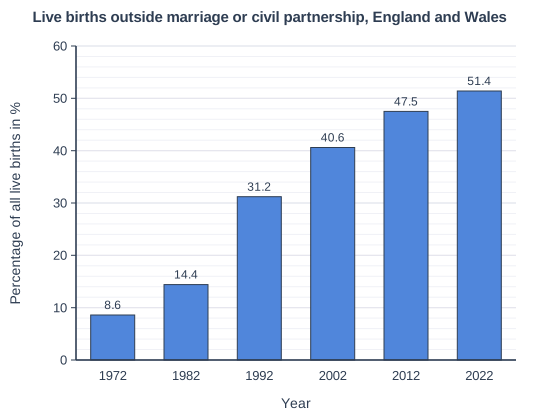
The bar chart in Item B shows the percentage of all live births in England and Wales that were outside marriage or civil partnership, every ten years from 1972 to 2022.
Source: ONS, Births in England and Wales: summary tables, 2022 (Table 1).

Item B is an example of which type of statistical data? Describe the pattern it shows and explain one reason that may account for it.

Live births outside marriage or civil partnership, England and Wales. Bar chart of percentage of all live births in % for each year: 1972 8.6, 1982 14.4, 1992 31.2, 2002 40.6, 2012 47.5, 2022 51.4.

Model answer

Item B shows official statistics produced by the Office for National Statistics from birth registrations. The pattern is upward: the percentage of live births outside marriage or civil partnership rose from 8.6% in 1972 to 51.4% in 2022, so by 2022 more than half of all births were outside marriage. One reason is the growing acceptance of cohabitation. In the past, couples who lived together without marrying faced disapproval, and having a child outside marriage carried a strong stigma. Today cohabitation is seen by many as a normal alternative to marriage, partly because of secularisation and changing social attitudes, so many couples now have children while cohabiting and may marry later or not at all. Many of the births counted as outside marriage are therefore to stable couples living together rather than to lone parents.

Explanation

Full marks need the type of data (official statistics), the upward trend and one reason explained in detail. A common error is to describe the bar chart as the type of data, or to explain the rise in divorce without linking it to births outside marriage.

Mark scheme
  1. 4 marks

    Levels of response (4 marks). AO1 = 1 mark, AO2 = 3 marks. 'Context' here refers to the increase in the percentage of live births outside marriage or civil partnership in England and Wales between 1972 and 2022.
    Level 4 (4 marks): Relevant description of the data (AO1). Upward trend identified and an appropriate, detailed and well-developed explanation offered of sociological theories, concepts, evidence and methods with a good application to the context. (AO2)
    Level 3 (3 marks): Relevant description of the data (AO1). Upward trend identified with an explanation of sociological theories, concepts, evidence and methods containing some inaccuracies or omissions but which has some application to the context. (AO2)
    Level 2 (2 marks): Relevant description of the data (AO1). Upward trend identified with either no explanation or a largely inaccurate or irrelevant explanation of sociological theories, concepts, evidence and methods that is only weakly applied to the context. (AO2)
    Level 1 (1 mark): Relevant description of the data. (AO1)
    0 marks: Nothing worthy of credit.

    Indicative content AO1 (not exhaustive, credit other valid points): Official statistics (ONS data from birth registrations); accept 'government statistics', 'secondary data from the ONS' or 'interval data'. Do not accept 'quantitative data' alone or a description of the type of chart. Indicative content AO2: Trend: upward (accept rising, increasing), from 8.6% in 1972 to 51.4% in 2022, so by 2022 more than half of births were outside marriage or civil partnership; the fastest rise was between 1982 and 1992 (14.4% to 31.2%); reasons: growing acceptance of cohabitation, so many couples have children together without marrying; decline in the stigma attached to having children outside marriage (once called 'illegitimacy'); secularisation, with fewer people following religious teachings on marriage; the cost of weddings; women's greater financial independence, so marriage is less of an economic necessity and some women choose lone motherhood; rising divorce leading to new relationships and children with new partners; changing social attitudes and values. NB: an answer explaining a rise in divorce or in lone-parent families must link it to births outside marriage to be credited.

Question 4

12 marks

Discuss how far sociologists would agree that people in Britain today are free to choose the type of family they live in.

Model answer

The Rapoports would largely agree with this claim. They argued in 1982 that Britain no longer had a single accepted pattern of family life and that a variety of family types was becoming accepted. Since then, legal and social changes have widened people's choices. Divorce is easier to obtain, cohabitation is widely accepted and civil partnerships (from 2005) and same-sex marriage in England and Wales (from 2014) have given legal recognition to same-sex families. Secularisation has reduced the influence of religious rules about marriage, and the decline in stigma means that people can live alone, cohabit or have children outside marriage; in 2022 more than half of births in England and Wales were outside marriage or civil partnership. Such diversity suggests that people now choose the family that suits them.

However, many sociologists argue that this choice is limited by social structures. Social class and income are major constraints: the Rapoports themselves identified class diversity, as a family's class position affects the resources available to it. High housing costs mean that many young adults cannot afford to leave home; the ONS estimated that 3.6 million people aged 20 to 34 lived with their parents in 2024. Many lone-parent families are created by separation or bereavement rather than chosen, and lone parents often face financial pressures that limit their options.

Gender also shapes choice. Feminists argue that women's choices are limited by lower average pay, the cost of childcare and the expectation that they will do most domestic work, so a woman who would prefer a dual career family may find that it is not practical. Oakley argued that the idea of the conventional family exercised social control, encouraging people to conform, and although she saw signs that this was weakening, people who live differently may still feel judged.

Culture, religion and the law also limit choice. In some communities, strong cultural or religious expectations shape marriage and family life, which the Rapoports called cultural diversity, although there is variation within every group. The law still restricts some forms of family: polygamy, which is legal in some other societies, is illegal in the UK.

The New Right takes a different view, arguing that too much choice has weakened the family. Murray, for example, saw the growth of lone-parent families as harmful to children and society, although critics argue that this view stigmatises lone parents and ignores the role of poverty.

In conclusion, most sociologists would agree that people in Britain have much more freedom to choose their type of family than in the past, especially in law and in social attitudes. However, the evidence suggests that this freedom is unequal and constrained by class, gender, culture and economic circumstances, so people are only partly free to choose the type of family they live in.

Explanation

Top answers use the Rapoports and evidence of legal and attitude change to support the idea of choice, then evaluate it with constraints such as class, housing costs, gender and culture before reaching a judgement. Answers that simply list family types without asking whether they are chosen do not address the question.

Mark scheme
  1. 12 marks

    Levels of response (12 marks). AO1 = 4 marks, AO2 = 4 marks, AO3 = 4 marks. AQA's AO3 descriptor for each level opens the comments; judge AO1, AO2 and AO3 together (best fit).
    Level 4 (10-12 marks): Detailed knowledge and understanding of relevant theories, concepts, evidence and methods presented in a well-developed answer. A wide range of specialist terms used with precision. (AO1) Sustained application of relevant theories, concepts, evidence and methods to the issues raised by the question. Few if any inaccuracies or omissions. (AO2) AO3: see Level 4 in the comments.
    Level 3 (7-9 marks): Good evidence of relevant knowledge and understanding of theories, concepts, evidence and methods but elements lacking detail and development. A good range of specialist terms used appropriately. (AO1) Good application of relevant theories, concepts, evidence and methods to the issues raised by the question. Some inaccuracies or omissions. (AO2) AO3: see Level 3 in the comments.
    Level 2 (4-6 marks): Limited evidence of relevant knowledge and understanding of theories, concepts, evidence and methods. A limited range of specialist terms used appropriately. (AO1) Limited application of relevant theories, concepts, evidence and methods to the issues raised by the question. Significant inaccuracies or omissions. (AO2) AO3: see Level 2 in the comments.
    Level 1 (1-3 marks): Fragments of basic knowledge and understanding of theories, concepts, evidence and methods relevant to the topic. Specialist terms generally used inappropriately if at all. (AO1) Little or no application of relevant theories, concepts, evidence and methods to the issues raised by the question. (AO2) AO3: see Level 1 in the comments.
    0 marks: Nothing worthy of credit.

    AO3 descriptors (AQA): Level 4: Developed critical analysis and evaluation of relevant theories, concepts, evidence and methods. Well-constructed arguments with supported judgements and evidence-based conclusions. Level 3: Good evidence of analysis and evaluation of the relevant theories, concepts, evidence and methods. A logical argument, but judgements and conclusions may be indistinct and/or lacking in appropriate development. Level 2: Limited attempt at analysis and evaluation of the relevant theories, concepts, evidence and methods but lacking in appropriate development. There may be inconsistencies in the argument made and reasoning may be inaccurate leading to false or contradictory judgements and conclusions. Level 1: Little or no analysis of the relevant theories, concepts, evidence and methods, assertion rather than evaluation, poorly-constructed argument with little or no evidence of substantiated judgements and only cursory conclusions. AO1, AO2 and AO3 are regarded as interdependent. When deciding on a mark all should be considered together using the best fit approach. For example, a level 3 mark could be awarded for level 3 evidence across each objective, or a mixture of 4, 3 and 2 evidence across different objectives.
    Indicative content (not exhaustive; credit other relevant points): AO1: The Rapoports: Britain no longer has one accepted pattern of family life; diversity reflects choice and a plurality of accepted family types; changing social attitudes and secularisation (cohabitation, divorce, births outside marriage); legal changes (easier divorce, civil partnerships from 2005, same-sex marriage in England and Wales from 2014, joint adoption by same-sex couples); constraints: social class and income (the Rapoports' class diversity), housing costs, culture and religion (cultural diversity), gender and the position of women, life course (eg young adults living with parents, care of elderly relatives), the law (eg polygamy illegal), social pressure and the idea of the conventional family (Oakley); New Right views (eg Murray) that some family forms are harmful; functionalist and feminist views. AO2: Apply: people can now cohabit, marry, form civil partnerships, divorce, remarry, live alone or raise children in same-sex families with legal recognition; more than half of births in England and Wales are now outside marriage or civil partnership, showing that marriage is a choice rather than an expectation; however, choices are limited by money, eg 3.6 million people aged 20 to 34 lived with their parents in 2024 (ONS), often because of housing costs; lone parenthood is often the result of relationship breakdown or bereavement rather than a free choice; cultural and religious expectations shape family life in some communities; women's choices are shaped by childcare costs and pay; stigma and the conventional family ideal still pressure people to conform. AO3: Evaluate: the Rapoports' view of growing choice is supported by legal and attitude change, but structural constraints (class, gender, ethnicity, law) mean choice is unequal; feminists argue women's choices are limited by patriarchy and economic dependence; the New Right argue that choice has gone too far and harmed children; distinguish freedom in law from freedom in practice; consider whether diversity reflects choice or circumstances; evidence-based judgement and conclusion on how far people are free to choose their type of family. NB: Level 4 requires discussion of both evidence of choice and evidence of constraints on choice.

Ready to try the rest? Every answer you write is marked against the mark scheme, so you can see exactly where the marks are.

Study Helper Hints first, answers after you try

Stuck on this one? Ask for a hint and I’ll point you in the right direction, without giving the answer away. Once you’ve checked your answer, I’ll show you how the marks are awarded.