Level:
Correct: 0
Incorrect: 0
Marks: 0/0
Exam Practice
Course:
Topics:
AQA GCSE Sociology (Paper 1) Smart practice A mixed round aimed at your weak spots
Unit 1
The sociological approach
The sociological approach; social structures, social processes and social issues
The sociological approach: socialisation and culture
Unit 2
Families
Functions of families
Family forms
Family forms
Conjugal role relationships
Changing relationships within families
Criticisms of families
Divorce
Divorce
Unit 3
Education
Unit 4
Sociological research methods
Avg
score:
–
Topics
done:
0/14

Roles and functions of education

Practise 35 exam-style questions on Roles and functions of education for AQA GCSE Sociology (Paper 1). Write your answer as you would in the exam and get it marked in seconds against the mark scheme, point by point, with the Study Helper on hand if you get stuck.

  • 35 questions
  • 1–12 marks each
  • Instant marking
  • No sign-up needed
20 questions, marked as you go

Sample questions with model answers

Here are 4 of the questions in this topic, each with a model answer, an explanation of why it earns the marks and the mark scheme an examiner would use.

Question 1

1 mark

What term is commonly used by sociologists to describe the system of state secondary education in which pupils were allocated by the eleven plus to grammar, secondary technical or secondary modern schools?

Choose your answer.

  • Compulsory state education
  • Inclusion (in education)
  • Marketization of education
  • Tripartite system

Model answer

Tripartite system

Explanation

The tripartite system followed the 1944 Education Act and was largely replaced by comprehensive schools in the 1960s and 1970s. It matters in debates about meritocracy because critics questioned whether a single test at the age of 11 could fairly sort children by ability.

Mark scheme
  1. 1 mark

    Tripartite system

    If more than one option is given, 0 marks.

Question 2

3 marks

Identify and describe one difference between state schools and private schools in the UK.

Model answer

One difference is how they are funded. State schools, such as comprehensives and academies, are paid for by the government out of taxation, so they are free for all children to attend. Private (independent) schools charge fees, so they are attended mainly by children from wealthier families. This matters sociologically because a family's income, rather than only a child's ability, can buy smaller classes and better facilities, which Marxists see as a way of passing on class advantage.

Explanation

A Level 3 answer identifies one clear difference and describes it accurately, ideally with a sociological point about why it matters. Many students confuse 'public schools', which in the UK are fee-paying, with state schools.

Mark scheme
  1. 3 marks

    Levels of response (3 marks). AO1 = 3 marks.
    Level 3 (3 marks): A coherent description with few inaccuracies. Demonstrates good knowledge and understanding of relevant sociological theories, concepts, evidence and methods. (AO1)
    Level 2 (2 marks): A partial description based on a mix of relevant and irrelevant material with some inaccuracies and omissions. Demonstrates some knowledge and understanding of relevant sociological theories, concepts, evidence and methods. (AO1)
    Level 1 (1 mark): Fragments of knowledge, some inaccurate or irrelevant. Demonstrates limited understanding of relevant sociological theories, concepts, evidence and methods. (AO1)
    0 marks: Nothing worthy of credit.

    Indicative content (AO1; not exhaustive, credit other valid points): Funding: state schools are funded by the government through taxation and are free to attend, while private (independent, fee-paying) schools charge fees; curriculum: local-authority-maintained schools must follow the national curriculum, while private schools do not have to (credit accurate reference to academies and free schools also having freedom); admissions: most state secondary schools are non-selective comprehensives or academies serving a local area, while private schools can select by ability or interview as well as ability to pay; resources: private schools often have smaller classes and more facilities, which sociologists link to higher results and access to elite universities and jobs; intake: private school pupils come mainly from wealthier families, which Marxists see as reproducing class advantage; inspection: state schools are inspected by Ofsted, private schools by Ofsted or the Independent Schools Inspectorate. NB: In the UK 'public schools' are old, prestigious fee-paying schools, not state schools; do not credit answers that confuse the two. Do not credit the claim that private schools are not inspected, or 'private schools are better' without explanation.

Question 3

4 marks

Item C
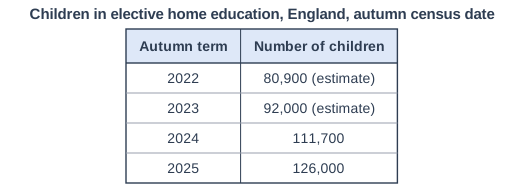
The table in Item C shows the number of children in England recorded by local authorities as electively home educated (educated at home by their parents instead of at school) on the census date in the autumn term of each year. The Department for Education first collected these figures in autumn 2022. Sending in the data became compulsory for local authorities in autumn 2024; the 2022 and 2023 figures are estimates that allow for local authorities that did not respond.
Source: Department for Education, Elective home education statistics, autumn term releases 2023/24, 2024/25 and 2025/26.

Using Item C, identify what kind of statistical data the table contains and the trend it shows, and explain one reason for this trend.

Children in elective home education, England, autumn census date. Table with columns "Autumn term", "Number of children". Autumn term: 2022; Number of children: 80,900 (estimate) | Autumn term: 2023; Number of children: 92,000 (estimate) | Autumn term: 2024; Number of children: 111,700 | Autumn term: 2025; Number of children: 126,000.

Model answer

Item C contains official statistics: secondary, quantitative data collected by the Department for Education from local authorities. The trend is upward: the number of children in elective home education on the autumn census date rose every year, from an estimated 80,900 in 2022 to 126,000 in 2025, an increase of about 56%. One reason may be growing dissatisfaction with how some schools meet children's needs, especially mental health and special educational needs. If a child is anxious at school, or a family feels their child's needs are not being supported, parents may decide that education at home is better. Pressure on schools to raise results and attendance in a competitive system may add to this. However, part of the rise may simply reflect better recording, because local authorities had to send in the data from 2024.

Explanation

Top answers name the type of data precisely (official, quantitative, secondary statistics), state the upward trend using figures from the table and explain one reason applied to home education. Listing several reasons without developing any keeps an answer in the lower levels, and it is worth knowing that a new data collection can show a rise partly because counting improves.

Mark scheme
  1. 4 marks

    Levels of response (4 marks). AO1 = 1 mark, AO2 = 3 marks. 'Context' here refers to the trend in the number of children in elective home education in England shown in Item C.
    Level 4 (4 marks): Relevant description of the data (AO1). Upward trend identified and an appropriate, detailed and well-developed explanation offered of sociological theories, concepts, evidence and methods with a good application to the context. (AO2)
    Level 3 (3 marks): Relevant description of the data (AO1). Upward trend identified with an explanation of sociological theories, concepts, evidence and methods containing some inaccuracies or omissions but which has some application to the context. (AO2)
    Level 2 (2 marks): Relevant description of the data (AO1). Upward trend identified with either no explanation or a largely inaccurate or irrelevant explanation of sociological theories, concepts, evidence and methods that is only weakly applied to the context. (AO2)
    Level 1 (1 mark): Relevant description of the data. (AO1)
    0 marks: Nothing worthy of credit.

    Indicative content AO1 (not exhaustive, credit other valid points): Official statistics: secondary, quantitative data collected by the Department for Education (government) from local authorities; the number of children in elective home education on the autumn census date, 2022 to 2025. Accept interval data. Do not credit 'quantitative data' alone (all statistics are quantitative) or a description of the table. Upward trend: the number rose every year, from an estimated 80,900 in 2022 to 126,000 in 2025 (an increase of 45,100, or about 56%). Indicative content AO2: One factor explained and applied, eg dissatisfaction with how schools meet some children's needs, such as mental health (anxiety) or special educational needs, leading parents to withdraw them; parents wanting to decide what and how their child learns for philosophical, religious or educational reasons (credit links to de-schooling); the experience of learning at home during the Covid-19 school closures showing some families that home education was possible; pressure on schools in a competitive, marketised system to raise results and attendance, so some children may not feel they fit in or some families may be encouraged to leave; growth of online resources and support groups making home education easier; better recording since the collection began in 2022 and became compulsory in 2024, so part of the rise may reflect more complete counting (credit as a valid explanation if developed). NB: For Level 3 or 4 the explanation must be linked to the rise in home education shown in the item; a reason for home education that is not linked to an increase is weakly applied. Reading the trend as falling earns no trend credit.

Question 4

12 marks

Discuss how far sociologists would agree that schools in Britain today operate on meritocratic principles.

Model answer

Functionalists argue that schools in Britain today are largely meritocratic. Parsons claimed that schools operate on meritocratic principles: in the family a child is judged by particularistic standards, but at school every pupil is judged by the same universalistic standards, so status is achieved through ability and effort rather than ascribed at birth. Schools socialise pupils into a value consensus based on achievement and equality of opportunity, and Davis and Moore add that schools sift and sort pupils so that the most able fill the functionally important roles. Supporters can point to free compulsory state education, national exams that every pupil sits, and the fact that girls and some ethnic minority groups, such as Chinese and Indian pupils, now achieve highly. This suggests that groups once held back can succeed when the rules are the same for all.

However, Marxists reject this view. Bowles and Gintis argue that meritocracy is a myth and that class background is the most important factor influencing attainment. Official statistics support this: in England in 2022/23, pupils eligible for free school meals had an average Attainment 8 score of 34.8, compared with 49.6 for other pupils. Halsey, Heath and Ridge found that a boy from the service class was eleven times more likely to go to university than one from the working class. Bourdieu's idea of cultural capital helps explain this: middle-class children arrive at school with the language, knowledge and attitudes that schools reward, so what looks like merit is partly inherited advantage. Wealthier parents can also buy advantage through private schools, tutoring or homes near high-achieving state schools, and Ball, Bowe and Gewirtz found that middle-class parents were the most skilled at using parental choice. For Marxists, the belief in meritocracy serves capitalism because it persuades those who fail that they have only themselves to blame.

Feminists add that although girls now outperform boys at GCSE, gendered subject choices and the glass ceiling mean that girls' merit is not rewarded equally later in life. Interactionists argue that processes inside schools, such as labelling and setting, can shape results, so pupils of similar ability may achieve differently.

The functionalist view can therefore be criticised for assuming that pupils start with equal chances: formal equality inside the school does not cancel out inequality outside it. On the other hand, the Marxist view can be criticised as deterministic, as many working-class pupils do succeed and education remains a major route to upward mobility.

Overall, most sociologists would agree only to a limited extent. Schools are meritocratic in their formal rules, because all pupils sit the same exams, but persistent class differences, and the advantages that wealthier families can buy, suggest that outcomes still depend heavily on social background. The functionalist claim describes an ideal more than the reality.

Explanation

Level 4 answers set Parsons' functionalist view against at least one alternative, support both sides with evidence such as official statistics or named studies, and reach a judgement on how far schools are meritocratic. Weaker answers describe differences in achievement without linking them to the idea of meritocracy, or end without a conclusion.

Mark scheme
  1. 12 marks

    Levels of response (12 marks). AO1 = 4 marks, AO2 = 4 marks, AO3 = 4 marks. AQA's AO3 descriptor for each level opens the comments; judge AO1, AO2 and AO3 together (best fit).
    Level 4 (10-12 marks): Detailed knowledge and understanding of relevant theories, concepts, evidence and methods presented in a well-developed answer. A wide range of specialist terms used with precision. (AO1) Sustained application of relevant theories, concepts, evidence and methods to the issues raised by the question. Few if any inaccuracies or omissions. (AO2) AO3: see Level 4 in the comments.
    Level 3 (7-9 marks): Good evidence of relevant knowledge and understanding of theories, concepts, evidence and methods but elements lacking detail and development. A good range of specialist terms used appropriately. (AO1) Good application of relevant theories, concepts, evidence and methods to the issues raised by the question. Some inaccuracies or omissions. (AO2) AO3: see Level 3 in the comments.
    Level 2 (4-6 marks): Limited evidence of relevant knowledge and understanding of theories, concepts, evidence and methods. A limited range of specialist terms used appropriately. (AO1) Limited application of relevant theories, concepts, evidence and methods to the issues raised by the question. Significant inaccuracies or omissions. (AO2) AO3: see Level 2 in the comments.
    Level 1 (1-3 marks): Fragments of basic knowledge and understanding of theories, concepts, evidence and methods relevant to the topic. Specialist terms generally used inappropriately if at all. (AO1) Little or no application of relevant theories, concepts, evidence and methods to the issues raised by the question. (AO2) AO3: see Level 1 in the comments.
    0 marks: Nothing worthy of credit.

    AO3 descriptors (AQA): Level 4: Developed critical analysis and evaluation of relevant theories, concepts, evidence and methods. Well-constructed arguments with supported judgements and evidence-based conclusions. Level 3: Good evidence of analysis and evaluation of the relevant theories, concepts, evidence and methods. A logical argument, but judgements and conclusions may be indistinct and/or lacking in appropriate development. Level 2: Limited attempt at analysis and evaluation of the relevant theories, concepts, evidence and methods but lacking in appropriate development. There may be inconsistencies in the argument made and reasoning may be inaccurate leading to false or contradictory judgements and conclusions. Level 1: Little or no analysis of the relevant theories, concepts, evidence and methods, assertion rather than evaluation, poorly-constructed argument with little or no evidence of substantiated judgements and only cursory conclusions. AO1, AO2 and AO3 are regarded as interdependent. When deciding on a mark all should be considered together using the best fit approach. For example, a level 3 mark could be awarded for level 3 evidence across each objective, or a mixture of 4, 3 and 2 evidence across different objectives.
    Indicative content (not exhaustive; credit other relevant points): AO1: Functionalism: Parsons (achieved status, universalistic standards, meritocratic principles, value consensus); Davis and Moore (role allocation, functionally important roles); Marxism: Bowles and Gintis (myth of meritocracy, class background); feminism; interactionism; key terms, eg meritocracy, achieved status, cultural capital, material deprivation, social mobility; evidence on class, gender and ethnic differences in achievement; Halsey, Heath and Ridge. AO2: Parsons: schools judge all pupils by universal standards and status is achieved on merit; supporting evidence, eg free compulsory state education, national exams, comprehensive schools, girls' and some ethnic minority groups' high achievement; Bowles and Gintis: class background is the most important factor in attainment and belief in meritocracy legitimates inequality; DfE data for England 2022/23 show an average Attainment 8 score of 34.8 for pupils eligible for free school meals compared with 49.6 for other pupils; Halsey, Heath and Ridge on large class inequalities in staying on and university entry; private schools, tutoring and house prices buy advantage; cultural capital (Bourdieu) and parental choice (Ball, Bowe and Gewirtz) favour the middle class; feminists: gendered subject choices and the glass ceiling; interactionists: labelling and setting shape results; ethnic differences linked to racism or an ethnocentric curriculum. AO3: Evaluation of functionalism, eg assumes equal starting points and a value consensus, ignores inequality outside school; evaluation of Marxism, eg deterministic, overlooks working-class success and upward mobility; formal equality (the same exams) versus unequal outcomes; in-school versus out-of-school influences; evidence-based judgement and conclusion on how far schools operate on meritocratic principles. NB: Level 4: there must be some detailed discussion of the functionalist view and of at least one alternative view (eg Marxist or feminist), supported by evidence, with a clear judgement on 'how far'. Answers that only describe differences in achievement without linking them to meritocracy can reach Level 2 at most.

Ready to try the rest? Every answer you write is marked against the mark scheme, so you can see exactly where the marks are.

Study Helper Hints first, answers after you try

Stuck on this one? Ask for a hint and I’ll point you in the right direction, without giving the answer away. Once you’ve checked your answer, I’ll show you how the marks are awarded.