Level:
Correct: 0
Incorrect: 0
Marks: 0/0
Exam Practice
Course:
Topics:
AQA GCSE Sociology (Paper 1) Smart practice A mixed round aimed at your weak spots
Unit 1
The sociological approach
The sociological approach; social structures, social processes and social issues
The sociological approach: socialisation and culture
Unit 2
Families
Functions of families
Family forms
Family forms
Conjugal role relationships
Changing relationships within families
Criticisms of families
Divorce
Divorce
Unit 3
Education
Unit 4
Sociological research methods
Avg
score:
–
Topics
done:
0/14

Educational achievement: social class

Practise 34 exam-style questions on Educational achievement: social class for AQA GCSE Sociology (Paper 1). Write your answer as you would in the exam and get it marked in seconds against the mark scheme, point by point, with the Study Helper on hand if you get stuck.

  • 34 questions
  • 1–12 marks each
  • Instant marking
  • No sign-up needed
20 questions, marked as you go

Sample questions with model answers

Here are 4 of the questions in this topic, each with a model answer, an explanation of why it earns the marks and the mark scheme an examiner would use.

Question 1

1 mark

What term is commonly used by sociologists to describe the level of success a pupil reaches in education, usually measured by their qualifications and exam results?

Choose your answer.

  • Achievement (in education)
  • Inclusion (in education)
  • Life chances
  • Social mobility

Model answer

Achievement (in education)

Explanation

Educational achievement is what sociologists compare when they study class, gender and ethnic differences, often using official statistics on exam results. Social mobility and life chances may follow from achievement but are not the same thing.

Mark scheme
  1. 1 mark

    Achievement (in education)

    Accept 'educational achievement' or 'attainment'. If more than one option is given, 0 marks.

Question 2

3 marks

Describe Bernstein's distinction between the restricted code and the elaborated code.

Model answer

Bernstein distinguished two forms of speech. The restricted code is context-bound: speakers rely on shared understanding, so meanings are not spelled out and sentences tend to be short and simple. In his account this was typical of working-class speech. The elaborated code is context-independent: meanings are made explicit, with wider vocabulary and more complex sentences, and it was typical of the middle class. Because teachers, textbooks and exams use the elaborated code, middle-class pupils are at an advantage at school.

Explanation

Full marks need both codes described accurately and a link to educational achievement, such as schools using the elaborated code. Avoid suggesting that working-class speech is simply 'wrong': Bernstein saw the restricted code as useful in everyday life.

Mark scheme
  1. 3 marks

    Levels of response (3 marks). AO1 = 3 marks.
    Level 3 (3 marks): A coherent description with few inaccuracies. Demonstrates good knowledge and understanding of relevant sociological theories, concepts, evidence and methods. (AO1)
    Level 2 (2 marks): A partial description based on a mix of relevant and irrelevant material with some inaccuracies and omissions. Demonstrates some knowledge and understanding of relevant sociological theories, concepts, evidence and methods. (AO1)
    Level 1 (1 mark): Fragments of knowledge, some inaccurate or irrelevant. Demonstrates limited understanding of relevant sociological theories, concepts, evidence and methods. (AO1)
    0 marks: Nothing worthy of credit.

    Indicative content (AO1; not exhaustive, credit other valid points): Restricted code: speech that is context-bound, with particularistic meanings that rely on shared understanding, shorter and simpler sentences, more description than explanation; in Bernstein's account typical of working-class speech; elaborated code: speech that is context-independent, with universalistic meanings made explicit, more complex vocabulary and sentences, used by the middle class; schools, teachers, textbooks and exams use the elaborated code, so middle-class pupils are advantaged and working-class pupils may struggle to understand or be judged less able; both codes are useful in everyday life, but school success requires the elaborated code. NB: Credit an accurate description of both codes; a description of one code only can reach Level 2 at most. Do not credit 'working-class people cannot speak properly'.

Question 3

4 marks

Item C
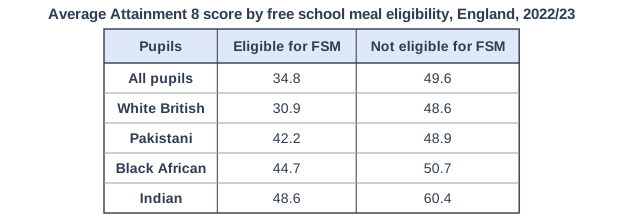
The table in Item C shows the average Attainment 8 score (a measure of GCSE results, out of 90) of pupils in state-funded schools in England in 2022/23, by whether or not they were eligible for free school meals (FSM). Pupils are eligible for free school meals if their parents receive certain benefits, which usually means the family has a low income. Figures are given for all pupils and for four ethnic groups.
Source: Department for Education, Key stage 4 performance 2022/23, published in GOV.UK Ethnicity facts and figures, GCSE results (Attainment 8), 2024.

Identify and explain one material factor that may account for the differences between pupils eligible and not eligible for free school meals shown in Item C.

Average Attainment 8 score by free school meal eligibility, England, 2022/23. Table with columns "Pupils", "Eligible for FSM", "Not eligible for FSM". Pupils: All pupils; Eligible for FSM: 34.8; Not eligible for FSM: 49.6 | Pupils: White British; Eligible for FSM: 30.9; Not eligible for FSM: 48.6 | Pupils: Pakistani; Eligible for FSM: 42.2; Not eligible for FSM: 48.9 | Pupils: Black African; Eligible for FSM: 44.7; Not eligible for FSM: 50.7 | Pupils: Indian; Eligible for FSM: 48.6; Not eligible for FSM: 60.4.

Model answer

One material factor is overcrowded or poor-quality housing. Item C shows that in 2022/23 pupils eligible for free school meals had an average Attainment 8 score of 34.8, compared with 49.6 for other pupils, and that FSM pupils scored lower in every group shown. Because free school meal eligibility is linked to low household income, these pupils are more likely to live in overcrowded homes, perhaps sharing a bedroom with siblings, without a quiet space to do homework or revise. Cold or damp housing can also lead to illness and missed school days. Over time, this lost study time and absence can lower GCSE results. Wealthier families, by contrast, can provide a desk, a computer and a quiet room, giving their children a material advantage.

Explanation

Top answers choose one material factor, explain how it affects achievement and use the figures in Item C. Answers that give a cultural factor, such as parents' attitudes, do not answer this question about material factors, and both low income and achievement must be linked for full marks.

Mark scheme
  1. 4 marks

    Levels of response (4 marks). AO1 = 1 mark, AO2 = 3 marks. 'Context' here refers to material factors that may account for the lower average achievement of pupils eligible for free school meals shown in Item C.
    Level 4 (4 marks): Relevant factor identified (AO1) and an appropriate, detailed and well-developed explanation of relevant sociological theories, concepts, evidence and methods offered with a good application to the context. (AO2)
    Level 3 (3 marks): Relevant factor identified (AO1) with an explanation of relevant sociological theories, concepts, evidence and methods containing some inaccuracies or omissions but which has some application to the context. (AO2)
    Level 2 (2 marks): Relevant factor identified (AO1) with a largely inaccurate or irrelevant explanation of relevant sociological theories, concepts, evidence and methods that is only weakly applied to the context. (AO2)
    Level 1 (1 mark): Relevant factor identified. (AO1)
    0 marks: Nothing worthy of credit.

    Indicative content AO1 (not exhaustive, credit other valid points): Poor or overcrowded housing; lack of a quiet study space, books, computers or internet access; poor diet and health leading to absence; the hidden costs of education, eg uniform, trips, equipment; young people needing part-time jobs or caring roles; stress in families on low incomes; inability to pay for tuition or to live in the catchment area of high-achieving schools. Indicative content AO2: Item C shows that in 2022/23 pupils eligible for free school meals had an average Attainment 8 score of 34.8, compared with 49.6 for other pupils, a gap of 14.8 points, and that FSM pupils scored lower in every group shown; free school meal eligibility indicates low household income, so material deprivation is a likely explanation: overcrowded housing makes homework and revision hard; families may not afford a computer, internet access or books; poor diet and cold or damp housing can affect health and attendance; hidden costs such as uniform and trips can lead to embarrassment or missed opportunities; wealthier families can buy tuition and resources; credit links to Marxist views of inequality in capitalist society; credit recognition that the gap varies between groups, eg 17.7 points for White British pupils compared with 6.7 for Pakistani pupils, suggesting material factors interact with others. NB: Both low income (material factors) and educational achievement are needed for 4 marks; a cultural factor is not credited as a material factor.

Question 4

12 marks

Discuss how far sociologists would agree that material deprivation is the main reason for working-class underachievement.

Model answer

Material deprivation means a lack of money and of the physical resources that money buys, and many sociologists see it as a major cause of working-class underachievement. Official statistics show a clear link between low income and lower achievement: in England in 2022/23 pupils eligible for free school meals, which depends on low family income, had an average Attainment 8 score of 34.8, compared with 49.6 for other pupils. Poverty can affect learning in many ways. Overcrowded housing may leave no quiet space for homework; families may not afford a computer, internet access or books; poor diet and cold, damp homes can lead to illness and absence; and the hidden costs of uniform, equipment and trips can leave pupils embarrassed or excluded. Some young people take part-time jobs, leaving less time for study. Meanwhile, wealthier families can buy private tuition, private schooling or homes near high-achieving schools. Marxists see these inequalities as a product of capitalism, which the education system then reproduces.

However, material deprivation cannot be the whole explanation. The same statistics show that the gap between FSM and other pupils varies greatly: it is 17.7 points among White British pupils but only 6.5 among Bangladeshi pupils, and Bangladeshi pupils eligible for free school meals averaged 47.7, well above White British FSM pupils at 30.9. If low income were the main cause, such differences would be hard to explain. Cultural deprivation theorists argue that values and attitudes matter, such as parents' interest in education and a willingness to defer gratification, and Bernstein suggested that schools use the elaborated code, which middle-class children are more familiar with. Bourdieu argues that the problem is not that working-class culture is deficient but that schools reward middle-class cultural capital. Inside schools, labelling and setting may also hold working-class pupils back, and Ball, Bowe and Gewirtz showed that parental choice and league tables led some schools to focus on the more able, who are more often middle class.

These explanations are not completely separate. Cultural deprivation theory can be criticised for blaming working-class families when their attitudes may themselves reflect material pressures, and Bourdieu shows how economic capital can be converted into cultural capital, for example by paying for music lessons or trips. Free school meal eligibility also measures low income rather than social class, so the statistics may exaggerate or hide some class effects.

Overall, sociologists would agree only to some extent. Material deprivation is a powerful influence, as the large gap between FSM and other pupils shows, but the variation between groups and the evidence on cultural capital and school processes suggest that it works alongside cultural and in-school factors, so it is best seen as one of several main reasons rather than the single main one.

Explanation

Level 4 answers explain material deprivation with specific examples and evidence, then weigh it against cultural and in-school explanations, recognising how the factors interact, before reaching a judgement. Weaker answers list factors without evaluating which matters most, or confuse material and cultural deprivation, a common confusion.

Mark scheme
  1. 12 marks

    Levels of response (12 marks). AO1 = 4 marks, AO2 = 4 marks, AO3 = 4 marks. AQA's AO3 descriptor for each level opens the comments; judge AO1, AO2 and AO3 together (best fit).
    Level 4 (10-12 marks): Detailed knowledge and understanding of relevant theories, concepts, evidence and methods presented in a well-developed answer. A wide range of specialist terms used with precision. (AO1) Sustained application of relevant theories, concepts, evidence and methods to the issues raised by the question. Few if any inaccuracies or omissions. (AO2) AO3: see Level 4 in the comments.
    Level 3 (7-9 marks): Good evidence of relevant knowledge and understanding of theories, concepts, evidence and methods but elements lacking detail and development. A good range of specialist terms used appropriately. (AO1) Good application of relevant theories, concepts, evidence and methods to the issues raised by the question. Some inaccuracies or omissions. (AO2) AO3: see Level 3 in the comments.
    Level 2 (4-6 marks): Limited evidence of relevant knowledge and understanding of theories, concepts, evidence and methods. A limited range of specialist terms used appropriately. (AO1) Limited application of relevant theories, concepts, evidence and methods to the issues raised by the question. Significant inaccuracies or omissions. (AO2) AO3: see Level 2 in the comments.
    Level 1 (1-3 marks): Fragments of basic knowledge and understanding of theories, concepts, evidence and methods relevant to the topic. Specialist terms generally used inappropriately if at all. (AO1) Little or no application of relevant theories, concepts, evidence and methods to the issues raised by the question. (AO2) AO3: see Level 1 in the comments.
    0 marks: Nothing worthy of credit.

    AO3 descriptors (AQA): Level 4: Developed critical analysis and evaluation of relevant theories, concepts, evidence and methods. Well-constructed arguments with supported judgements and evidence-based conclusions. Level 3: Good evidence of analysis and evaluation of the relevant theories, concepts, evidence and methods. A logical argument, but judgements and conclusions may be indistinct and/or lacking in appropriate development. Level 2: Limited attempt at analysis and evaluation of the relevant theories, concepts, evidence and methods but lacking in appropriate development. There may be inconsistencies in the argument made and reasoning may be inaccurate leading to false or contradictory judgements and conclusions. Level 1: Little or no analysis of the relevant theories, concepts, evidence and methods, assertion rather than evaluation, poorly-constructed argument with little or no evidence of substantiated judgements and only cursory conclusions. AO1, AO2 and AO3 are regarded as interdependent. When deciding on a mark all should be considered together using the best fit approach. For example, a level 3 mark could be awarded for level 3 evidence across each objective, or a mixture of 4, 3 and 2 evidence across different objectives.
    Indicative content (not exhaustive; credit other relevant points): AO1: Material deprivation (housing, diet, health, resources, hidden costs, part-time work); cultural deprivation (parental attitudes, immediate gratification, language: Bernstein); cultural capital (Bourdieu); in-school factors (labelling, setting); marketisation and parental choice (Ball, Bowe and Gewirtz); perspectives: Marxist, functionalist, feminist, interactionist; evidence, eg DfE free school meal data, Halsey, Heath and Ridge. AO2: Pupils eligible for free school meals (low income) averaged 34.8 in Attainment 8 in England in 2022/23 compared with 49.6 for other pupils; poverty can mean overcrowded housing with no study space, poor diet and health, lack of computers or internet, hidden costs of uniform and trips, and young people taking part-time jobs; wealthier families buy tuition, private schooling and homes near high-achieving schools; Marxists link this to inequality in capitalist society; against: the size of the FSM gap varies widely between groups, eg 17.7 points among White British pupils but 6.5 among Bangladeshi pupils, and Bangladeshi FSM pupils (47.7) outscore White British FSM pupils (30.9), suggesting cultural and other factors matter; cultural deprivation theorists stress parental attitudes and values; Bernstein's codes; Bourdieu: schools reward middle-class cultural capital; in-school factors such as labelling and setting affect working-class pupils; marketisation advantages middle-class 'skilled choosers'; feminists: class interacts with gender. AO3: Evaluation of material explanations (FSM measures income not class; the poorest are not all working class); evaluation of cultural deprivation (blames families; may reflect material constraints); material and cultural factors interact (economic capital converted into cultural capital); in-school versus out-of-school factors; evidence-based judgement and conclusion on how far material deprivation is the main reason. NB: Level 4: there must be some detailed discussion of material deprivation and of at least one alternative explanation (eg cultural factors or in-school factors), with a clear judgement on 'how far'.

Ready to try the rest? Every answer you write is marked against the mark scheme, so you can see exactly where the marks are.

Study Helper Hints first, answers after you try

Stuck on this one? Ask for a hint and I’ll point you in the right direction, without giving the answer away. Once you’ve checked your answer, I’ll show you how the marks are awarded.