Level:
Correct: 0
Incorrect: 0
Marks: 0/0
Exam Practice
Course:
Topics:
AQA GCSE Sociology (Paper 2) Smart practice A mixed round aimed at your weak spots
Unit 1
The sociological approach
Unit 2
Crime and deviance
Unit 3
Social stratification
Functionalist theory of stratification
Socio-economic class
Life chances
Life chances
Poverty as a social issue
Power and authority
Power and authority
Power relationships
Power relationships
Unit 4
Sociological research methods
Avg
score:
–
Topics
done:
0/14

Social control

Practise 32 exam-style questions on Social control for AQA GCSE Sociology (Paper 2). Write your answer as you would in the exam and get it marked in seconds against the mark scheme, point by point, with the Study Helper on hand if you get stuck.

  • 32 questions
  • 1–12 marks each
  • Instant marking
  • No sign-up needed
20 questions, marked as you go

Sample questions with model answers

Here are 4 of the questions in this topic, each with a model answer, an explanation of why it earns the marks and the mark scheme an examiner would use.

Question 1

1 mark

What term is commonly used by sociologists to describe the body that makes the laws of a country, such as Parliament in the UK?

Choose your answer.

  • Criminal justice system
  • Legislature
  • Pressure group
  • Prison system

Model answer

Legislature

Explanation

The legislature is the law-making body, which in the UK is Parliament. The criminal justice system enforces and applies the law through the police, courts, prisons and probation, but it does not make it. Do not confuse the legislature with the judiciary, the judges who interpret the law in court.

Mark scheme
  1. 1 mark

    Legislature

    If more than one option is given, 0 marks.

Question 2

3 marks

Describe one method used by the criminal justice system to control people's behaviour.

Model answer

One method is the use of formal sanctions by the courts. When someone is found guilty of a crime, magistrates or judges can impose a punishment set out in law, such as a fine, a community order that involves unpaid work, or a prison sentence. These sanctions punish the offender and are meant to deter both the offender and other people from breaking the law in future, because everyone knows the penalties that can follow. A prison sentence also controls behaviour directly by removing the offender from society.

Explanation

Full marks need a specific method, such as police powers of arrest or the courts' formal sanctions, and a description of how it makes people conform, for example through punishment or deterrence. Naming an agency without describing a method is Level 1. Informal methods of social control do not answer this question.

Mark scheme
  1. 3 marks

    Levels of response (3 marks). AO1 = 3 marks.
    Level 3 (3 marks): A coherent description with few inaccuracies. Demonstrates good knowledge and understanding of relevant sociological theories, concepts, evidence and methods. (AO1)
    Level 2 (2 marks): A partial description based on a mix of relevant and irrelevant material with some inaccuracies and omissions. Demonstrates some knowledge and understanding of relevant sociological theories, concepts, evidence and methods. (AO1)
    Level 1 (1 mark): Fragments of knowledge, some inaccurate or irrelevant. Demonstrates limited understanding of relevant sociological theories, concepts, evidence and methods. (AO1)
    0 marks: Nothing worthy of credit.

    Indicative content (AO1; not exhaustive, credit other valid points): Police powers: stop and search, arrest, police cautions and charging suspects, with the power to use reasonable force; police patrols and presence as a deterrent; the courts, judiciary and magistrates: deciding guilt and imposing formal sanctions such as fines, community orders (eg unpaid work) or prison sentences; the prison system: removing offenders from society, punishment, deterrence and rehabilitation; the probation service: supervising offenders in the community and on licence after release, with the power to recall them to prison; curfews and electronic tagging; the description should show control through official laws, legal powers or formal sanctions. NB: Level 3 needs a method used by an agency of the criminal justice system and a description of how it controls behaviour. Informal methods such as gossip or parental disapproval do not answer the question.

Question 3

4 marks

Item C
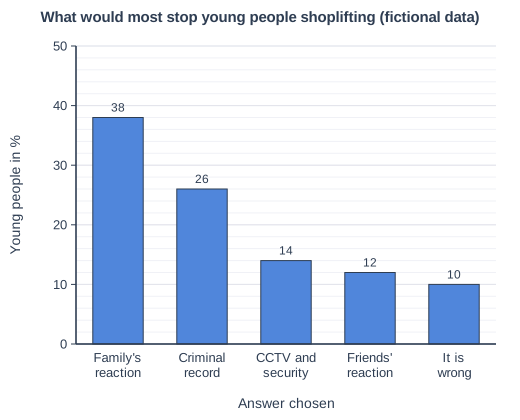
A researcher gave a paper questionnaire to 450 young people aged 13-17 who attended 12 youth clubs in one English county (fictional study). The young people filled it in at their club and did not write their names. Each was asked to choose the one thing that would most stop them from shoplifting, from five answers: what my family would think; getting a criminal record; CCTV and security staff in shops; what my friends would think; and 'shoplifting is wrong'. The bar chart in Item C shows the percentage of young people choosing each answer (fictional data).

Identify and explain one reason why many of the young people in Item C may be more strongly influenced by informal social control than by formal social control.

What would most stop young people shoplifting (fictional data). Bar chart of young people in % for each answer chosen: Family's reaction 38, Criminal record 26, CCTV and security 14, Friends' reaction 12, It is wrong 10.

Model answer

One reason is that young people have strong emotional ties to their families, so the fear of disappointing them is a powerful informal sanction. Item C shows that 'what my family would think' was the most common answer, chosen by 38% of the young people, and that answers about family or friends together made up 50%, compared with 40% for a criminal record or CCTV and security staff. Hirschi's control theory suggests that attachment to parents is one of the main bonds that keeps young people from offending, because they care about their parents' opinion. Family reactions are also certain and personal, whereas many young people may think the chance of being caught by security staff or the police is low, so formal sanctions feel more distant.

Explanation

Level 4 answers identify a reason, such as attachment to the family or the certainty of informal sanctions, explain it sociologically and use the data in Item C, for example comparing the 50% who chose family or friends with the 40% who chose formal controls. Answers that only describe the chart, without a reason, are limited. Linking the explanation to a theory such as control theory shows depth.

Mark scheme
  1. 4 marks

    Levels of response (4 marks). AO1 = 1 mark, AO2 = 3 marks. 'Context' here refers to the influence of informal and formal social control on young people's decisions about shoplifting, as shown in Item C.
    Level 4 (4 marks): Relevant reason identified (AO1) and an appropriate, detailed and well-developed explanation of relevant sociological theories, concepts, evidence and methods offered with a good application to the context. (AO2)
    Level 3 (3 marks): Relevant reason identified (AO1) with an explanation of relevant sociological theories, concepts, evidence and methods containing some inaccuracies or omissions but which has some application to the context. (AO2)
    Level 2 (2 marks): Relevant reason identified (AO1) with a largely inaccurate or irrelevant explanation of relevant sociological theories, concepts, evidence and methods that is only weakly applied to the context. (AO2)
    Level 1 (1 mark): Relevant reason identified. (AO1)
    0 marks: Nothing worthy of credit.

    Indicative content AO1 (not exhaustive, credit other valid points): Attachment to family and fear of disappointing them (eg Hirschi's bonds of attachment); fear of shame, gossip and loss of reputation (informal sanctions); norms internalised through primary socialisation; informal controls are constant and immediate, while the chance of being caught by formal agents may seem low; peer group approval. Indicative content AO2: Item C shows that 38% chose 'what my family would think', the most common answer, and 50% chose family or friends compared with 40% for a criminal record or CCTV and security staff; young people spend much of their lives with family and friends, whose approval matters to them, so the risk of disappointing parents is an informal sanction that feels more certain and personal than a distant formal sanction; Hirschi's control theory suggests that strong attachment to parents keeps young people from offending; primary socialisation means that family norms are internalised, so young people imagine their family's reaction; many young people may believe they are unlikely to be caught, which weakens the deterrent effect of CCTV or the police; functionalists would see the family as the most important agent of informal control. NB: for Level 4 the explanation must be applied to Item C, eg by using the figures for family and friends compared with the criminal record and CCTV answers.

Question 4

12 marks

Discuss how far sociologists would agree that social control mainly serves the interests of powerful groups.

Model answer

Marxists argue that social control mainly serves the ruling class. Althusser distinguished between repressive state apparatuses, such as the police, courts, prisons and army, which control people through force, and ideological state apparatuses, such as education, the media, religion and the family, which control people by spreading ruling class ideology. In this view, the law protects private property, and agents of formal control concentrate on working-class crimes such as theft, while crimes of the powerful, such as corporate fraud, are policed far less. Ideology also produces false class consciousness, so that workers accept inequality as fair and rarely challenge it.

Feminists also see social control as serving the powerful, but they identify men as the dominant group. Heidensohn argued that male-dominated patriarchal societies control women more closely than men: at home through the expectation that they will do most of the housework and childcare, in public through fear of male violence and loss of reputation, and at work through male-dominated hierarchies and sexual harassment. Double standards mean that girls and women are judged more harshly than boys and men for the same behaviour.

Interactionists add that agents of social control have the power to label less powerful groups. Becker argued that rules are made and enforced by those with power, and the police may focus on young people, working-class people and some ethnic minority groups, who are then more likely to be labelled as deviant. Home Office figures for the year ending March 2025 show that people who identified as Black were stopped and searched at 3.8 times the rate of White people, which interactionists link to police typifications and labelling.

However, functionalists argue that social control benefits everyone. Durkheim believed that shared norms and values are essential for social order, and that punishing those who break the law reaffirms the boundaries of acceptable behaviour for the whole of society. Informal controls in families and communities protect children, the elderly and other vulnerable people, and many victims of crimes such as burglary are themselves from less powerful groups, so effective policing protects them too. Some laws, such as health and safety and equality laws, limit the power of employers and protect women and minority groups.

In conclusion, sociologists would partly agree. Conflict perspectives provide strong evidence that social control is applied unequally and often reflects the interests of the powerful, whether by class, gender or ethnicity. However, the functionalist view that social control maintains order and protects most people, including the less powerful, is also convincing. The most balanced judgement is that social control benefits society as a whole in many ways, but that the way it is exercised often favours powerful groups.

Explanation

Level 4 answers explain at least two conflict or interactionist views, such as Marxist and feminist arguments, support them with evidence and evaluate them against the functionalist view that social control benefits everyone. Accurate use of evidence, such as stop and search figures, should be explained sociologically rather than presented as a trait of any group. The conclusion should separate how control is applied from what it achieves.

Mark scheme
  1. 12 marks

    Levels of response (12 marks). AO1 = 4 marks, AO2 = 4 marks, AO3 = 4 marks. AQA's AO3 descriptor for each level opens the comments; judge AO1, AO2 and AO3 together (best fit).
    Level 4 (10-12 marks): Detailed knowledge and understanding of relevant theories, concepts, evidence and methods presented in a well-developed answer. A wide range of specialist terms used with precision. (AO1) Sustained application of relevant theories, concepts, evidence and methods to the issues raised by the question. Few if any inaccuracies or omissions. (AO2) AO3: see Level 4 in the comments.
    Level 3 (7-9 marks): Good evidence of relevant knowledge and understanding of theories, concepts, evidence and methods but elements lacking detail and development. A good range of specialist terms used appropriately. (AO1) Good application of relevant theories, concepts, evidence and methods to the issues raised by the question. Some inaccuracies or omissions. (AO2) AO3: see Level 3 in the comments.
    Level 2 (4-6 marks): Limited evidence of relevant knowledge and understanding of theories, concepts, evidence and methods. A limited range of specialist terms used appropriately. (AO1) Limited application of relevant theories, concepts, evidence and methods to the issues raised by the question. Significant inaccuracies or omissions. (AO2) AO3: see Level 2 in the comments.
    Level 1 (1-3 marks): Fragments of basic knowledge and understanding of theories, concepts, evidence and methods relevant to the topic. Specialist terms generally used inappropriately if at all. (AO1) Little or no application of relevant theories, concepts, evidence and methods to the issues raised by the question. (AO2) AO3: see Level 1 in the comments.
    0 marks: Nothing worthy of credit.

    AO3 descriptors (AQA): Level 4: Developed critical analysis and evaluation of relevant theories, concepts, evidence and methods. Well-constructed arguments with supported judgements and evidence-based conclusions. Level 3: Good evidence of analysis and evaluation of the relevant theories, concepts, evidence and methods. A logical argument, but judgements and conclusions may be indistinct and/or lacking in appropriate development. Level 2: Limited attempt at analysis and evaluation of the relevant theories, concepts, evidence and methods but lacking in appropriate development. There may be inconsistencies in the argument made and reasoning may be inaccurate leading to false or contradictory judgements and conclusions. Level 1: Little or no analysis of the relevant theories, concepts, evidence and methods, assertion rather than evaluation, poorly-constructed argument with little or no evidence of substantiated judgements and only cursory conclusions. AO1, AO2 and AO3 are regarded as interdependent. When deciding on a mark all should be considered together using the best fit approach. For example, a level 3 mark could be awarded for level 3 evidence across each objective, or a mixture of 4, 3 and 2 evidence across different objectives.
    Indicative content (not exhaustive; credit other relevant points): AO1: Marxism (ruling class, ideology, false class consciousness; Althusser's repressive and ideological state apparatuses); feminism (patriarchy; Heidensohn's control of women at home, in public and at work; double standards); interactionism (power to label; Becker; typifications; stop and search); functionalism (Durkheim: shared values, boundary maintenance, social order; Parsons); formal and informal social control. AO2: For: Marxists say the law protects private property, agents of formal control concentrate on working-class crime and crimes of the powerful are policed less, while ideological control makes workers accept inequality; feminists argue that informal and formal controls keep women conformist and serve men; interactionists say agents of control use their power to label less powerful groups, eg Home Office figures for the year ending March 2025 show people who identified as Black were stopped and searched at 3.8 times the rate of White people. Against: functionalists argue social control maintains social order and value consensus for everyone; most victims of crime are not powerful, so policing protects the less powerful; many laws limit the powerful (eg health and safety and equality laws); informal controls protect children and vulnerable people. AO3: Analysis and evaluation of each perspective; difference between how social control is applied and what it achieves; evidence-based judgement and conclusion on how far sociologists would agree. NB: Level 4: there must be some detailed discussion of at least one conflict or interactionist perspective and of the functionalist view.

Ready to try the rest? Every answer you write is marked against the mark scheme, so you can see exactly where the marks are.

Study Helper Hints first, answers after you try

Stuck on this one? Ask for a hint and I’ll point you in the right direction, without giving the answer away. Once you’ve checked your answer, I’ll show you how the marks are awarded.