Level:
Correct: 0
Incorrect: 0
Marks: 0/0
Exam Practice
Course:
Topics:
AQA GCSE Sociology (Paper 2) Smart practice A mixed round aimed at your weak spots
Unit 1
The sociological approach
Unit 2
Crime and deviance
Unit 3
Social stratification
Functionalist theory of stratification
Socio-economic class
Life chances
Life chances
Poverty as a social issue
Power and authority
Power and authority
Power relationships
Power relationships
Unit 4
Sociological research methods
Avg
score:
–
Topics
done:
0/14

Functionalist theory of stratification

Practise 33 exam-style questions on Functionalist theory of stratification for AQA GCSE Sociology (Paper 2). Write your answer as you would in the exam and get it marked in seconds against the mark scheme, point by point, with the Study Helper on hand if you get stuck.

  • 33 questions
  • 1–12 marks each
  • Instant marking
  • No sign-up needed
20 questions, marked as you go

Sample questions with model answers

Here are 4 of the questions in this topic, each with a model answer, an explanation of why it earns the marks and the mark scheme an examiner would use.

Question 1

1 mark

What term is commonly used by sociologists to describe the way society is divided into a hierarchy of layers, with groups having unequal amounts of wealth, power and prestige?

Choose your answer.

  • Social cohesion
  • Social mobility
  • Social stratification
  • Socialisation

Model answer

Social stratification

Explanation

Social stratification describes structured inequality between groups, such as social classes, in a hierarchy. Social mobility is movement between the layers, which is a different idea.

Mark scheme
  1. 1 mark

    Social stratification

    If more than one option is given, 0 marks.

Question 2

3 marks

Describe one reason why Davis and Moore saw social stratification as a 'universal necessity'.

Model answer

Davis and Moore argued that every society has to make sure that its most important positions are filled by the people best able to perform them, and that these people train properly and do their jobs conscientiously. Because talent is scarce and training involves sacrifices, such as years without a full wage, higher rewards such as income and prestige are needed to motivate the most able to compete for these positions. As every society faces this problem, they believed unequal rewards are found in every known society.

Explanation

A top answer explains the problem that Davis and Moore said every society faces, and how unequal rewards solve it, using terms such as role allocation. Simply stating that 'all societies are unequal' without their reasoning stays in Level 1.

Mark scheme
  1. 3 marks

    Levels of response (3 marks). AO1 = 3 marks.
    Level 3 (3 marks): A coherent description with few inaccuracies. Demonstrates good knowledge and understanding of relevant sociological theories, concepts, evidence and methods. (AO1)
    Level 2 (2 marks): A partial description based on a mix of relevant and irrelevant material with some inaccuracies and omissions. Demonstrates some knowledge and understanding of relevant sociological theories, concepts, evidence and methods. (AO1)
    Level 1 (1 mark): Fragments of knowledge, some inaccurate or irrelevant. Demonstrates limited understanding of relevant sociological theories, concepts, evidence and methods. (AO1)
    0 marks: Nothing worthy of credit.

    Indicative content (AO1; not exhaustive, credit other valid points): Every society must make sure that all its positions are filled, that they are filled by those best able to perform them, that the necessary training takes place and that roles are performed conscientiously; a system of unequal rewards and privileges attached to positions is the 'mechanism' that achieves this, so stratification is found in every known society; talent is scarce and training for important positions involves sacrifice (eg loss of income while training), so greater rewards are needed as an incentive; without unequal rewards the most important positions might not be filled by the most able. Credit reference to the functionalist idea of the needs (functional prerequisites) of society. NB: A description of inequality in general, without Davis and Moore's reason for its universality, is Level 1.

Question 3

4 marks

Item B
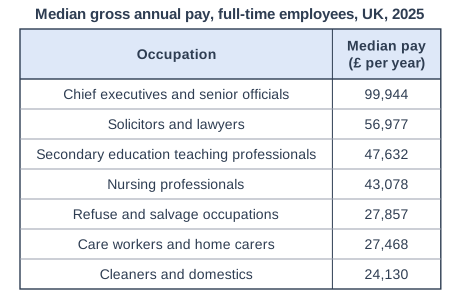
The Annual Survey of Hours and Earnings collects pay information from employers for a large sample of employee jobs in the UK. The table in Item B shows the median (middle) gross annual pay of full-time employees in selected occupations in 2025. The median for all full-time employees was £39,039. The survey does not cover the self-employed, and the 2025 figures are provisional.
Source: ONS, Annual Survey of Hours and Earnings 2025 (provisional), Table 14.7a.

Identify and explain one criticism of Davis and Moore's theory that is suggested by the pay figures in Item B.

Median gross annual pay, full-time employees, UK, 2025. Table with columns "Occupation", "Median pay (£ per year)". Occupation: Chief executives and senior officials; Median pay (£ per year): 99,944 | Occupation: Solicitors and lawyers; Median pay (£ per year): 56,977 | Occupation: Secondary education teaching professionals; Median pay (£ per year): 47,632 | Occupation: Nursing professionals; Median pay (£ per year): 43,078 | Occupation: Refuse and salvage occupations; Median pay (£ per year): 27,857 | Occupation: Care workers and home carers; Median pay (£ per year): 27,468 | Occupation: Cleaners and domestics; Median pay (£ per year): 24,130.

Model answer

One criticism is that many jobs that are essential to society are poorly paid. Item B shows that care workers and home carers earned a median of £27,468 and refuse and salvage workers £27,857 in 2025, both well below the median for all full-time employees of £39,039. Yet society could not function without people to care for older and disabled people or to remove waste safely; during an outbreak of disease, for example, these jobs are vital to public health. Similarly, nursing professionals earned £43,078, less than solicitors and lawyers at £56,977, which raises the question of whether lawyers are really more important than nurses. If Davis and Moore were right, the most important jobs would receive the highest rewards, so these figures suggest that pay reflects other factors, such as the power of some groups to bargain for higher pay, rather than functional importance.

Explanation

A top answer identifies one criticism and supports it with accurate figures from Item B, explaining why they contradict the idea that rewards match functional importance. Answers that do not use the figures, or that misread them, are only weakly applied.

Mark scheme
  1. 4 marks

    Levels of response (4 marks). AO1 = 1 mark, AO2 = 3 marks. 'Context' here refers to using the pay figures in Item B to criticise Davis and Moore's theory.
    Level 4 (4 marks): Relevant criticism identified (AO1) and an appropriate, detailed and well-developed explanation of relevant sociological theories, concepts, evidence and methods offered with a good application to the context. (AO2)
    Level 3 (3 marks): Relevant criticism identified (AO1) with an explanation of relevant sociological theories, concepts, evidence and methods containing some inaccuracies or omissions but which has some application to the context. (AO2)
    Level 2 (2 marks): Relevant criticism identified (AO1) with a largely inaccurate or irrelevant explanation of relevant sociological theories, concepts, evidence and methods that is only weakly applied to the context. (AO2)
    Level 1 (1 mark): Relevant criticism identified. (AO1)
    0 marks: Nothing worthy of credit.

    Indicative content AO1 (not exhaustive, credit other valid points): Many essential jobs are poorly paid (eg care workers, refuse collectors, nurses); differences in pay may reflect power rather than functional importance; the size of the gap at the top cannot be explained by talent or training alone; gender - jobs mainly done by women, such as caring, are undervalued; there is no agreed way of measuring importance, so rewards cannot be shown to match it. Credit other valid criticisms. Indicative content AO2: Essential jobs eg care workers and home carers (£27,468) and refuse and salvage occupations (£27,857) earn less than the median for all full-time employees (£39,039), yet society could not function without care for older and disabled people or the safe removal of waste; nurses and lawyers eg nursing professionals (£43,078) earn less than solicitors and lawyers (£56,977), which raises the question in the specification of whether lawyers are more important than nurses; power eg chief executives and senior officials (£99,944) earn more than twice as much as nurses (2.3 times), which Marxists explain by their power to set rewards and their link to owners of capital rather than by functional importance; gender eg feminists note that low-paid caring and cleaning jobs are mainly done by women, reflecting patriarchy rather than importance; credit Tumin's point that functional importance cannot be measured independently of rewards. NB: For Level 4 the criticism must be applied to figures in Item B.

Question 4

4 marks

Identify and explain one reason why it is difficult to measure the functional importance of a job.

Model answer

One reason is that almost every job depends on others, so it is very hard to say which is more important. Davis and Moore suggested judging importance by how unique a position is and how many other positions depend on it, but in practice the jobs in an organisation rely on one another. A hospital surgeon is highly skilled, but surgery would be dangerous without cleaners preventing infection, porters moving patients and nurses providing care. Because the surgeon is paid far more, it is tempting to assume their job is more important, but, as Tumin argued, judging importance by existing rewards is circular: it assumes what the theory is trying to prove. Without an independent and agreed measure, the claim that the most important jobs receive the highest rewards cannot easily be tested.

Explanation

A top answer gives one clear reason, such as interdependence or circularity, illustrates it with an example and links it to testing Davis and Moore's theory. Answers that only say 'all jobs are important' without explaining the measurement problem stay in the lower levels.

Mark scheme
  1. 4 marks

    Levels of response (4 marks). AO1 = 1 mark, AO2 = 3 marks. 'Context' here refers to the problem of measuring the functional importance of jobs in the functionalist theory of stratification.
    Level 4 (4 marks): Relevant reason identified (AO1) and an appropriate, detailed and well-developed explanation of relevant sociological theories, concepts, evidence and methods offered with a good application to the context. (AO2)
    Level 3 (3 marks): Relevant reason identified (AO1) with an explanation of relevant sociological theories, concepts, evidence and methods containing some inaccuracies or omissions but which has some application to the context. (AO2)
    Level 2 (2 marks): Relevant reason identified (AO1) with a largely inaccurate or irrelevant explanation of relevant sociological theories, concepts, evidence and methods that is only weakly applied to the context. (AO2)
    Level 1 (1 mark): Relevant reason identified. (AO1)
    0 marks: Nothing worthy of credit.

    Indicative content AO1 (not exhaustive, credit other valid points): There is no agreed or objective measure of importance; all jobs depend on each other (interdependence), so many are essential; judging importance by existing rewards is circular (Tumin); importance changes with circumstances (eg in a pandemic); people disagree about which jobs matter most (no value consensus); powerful groups can influence how important their jobs appear. Credit other valid reasons. Indicative content AO2: No agreed measure eg Davis and Moore suggested functional uniqueness and how far other positions depend on a job, but these do not produce a clear ranking - a hospital needs both surgeons and cleaners to prevent infection; circularity eg if the highest-paid jobs are assumed to be the most important, the theory becomes circular, as Tumin argued; interdependence eg a factory cannot run without its managers or without its workers; changing circumstances eg during the coronavirus pandemic many low-paid workers, such as carers and delivery drivers, were treated as essential; disagreement eg different groups may rank jobs differently, so there may be no consensus; power eg professions and executives may use their power to present their work as more important than it is.

Ready to try the rest? Every answer you write is marked against the mark scheme, so you can see exactly where the marks are.

Study Helper Hints first, answers after you try

Stuck on this one? Ask for a hint and I’ll point you in the right direction, without giving the answer away. Once you’ve checked your answer, I’ll show you how the marks are awarded.