Level:
Correct: 0
Incorrect: 0
Marks: 0/0
Exam Practice
Course:
Topics:
AQA GCSE Sociology (Paper 2) Smart practice A mixed round aimed at your weak spots
Unit 1
The sociological approach
Unit 2
Crime and deviance
Unit 3
Social stratification
Functionalist theory of stratification
Socio-economic class
Life chances
Life chances
Poverty as a social issue
Power and authority
Power and authority
Power relationships
Power relationships
Unit 4
Sociological research methods
Avg
score:
–
Topics
done:
0/14

Power and authority

Practise 30 exam-style questions on Power and authority for AQA GCSE Sociology (Paper 2). Write your answer as you would in the exam and get it marked in seconds against the mark scheme, point by point, with the Study Helper on hand if you get stuck.

  • 30 questions
  • 1–12 marks each
  • Instant marking
  • No sign-up needed
20 questions, marked as you go

Sample questions with model answers

Here are 4 of the questions in this topic, each with a model answer, an explanation of why it earns the marks and the mark scheme an examiner would use.

Question 1

1 mark

What term is commonly used by sociologists to describe a large organisation run according to written rules, with a hierarchy of officials who are appointed for their qualifications?

Choose your answer.

  • Aristocracy
  • Bureaucracy
  • Monarchy
  • Oligarchy

Model answer

Bureaucracy

Explanation

Weber saw bureaucracy, with its hierarchy, written rules, specialised roles and appointment on merit, as the organisational form of rational-legal authority. Government departments, the NHS and large companies are examples. An aristocracy and a monarchy are based on inherited position, not qualifications.

Mark scheme
  1. 1 mark

    Bureaucracy

    If more than one option is given, 0 marks.

Question 2

3 marks

Describe one example of charismatic authority.

Model answer

One example of charismatic authority is Martin Luther King Jr, a leader of the civil rights movement in the USA in the 1950s and 1960s. He did not hold a powerful government position, but millions of people were inspired by his speeches, his courage and his commitment to non-violent protest, and they followed his lead in boycotts and marches. In Weber's terms, his authority came from devotion to his exceptional personal qualities rather than from rules or tradition.

Explanation

Level 3 answers give a clear example and explain why it is charismatic: followers obey because of the leader's personal qualities, not their position or custom. Naming a famous person without explaining the source of their authority is only a partial answer. Any well-explained example, historical or everyday, can earn full marks.

Mark scheme
  1. 3 marks

    Levels of response (3 marks). AO1 = 3 marks.
    Level 3 (3 marks): A coherent description with few inaccuracies. Demonstrates good knowledge and understanding of relevant sociological theories, concepts, evidence and methods. (AO1)
    Level 2 (2 marks): A partial description based on a mix of relevant and irrelevant material with some inaccuracies and omissions. Demonstrates some knowledge and understanding of relevant sociological theories, concepts, evidence and methods. (AO1)
    Level 1 (1 mark): Fragments of knowledge, some inaccurate or irrelevant. Demonstrates limited understanding of relevant sociological theories, concepts, evidence and methods. (AO1)
    0 marks: Nothing worthy of credit.

    Indicative content (AO1; not exhaustive, credit other valid points): Weber: authority based on devotion to a leader believed to have exceptional personal qualities; examples of leaders widely described as charismatic, eg Martin Luther King Jr in the US civil rights movement, Mahatma Gandhi in India's independence movement, Nelson Mandela, founders of religious movements, and Hitler as a charismatic leader who used his authority for harmful ends; followers obey because they are inspired by the person rather than by rules or tradition; charismatic leaders often challenge existing authority; everyday examples, eg an inspirational team captain or teacher, if explained in terms of personal qualities; credit any well-explained example. NB: The example must be explained in terms of the leader's personal qualities inspiring obedience. An example of a person with a formal position (eg a Prime Minister) needs to show that people follow them because of their personality, not their office.

Question 3

4 marks

Item B
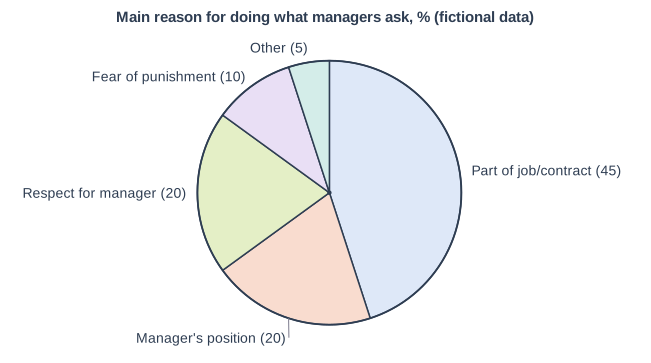
A team of sociologists sent an anonymous online questionnaire to employees in 40 workplaces of different sizes across England, and 1,200 employees completed it (fictional data). One closed question asked: 'When your manager asks you to do something, what is the main reason you do it?' The pie chart in Item B shows the percentage of employees giving each answer.

Identify and explain one reason why most employees accept their manager's authority, as shown in Item B.

Main reason for doing what managers ask, % (fictional data). Pie chart. A circle divided into sectors, drawn clockwise from the top (12 o'clock): Part of job/contract (45 printed in it), 162°; Manager's position (20 printed in it), 72°; Respect for manager (20 printed in it), 72°; Fear of punishment (10 printed in it), 36°; Other (5 printed in it), 18°. (Angles are not printed on the chart; these are the drawn sizes, which can be measured with a protractor.)

Model answer

One reason is that employees accept rational-legal authority. Item B shows that 45% of employees said they did what their manager asked because it was part of their job or contract, and another 20% said the manager's position gave them the right to ask, so 65% gave reasons based on rules and positions. Weber argued that in modern societies people obey rational-legal authority because they accept shared, impersonal rules. Employees agree to a contract that sets out their duties, and they accept that a manager, as part of the organisation's hierarchy, has the legitimate right to direct their work. They are obeying the position rather than the individual, which is why they would follow a new manager's instructions in the same way. Only 10% said they obeyed mainly through fear of punishment, which would be power rather than authority.

Explanation

Level 4 answers identify a reason, explain it using sociological ideas such as Weber's rational-legal authority, and apply the figures in Item B. Combining the 45% and 20% to show that most employees gave reasons based on rules and position is good use of the data. Answers that explain fear of punishment as 'authority' confuse power with legitimate authority.

Mark scheme
  1. 4 marks

    Levels of response (4 marks). AO1 = 1 mark, AO2 = 3 marks. 'Context' here refers to the reasons why employees accept their managers' authority.
    Level 4 (4 marks): Relevant reason identified (AO1) and an appropriate, detailed and well-developed explanation of relevant sociological theories, concepts, evidence and methods offered with a good application to the context. (AO2)
    Level 3 (3 marks): Relevant reason identified (AO1) with an explanation of relevant sociological theories, concepts, evidence and methods containing some inaccuracies or omissions but which has some application to the context. (AO2)
    Level 2 (2 marks): Relevant reason identified (AO1) with a largely inaccurate or irrelevant explanation of relevant sociological theories, concepts, evidence and methods that is only weakly applied to the context. (AO2)
    Level 1 (1 mark): Relevant reason identified. (AO1)
    0 marks: Nothing worthy of credit.

    Indicative content AO1 (not exhaustive, credit other valid points): Rational-legal authority: obeying because it is part of the job or contract; acceptance of the manager's official position in the hierarchy; respect for the manager as a person (charismatic or informal power); fear of sanctions such as discipline or dismissal (power rather than authority); value consensus or socialisation into accepting workplace rules; economic dependence on wages (Marxist view). Indicative content AO2: Uses Item B, eg 45% said it was part of their job or contract and 20% said the manager's position gave them the right, so 65% gave reasons linked to rules and position; this fits Weber's rational-legal authority, where people obey the position rather than the person and the rules are seen as legitimate; 20% obeyed because they respected their manager as a person, closer to informal power or charisma; 10% obeyed through fear of punishment, which is power rather than legitimate authority; functionalists see acceptance of workplace authority as based on shared values; Marxists argue that workers accept authority because they depend on wages and are socialised by ruling class ideology.

Question 4

12 marks

Discuss how far sociologists would agree that rational-legal authority is the main form of authority in modern Britain.

Model answer

Max Weber identified three types of legitimate authority: traditional authority based on custom and inherited status, charismatic authority based on devotion to a leader with exceptional qualities, and rational-legal authority based on the acceptance of shared, impersonal rules. Weber argued that modern societies are increasingly organised through rational-legal authority and bureaucracy.

There is strong evidence that rational-legal authority is the main form in modern Britain. Laws are made by an elected Parliament according to agreed procedures, and people generally obey them because they accept that the system is legitimate. Police officers, judges, civil servants, teachers and managers have authority because of their official positions, which are defined by rules and contracts. When a Prime Minister leaves office, their authority passes to the next holder of the position, showing that people obey the office rather than the person. Large organisations, from government departments to the NHS and private companies, are run as bureaucracies, with hierarchies and written rules. Functionalists would see this as a sign of value consensus: people accept rational-legal authority because they share the values it protects.

However, other forms of authority have not disappeared. Traditional authority can still be seen in the monarchy, which is based on inheritance and long-established custom. Although the monarch's role is now largely ceremonial, the monarchy still has a symbolic importance for many people. In some families and communities, parents, elders or religious leaders hold authority based on custom. Charismatic authority also remains important. Political leaders' personalities can strongly influence how people vote, and social movements are often inspired by charismatic individuals. On social media, influencers can shape the opinions and behaviour of millions of followers without any official position.

Weber himself saw his three types as 'ideal types' that rarely exist in pure form. A Prime Minister holds rational-legal authority but may also rely on charisma to win elections, and the monarchy combines tradition with a constitutional role. Charismatic movements often become routinised into rules and committees, turning charisma into rational-legal authority.

Other perspectives question whether rational-legal authority is really legitimate. Marxists argue that it hides the power of the ruling class, because the law and the state protect private property and the interests of capitalists. Feminists argue that positions of rational-legal authority are still dominated by men, so the rules themselves may reflect male interests.

In conclusion, most sociologists would largely agree that rational-legal authority is the main form of authority in modern Britain, especially in public life, as Weber predicted. However, traditional and charismatic authority still play important roles, often alongside rational-legal authority, and perspectives such as Marxism and feminism question how far this authority serves everyone equally.

Explanation

Top answers explain all three of Weber's types accurately, apply them to real examples in modern Britain, and weigh the dominance of rational-legal authority against the continuing role of traditional and charismatic authority. Evaluation from Marxist or feminist views, or of Weber's ideal types, lifts the answer to Level 4. A common weakness is describing the three types without applying them to Britain today.

Mark scheme
  1. 12 marks

    Levels of response (12 marks). AO1 = 4 marks, AO2 = 4 marks, AO3 = 4 marks. AQA's AO3 descriptor for each level opens the comments; judge AO1, AO2 and AO3 together (best fit).
    Level 4 (10-12 marks): Detailed knowledge and understanding of relevant theories, concepts, evidence and methods presented in a well-developed answer. A wide range of specialist terms used with precision. (AO1) Sustained application of relevant theories, concepts, evidence and methods to the issues raised by the question. Few if any inaccuracies or omissions. (AO2) AO3: see Level 4 in the comments.
    Level 3 (7-9 marks): Good evidence of relevant knowledge and understanding of theories, concepts, evidence and methods but elements lacking detail and development. A good range of specialist terms used appropriately. (AO1) Good application of relevant theories, concepts, evidence and methods to the issues raised by the question. Some inaccuracies or omissions. (AO2) AO3: see Level 3 in the comments.
    Level 2 (4-6 marks): Limited evidence of relevant knowledge and understanding of theories, concepts, evidence and methods. A limited range of specialist terms used appropriately. (AO1) Limited application of relevant theories, concepts, evidence and methods to the issues raised by the question. Significant inaccuracies or omissions. (AO2) AO3: see Level 2 in the comments.
    Level 1 (1-3 marks): Fragments of basic knowledge and understanding of theories, concepts, evidence and methods relevant to the topic. Specialist terms generally used inappropriately if at all. (AO1) Little or no application of relevant theories, concepts, evidence and methods to the issues raised by the question. (AO2) AO3: see Level 1 in the comments.
    0 marks: Nothing worthy of credit.

    AO3 descriptors (AQA): Level 4: Developed critical analysis and evaluation of relevant theories, concepts, evidence and methods. Well-constructed arguments with supported judgements and evidence-based conclusions. Level 3: Good evidence of analysis and evaluation of the relevant theories, concepts, evidence and methods. A logical argument, but judgements and conclusions may be indistinct and/or lacking in appropriate development. Level 2: Limited attempt at analysis and evaluation of the relevant theories, concepts, evidence and methods but lacking in appropriate development. There may be inconsistencies in the argument made and reasoning may be inaccurate leading to false or contradictory judgements and conclusions. Level 1: Little or no analysis of the relevant theories, concepts, evidence and methods, assertion rather than evaluation, poorly-constructed argument with little or no evidence of substantiated judgements and only cursory conclusions. AO1, AO2 and AO3 are regarded as interdependent. When deciding on a mark all should be considered together using the best fit approach. For example, a level 3 mark could be awarded for level 3 evidence across each objective, or a mixture of 4, 3 and 2 evidence across different objectives.
    Indicative content (not exhaustive; credit other relevant points): AO1: Weber's three types of legitimate authority: traditional, charismatic, rational-legal; bureaucracy; Weber's view that modern societies are increasingly organised through rational-legal authority; examples of rational-legal authority (Parliament, the courts, police, civil service, NHS, schools, employers); traditional authority (monarchy, customs, families); charismatic authority (political, religious and celebrity leaders, social media); functionalism (authority based on value consensus); Marxism (authority masks ruling-class power); feminism (male domination of authority); informal power. AO2: Most areas of life are governed by written rules and official positions, eg laws made by Parliament, police powers, school rules and employment contracts; people usually obey the office, not the person; the monarchy remains but is largely ceremonial; charismatic leaders still influence voters and followers, and in political campaigns and social movements personality matters; in some families and communities, traditional authority based on age or custom remains important; Marxists argue rational-legal authority hides class power, and feminists that it is dominated by men. AO3: Weber's ideal types are rarely found in pure form; modern leaders often combine rational-legal and charismatic authority, and traditional authority survives in rituals; charisma may become routinised into rules; rational-legal authority is weakened when trust in institutions falls; the main form of authority may differ between public life and private life; evidence-based judgement and conclusion on how far, eg rational-legal authority dominates public life, but traditional and charismatic authority still matter. Level 4: there must be accurate use of Weber's types of authority, applied to modern Britain, with discussion of evidence for and against the dominance of rational-legal authority and a supported conclusion.

Ready to try the rest? Every answer you write is marked against the mark scheme, so you can see exactly where the marks are.

Study Helper Hints first, answers after you try

Stuck on this one? Ask for a hint and I’ll point you in the right direction, without giving the answer away. Once you’ve checked your answer, I’ll show you how the marks are awarded.