Level:
Correct: 0
Incorrect: 0
Marks: 0/0
Practice
Course:
Topics:
Year 1 Maths Smart practice A mixed round aimed at your weak spots
Unit 1
Place value
Unit 2
Addition and subtraction
Unit 3
Multiplication and division
Unit 4
Fractions
Unit 5
Measurement
Unit 6
Geometry
Avg
score:
–
Topics
done:
0/27

Position, direction and turns

Practise 16 questions on Position, direction and turns for Year 1 Maths. Tap your answer and find out straight away if you are right, with the Study Helper on hand if you get stuck.

  • 16 questions
  • 1–3 marks each
  • Instant marking
  • No sign-up needed
16 questions, marked as you go

Sample questions with model answers

Here are 4 of the questions in this topic, each with a model answer, an explanation of why it earns the marks and the mark scheme.

Question 1

1 mark

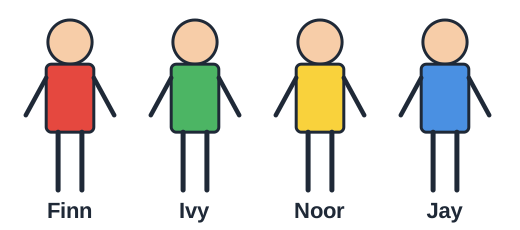
Look at the picture.

Who is between Ivy and Jay?

Four children standing in a row with their names under them. From left to right: Finn, Ivy, Noor, Jay.

Model answer

Noor

Explanation

Between means in the middle of two. Find Ivy and Jay. The child in the middle of them is Noor.

Mark scheme
  1. 1 mark

    Noor

    Accept a small first letter, or a clear misspelling such as Nor. Do not accept Finn, Ivy or Jay.

Question 2

1 mark

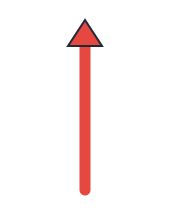
Look at the picture.

The arrow points up.

It makes a three-quarter turn clockwise.

Which way does it point now?

A red arrow pointing up.

Model answer

left

Explanation

Go the way a clock's hands go. One quarter turn is right, two is down and three is left.

Mark scheme
  1. 1 mark

    left

    Accept 'to the left', or a clear misspelling such as lefft. Left means left as you look at the picture. Do not accept right, which is a three-quarter turn the other way. Do not accept down, which is a half turn.

Question 3

2 marks

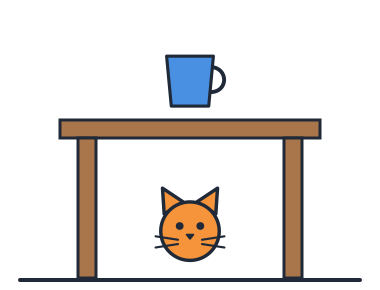
Look at the picture.

What is on top of the table?

What is below the table?

A table with one thing on it and one thing under it.

Model answer

cup, cat

Explanation

The cup is on top of the table. The cat is lower down, under the table, so it is below the table.

Mark scheme
  1. 1 mark

    cup

    On top of the table. Accept 'the cup', 'a cup', or a clear misspelling such as cupp.

  2. 1 mark

    cat

    Below the table. Accept 'the cat', 'a cat', or a clear misspelling such as catt. Each part is marked on its own, with no follow through. Answers typed in order, such as cup, cat, score both marks. Swapped answers (cat, cup) score 0.

Question 4

3 marks

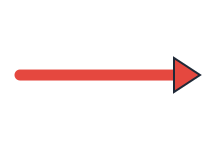
Look at the picture. The arrow points right.

It makes a quarter turn clockwise. Which way does it point now?

Start again. A quarter turn anticlockwise. Which way now?

Start again. A half turn. Which way now?

A red arrow pointing to the right.

Model answer

down, up, left

Explanation

Clockwise goes the way clock hands go, so a quarter turn from right is down. Anticlockwise goes the other way, to up. A half turn makes it point the opposite way, to left.

Mark scheme
  1. 1 mark

    down

    A quarter turn clockwise. Accept downwards, pointing down, or a clear misspelling such as doun. Do not accept up, which is anticlockwise.

  2. 1 mark

    up

    A quarter turn anticlockwise. Accept upwards, pointing up, or a clear misspelling such as upp. Do not accept down, which is clockwise.

  3. 1 mark

    left

    A half turn. Accept 'to the left', or a clear misspelling such as lefft. Each part is marked on its own, with no follow through. Answers typed in order, such as down, up, left, score all 3 marks. Left alone scores this mark only.

Ready to try the rest? Tap your answers and see straight away how you did.

Topic notes

Position, direction and turns

The big idea

Some words tell us where things are. Some tell us which way to go. Some tell us how far to turn.

Where things are

Position means where something is.

  • The top is the highest part. The bottom is the lowest. The middle is between them.
  • On top of means resting on something.
  • Above means higher up. Below means lower down.
  • In front of means nearer to you. Behind means at the back.
  • Between means in the middle of two things. Your nose is between your eyes.
  • Inside means in something. Outside means not in it.
  • Near means close. Far means a long way off.
  • Left and right are your two sides. Hold up both hands with your palms facing away and your thumbs out. Your left hand makes an L.

Tia has 3 cushions in a pile. Red is on top. Blue is at the bottom. Where is green?

Red is at the top. Blue is at the bottom.

There is one more place. That is the middle.

So green is between red and blue.

Turns

A turn is when something spins round on the spot. Clockwise means the way the hands of a clock go. Anticlockwise means the other way.

Four turns that start at the top and go clockwise. A quarter turn is 1 quarter, a half turn is 2 quarters, a three-quarter turn is 3 quarters and a whole turn is 4 quarters.
Each turn starts at the top. Each one goes clockwise.

A quarter turn is the smallest of these turns. A half turn is 2 quarter turns. You face the opposite way. A three-quarter turn is 3 quarter turns. A whole turn is 4 quarter turns. You are back where you started.

Jo faces the door. The window is on her right. She makes a quarter turn clockwise. What does she face now?

Stand up and try it. Clockwise takes you round to your right.

The window is on her right. So she faces the window.

Moving on a grid

A grid is made of squares. Forwards means the way you are looking. Backwards means the opposite way. Up goes to the top. Down goes to the bottom.

A grid with 5 squares across and 3 rows. The snail is in the bottom left square, looking right. The stone is 3 squares to the right of it. The leaf is 2 squares to the right and 1 square up. The flower is 1 square to the right and 2 squares up.
The arrow shows the snail looking right.

The snail wants the leaf. It goes forwards, then up. How many squares each way?

Start on the snail. Do not count its square.

Go forwards. 1, 2. The leaf is just above.

Go up. 1.

So it goes forwards 2, then up 1.

Common mistakes

  • Counting the square you start on. Start on the next square.
  • Mixing up clockwise and anticlockwise. Follow the hands of a clock.
  • Thinking a whole turn faces a new way. It comes back to the start.

Top tip

Stand up and try each turn.

Study Helper Hints first, answers after you try

Stuck on this one? Ask for a hint and I’ll point you in the right direction, without giving the answer away. Once you’ve checked your answer, I’ll show you how the marks are awarded.