Practise 16 questions on One more and one less for Year 1 Maths. Tap your answer and find out straight away if you are right, with the Study Helper on hand if you get stuck.
16 questions
1–3 marks each
Instant marking
No sign-up needed
16 questions, marked as you go
Sample questions with model answers
Here are 4 of the questions in this topic, each with a model answer, an explanation of why it earns the marks and the mark scheme.
Question 1
1 mark
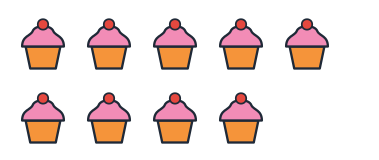
Look at the picture.
Tom eats one cake.
How many cakes are left?
Model answer
8
Explanation
There are 9 cakes. One less than 9 is 8, so 8 cakes are left.
Mark scheme
1 mark
8
Accept eight. Accept 8 cakes. Do not accept 9, which is how many there are before Tom eats one, or 10.
Question 2
1 mark
Which number is one less than 14?
Model answer
13
Explanation
One less means you count back one. Before 14 comes 13. A common slip is to choose 15, which is one more.
Mark scheme
1 mark
13
Accept thirteen. Do not accept 15, which is one more than 14, or 12, which is two less.
Question 3
2 marks
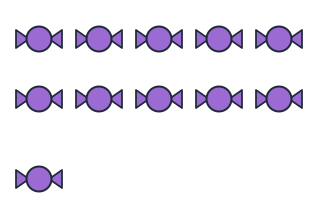
Look at the picture.
How many sweets are there?
Ada eats one sweet.
How many sweets are left?
Model answer
11, 10
Explanation
The top two rows have 5 and 5, which makes 10, and there is 1 more, so that is 11. One less than 11 is 10.
Mark scheme
1 mark
11
All the sweets. Accept eleven.
1 mark
10
The sweets left. Accept ten. Allow follow-through: one less than the pupil's own count (for example 12, 11). Each part is marked on its own. Answers typed in order, such as 11, 10, score both marks. 10 alone scores this mark only.
Question 4
3 marks
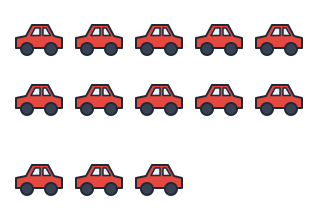
Look at the picture.
How many cars are there?
One more car comes.
How many cars are there now?
Then one car drives away.
How many cars are there now?
Model answer
13, 14, 13
Explanation
Count the cars: 13. One more makes 14. One less takes you back to 13. Well done for spotting that!
Mark scheme
1 mark
13
The cars in the picture. Accept thirteen.
1 mark
14
After one more comes. Accept fourteen. Allow follow-through: one more than the pupil's first answer (for example 12, 13).
1 mark
13
After one drives away. Accept thirteen. Allow follow-through: one less than the pupil's second answer (for example 12, 13, 12). Each part is marked on its own. Answers typed in order, such as 13, 14, 13, score all 3 marks. 13 typed once on its own scores 1 mark only.
Ready to try the rest? Tap your answers and see straight away how you did.
Ctrl + Enter to check
Study HelperHints first, answers after you try
Stuck on this one? Ask for a hint and I’ll point you in the right direction, without giving the answer away. Once you’ve checked your answer, I’ll show you how the marks are awarded.