Level:
Correct: 0
Incorrect: 0
Marks: 0/0
Practice
Course:
Topics:
Year 1 Maths Smart practice A mixed round aimed at your weak spots
Unit 1
Place value
Unit 2
Addition and subtraction
Unit 3
Multiplication and division
Unit 4
Fractions
Unit 5
Measurement
Unit 6
Geometry
Avg
score:
–
Topics
done:
0/27

Days, months and order of events

Practise 16 questions on Days, months and order of events for Year 1 Maths. Tap your answer and find out straight away if you are right, with the Study Helper on hand if you get stuck.

  • 16 questions
  • 1–3 marks each
  • Instant marking
  • No sign-up needed
16 questions, marked as you go

Sample questions with model answers

Here are 4 of the questions in this topic, each with a model answer, an explanation of why it earns the marks and the mark scheme.

Question 1

1 mark

Do you eat lunch before or after breakfast?

Model answer

after

Explanation

Breakfast is the first meal of the day. Lunch comes later, so you eat lunch after breakfast.

Mark scheme
  1. 1 mark

    after

    Accept after breakfast, or a clear misspelling such as aftr or arfter. Do not accept before.

Question 2

1 mark

The picture shows June, a gap, then August.

The months are in order.

Which month is missing?

Word cards in a row. They say June, then a card with a question mark for the gap, then August.

Model answer

July

Explanation

Say the months in order: June, July, August. So July is missing. Well done!

Mark scheme
  1. 1 mark

    July

    Accept clear misspellings such as juli or jully. Do not accept May or September.

Question 3

2 marks

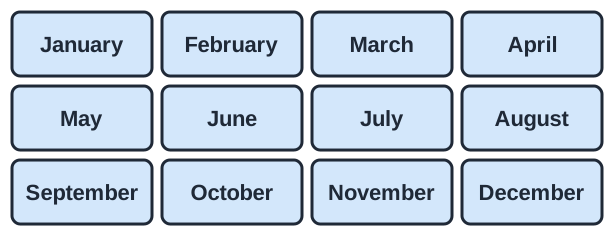
Look at the picture.

How many months are in one year?

Which month comes last?

Word cards with the months of the year, in order, starting with January.

Model answer

12, December

Explanation

Count the cards: there are 12 months in a year. The year starts with January and ends with December.

Mark scheme
  1. 1 mark

    12

    Accept twelve, or 12 months.

  2. 1 mark

    December

    Accept clear misspellings such as desember or decmber. Do not accept January, which comes first. Each part is marked on its own. Answers typed in order, such as 12, December, score both marks. December alone scores this mark only.

Question 4

3 marks

Ada does three things.

A is eat lunch.

B is wake up.

C is go to bed.

Which comes first?

Which comes next?

Which comes last?

Model answer

B, A, C

Explanation

Ada wakes up first. She eats lunch in the middle of the day. She goes to bed last.

Mark scheme
  1. 1 mark

    B

    First. Accept B, a small letter b, or wake up.

  2. 1 mark

    A

    Next. Accept A, a small letter a, or eat lunch.

  3. 1 mark

    C

    Last. Accept C, a small letter c, or go to bed. Each part is marked on its own. Answers typed in order, such as B, A, C, score all 3 marks. A list the wrong way round, C, A, B, scores 1 mark, for the middle letter.

Ready to try the rest? Tap your answers and see straight away how you did.

Topic notes

Days, months and order of events

The big idea

Things happen in an order. Days and months have an order too.

First, next, then, last

We can put things in order. We say first, next, then and last. Before means sooner. After means later. We wash our hands before we eat.

Noor plants a seed. She pours on water. She digs a hole. She covers the seed with soil. She drops in the seed. What is the right order?

First, she digs a hole.

Next, she drops in the seed.

Then, she covers the seed with soil.

Last, she pours on water.

Morning to night

A day goes in this order. The morning is the start of the day. The afternoon comes after lunch. The evening comes before bedtime. Night is when it is dark and we sleep.

Yesterday, today and tomorrow

Today is the day it is now. Yesterday was the day before. Tomorrow is the next day.

If today is Friday, yesterday was Thursday. Tomorrow is Saturday.

The days of the week

A week has 7 days. They always go in this order. Then a new week starts.

A table of the 7 days of the week in order, numbered from 1 to 7, from Monday to Sunday.
The 7 days of the week, in order. Monday, Tuesday, Wednesday, Thursday, Friday, Saturday, Sunday.

Football is on Saturday. Mo packs his bag the day before. Which day does he pack it?

Say the days in order. Stop at Saturday.

Monday, Tuesday, Wednesday, Thursday, Friday, Saturday.

The day just before Saturday is Friday.

The months of the year

A year has 12 months. They always go in this order.

A table of the 12 months of the year in order, numbered from 1 to 12, from January to December.
The 12 months of the year, in order, from January to December.

Pia's birthday is in March. Ben's birthday is in October. Whose birthday comes first in the year?

Start at January. Say the months in order.

January, February, March. We reach March first.

October is still to come.

So Pia's birthday comes first.

Quicker or slower, earlier or later

Quicker means it takes less time. Slower means it takes more time. Running is quicker than walking.

Earlier means sooner. Later means after. 1 o'clock is earlier than 5 o'clock.

Remember

  • A week has 7 days.
  • A year has 12 months.

Common mistakes

  • Mixing up yesterday and tomorrow. Yesterday has gone. Tomorrow has not come yet.
  • Mixing up days and months. Tuesday is a day. April is a month.
  • Stopping at the end of the year. January comes next, because a new year starts.

Top tip

Say the days and months with your child. Clap once for each one.

Study Helper Hints first, answers after you try

Stuck on this one? Ask for a hint and I’ll point you in the right direction, without giving the answer away. Once you’ve checked your answer, I’ll show you how the marks are awarded.