Level:
Correct: 0
Incorrect: 0
Marks: 0/0
Practice
Course:
Topics:
Year 1 Maths Smart practice A mixed round aimed at your weak spots
Unit 1
Place value
Unit 2
Addition and subtraction
Unit 3
Multiplication and division
Unit 4
Fractions
Unit 5
Measurement
Unit 6
Geometry
Avg
score:
–
Topics
done:
0/27

Mass

Practise 13 questions on Mass for Year 1 Maths. Tap your answer and find out straight away if you are right, with the Study Helper on hand if you get stuck.

  • 13 questions
  • 1–3 marks each
  • Instant marking
  • No sign-up needed
13 questions, marked as you go

Sample questions with model answers

Here are 4 of the questions in this topic, each with a model answer, an explanation of why it earns the marks and the mark scheme.

Question 1

1 mark

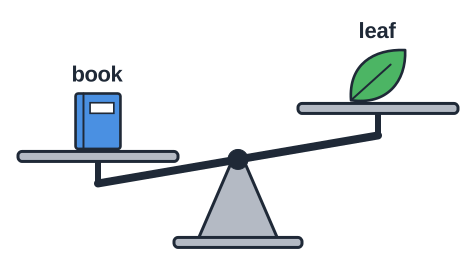
Look at the picture.

The heavier side of a balance goes down.

What is on the heavier side?

A balance that is not level. A book is on the left pan and a leaf is on the right pan. The left side is lower than the right side.

Model answer

book

Explanation

The side with the book has gone down, so the book is heavier than the leaf. Well done!

Mark scheme
  1. 1 mark

    the book

    Accept book or the book, and clear misspellings such as buk. Do not accept the leaf, which has gone up.

Question 2

1 mark

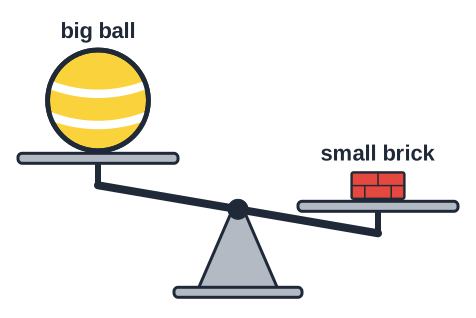
Look at the balance in the picture.

A big ball is on one side.

A small brick is on the other.

Which is lighter?

A balance that is not level. A big yellow ball is on the left pan and a small red brick is on the right pan. The right side is lower than the left side.

Model answer

the big ball

Explanation

The side with the brick has gone down, so the brick is heavier. That makes the big ball lighter. Big things are not always heavy!

Mark scheme
  1. 1 mark

    the big ball

    Accept the big ball, big ball, the ball or ball, and clear misspellings such as baul. Do not accept the small brick or brick, which has gone down: choosing it means looking at the size and not at the balance.

Question 3

2 marks

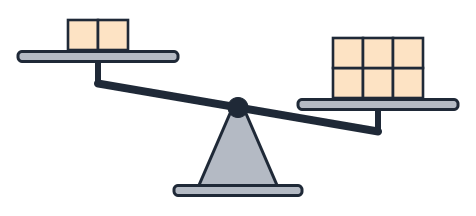
Look at the balance in the picture.

It has cubes on both sides.

How many cubes are on the heavier side?

How many cubes are on the lighter side?

A balance that is not level, with cubes on both pans. The right side is lower than the left side.

Model answer

6, 2

Explanation

The heavier side goes down. The low side has 6 cubes. The high side has 2 cubes, so it is the lighter side.

Mark scheme
  1. 1 mark

    6

    The heavier side. Accept 6 or six, with or without the word cubes.

  2. 1 mark

    2

    The lighter side. Accept 2 or two, with or without the word cubes. Each part is marked on its own. Answers typed in order, such as 6, 2, score both marks. If the answers are swapped (2 on the heavier side, 6 on the lighter side), neither mark is earned.

Question 4

3 marks

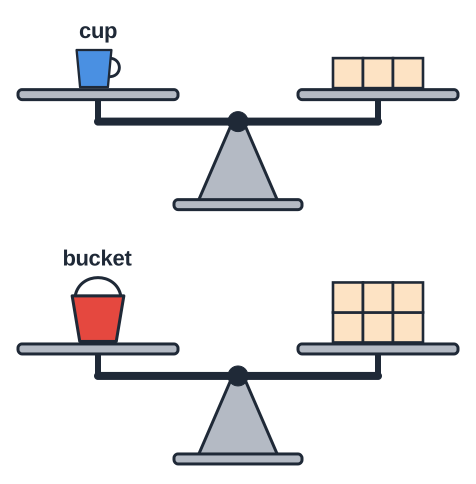
Look at the picture.

How many cubes does the cup weigh?

How many cubes does the bucket weigh?

How many cubes do they weigh altogether?

Two balances, one above the other, both level. One has a cup and some cubes. The other has a bucket and some cubes.

Model answer

3, 6, 9

Explanation

Both balances are level, so count the cubes on each one. The cup weighs 3 cubes and the bucket weighs 6 cubes. \(3 + 6 = 9\).

Mark scheme
  1. 1 mark

    3

    The cup. Accept 3 or three, with or without the word cubes.

  2. 1 mark

    6

    The bucket. Accept 6 or six, with or without the word cubes.

  3. 1 mark

    9

    Altogether. Accept 9 or nine, with or without the word cubes. Do not accept 3 (the difference). Each part is marked on its own. Follow through: if a count is wrong, accept their first two answers added (for example 3, 7, then 10). Answers typed in order, such as 3, 6, 9, score all 3 marks. 9 alone scores this mark only.

Ready to try the rest? Tap your answers and see straight away how you did.

Topic notes

Mass

The big idea

Mass is how heavy something is. You may hear people call it weight. Heavy things are hard to lift. Light things are easy to lift.

Heavier and lighter

Heavier means it has more mass. Lighter means it has less mass. The same means neither one is heavier.

Reading a balance

A balance has two sides. The heavier side goes down. The lighter side goes up. When the sides are level, they weigh the same.

A balance that is not level. A melon is on the left side, which has gone down. A grape is on the right side, which has gone up.
The melon's side has gone down. So the melon is heavier than the grape.

Sam puts a school bag on one side of a balance. He puts a pencil on the other side. Which side will go down?

Lift the bag. It pulls your hand down.

Lift the pencil. It feels very light.

The heavier side goes down. So the bag's side goes down.

Measuring with cubes

We can measure mass with cubes. Put the thing on one side. Add cubes to the other side, one at a time. Stop when the balance is level. Then count the cubes.

A level balance. A lemon is on the left side. A row of 5 cubes is on the right side. Both sides are at the same height.
The balance is level. So the lemon weighs 5 cubes.

Kim puts a toy dinosaur on one side of a balance. She puts 6 cubes on the other side. The dinosaur's side stays down. What should she do?

The dinosaur is heavier than 6 cubes.

Add one more cube. That makes 7. The dinosaur's side is still down.

Add one more cube. That makes 8. Now the balance is level.

The dinosaur weighs 8 cubes.

Putting three in order

A key weighs 3 cubes. A torch weighs 9 cubes. A mug weighs 7 cubes. Put them in order. Start with the heaviest.

More cubes means heavier.

9 is the biggest number. So the torch comes first.

7 comes next. That is the mug.

3 comes last. That is the key.

The order is torch, mug, key.

Remember

  • The heavier side goes down.
  • Level means they weigh the same.
  • More cubes means heavier.

Common mistakes

  • Thinking the higher side is heavier. The side that goes down is heavier.
  • Thinking big means heavy. A big balloon is very light. A small stone can feel heavy.
  • Thinking fewer cubes means heavier. 9 cubes is heavier than 3 cubes.

Top tip

Hold one thing in each hand. Guess which is heavier. Then check on a balance.

Study Helper Hints first, answers after you try

Stuck on this one? Ask for a hint and I’ll point you in the right direction, without giving the answer away. Once you’ve checked your answer, I’ll show you how the marks are awarded.