Level:
Correct: 0
Incorrect: 0
Marks: 0/0
Practice
Course:
Topics:
Year 1 Maths Smart practice A mixed round aimed at your weak spots
Unit 1
Place value
Unit 2
Addition and subtraction
Unit 3
Multiplication and division
Unit 4
Fractions
Unit 5
Measurement
Unit 6
Geometry
Avg
score:
–
Topics
done:
0/27

Numbers to 100

Practise 16 questions on Numbers to 100 for Year 1 Maths. Tap your answer and find out straight away if you are right, with the Study Helper on hand if you get stuck.

  • 16 questions
  • 1–3 marks each
  • Instant marking
  • No sign-up needed
16 questions, marked as you go

Sample questions with model answers

Here are 4 of the questions in this topic, each with a model answer, an explanation of why it earns the marks and the mark scheme.

Question 1

1 mark

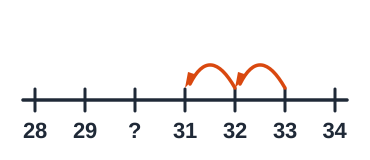
Look at the number line in the picture.

Count back: 33, 32, 31.

What number comes next?

A number line with marks numbered 28, 29, a question mark, 31, 32, 33 and 34. Curved arrows hop back from 33 to 32 and from 32 to 31.

Model answer

30

Explanation

The numbers go down by one each time. After 31, you say 30.

Mark scheme
  1. 1 mark

    30

    Accept thirty. Do not accept 32 or 40.

Question 2

1 mark

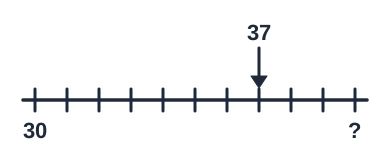
Look at the number line in the picture.

Tens are numbers like 10, 20 and 30.

What is the next ten after 37?

A number line that starts at 30 and ends at a question mark. An arrow labelled 37 points to a mark on the line.

Model answer

40

Explanation

Count on from 37: 38, 39, 40. The first ten you reach is 40.

Mark scheme
  1. 1 mark

    40

    Accept forty. Accept the common misspelling fourty. Do not accept 38, which is just the next number, or 30, which comes before 37.

Question 3

2 marks

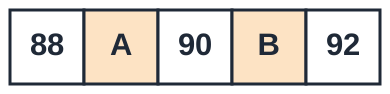
Look at the number track in the picture.

What number is A?

What number is B?

A number track of five squares. It shows 88, the letter A, 90, the letter B and 92.

Model answer

89, 91

Explanation

Count along the track: 88, 89, 90, 91, 92. So A is 89 and B is 91.

Mark scheme
  1. 1 mark

    89

    A is 89. Accept eighty-nine, with or without the hyphen.

  2. 1 mark

    91

    B is 91. Accept ninety-one, with or without the hyphen. Do not accept 19. Each part is marked on its own. Answers typed in order, such as 89, 91, score both marks. 91 alone scores this mark only.

Question 4

3 marks

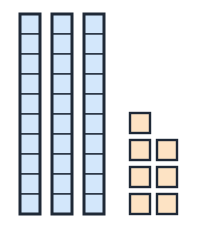
Look at the picture.

Each stick is 1 ten. Each small cube is 1 one.

How many tens are there?

How many ones are there?

What number do they make?

Some sticks of ten cubes and some small single cubes.

Model answer

3, 7, 37

Explanation

There are 3 sticks, so that is 30. Count on the 7 cubes: 31, 32, up to 37. Well done!

Mark scheme
  1. 1 mark

    3

    The tens. Accept three, 3 tens. Do not accept 30, as the question asks how many tens.

  2. 1 mark

    7

    The ones. Accept seven, 7 ones.

  3. 1 mark

    37

    The number. Accept thirty-seven, with or without the hyphen. Do not accept 73 or 10. Allow follow-through: the number made by the pupil's own tens and ones (for example 3, 6, 36). Each part is marked on its own. Answers typed in order, such as 3, 7, 37, score all 3 marks. 37 alone scores this mark only.

Ready to try the rest? Tap your answers and see straight away how you did.

Topic notes

Numbers to 100

The big idea

Numbers keep going after 20, all the way to 100. Tens and ones help us read them.

Tens and ones

A stick is 10 cubes joined up. It is 1 ten. A small cube is 1 one. Tens are numbers like 10, 20 and 30.

Two sticks of 10 cubes and 8 small cubes. They make 28.
Each box is one cube. 2 sticks and 8 cubes make 28.

Count the sticks in tens: 10, 20. Then count the cubes: 21, 22, and on to 28. So 28 has 2 tens and 8 ones.

We say the tens first. We write the tens first too. So seventy-two is 72. The 7 is 7 tens. The 2 is 2 ones.

Each string holds 10 beads. Ana has 6 strings and 2 loose beads. How many beads does she have?

Touch each string and count in tens: 10, 20, 30, 40, 50, 60.

Now touch each loose bead: 61, 62.

Ana has 62 beads.

Counting on and back

Counting on means saying the next numbers, going up. Counting back means going down. We can start at any number. A new ten comes after a 9: 29, 30.

Counting goes past 100 too: 99, 100, 101. To count back, say them the other way round.

Some pages fall out of a story book. The book goes from page 47 to page 50. Which page numbers are missing?

Put your finger on 47. Do not say 47 again.

Count on: 48, 49, 50. Stop at 50.

The missing page numbers are 48 and 49.

The next ten

The next ten is the first ten we reach when we count on.

A toy bus stops only at the tens. It is at 53 now. Where does it stop next?

A number line from 50 to 60 with every mark numbered. Arrow A points to 53.
Arrow A shows the bus at 53.

Count on from 53: 54, 55, 56, 57, 58, 59, 60.

60 is a ten, so the bus stops there.

The bus stops next at 60.

Common mistakes

  • Swapping the tens and ones. 2 tens and 7 ones is 27, not 72.
  • Counting the sticks in ones. 8 sticks are 80 cubes, not 8.
  • Going down past a ten. Back from 70 comes 69, not 60.
  • Saying the next number, not the next ten. The next ten after 16 is 20, not 17.

Top tip

Say the numbers out loud together. Slow down at each new ten.

Study Helper Hints first, answers after you try

Stuck on this one? Ask for a hint and I’ll point you in the right direction, without giving the answer away. Once you’ve checked your answer, I’ll show you how the marks are awarded.