Level:
Correct: 0
Incorrect: 0
Marks: 0/0
Practice
Course:
Topics:
Year 1 Maths Smart practice A mixed round aimed at your weak spots
Unit 1
Place value
Unit 2
Addition and subtraction
Unit 3
Multiplication and division
Unit 4
Fractions
Unit 5
Measurement
Unit 6
Geometry
Avg
score:
–
Topics
done:
0/27

Coins and notes

Practise 16 questions on Coins and notes for Year 1 Maths. Tap your answer and find out straight away if you are right, with the Study Helper on hand if you get stuck.

  • 16 questions
  • 1–3 marks each
  • Instant marking
  • No sign-up needed
16 questions, marked as you go

Sample questions with model answers

Here are 4 of the questions in this topic, each with a model answer, an explanation of why it earns the marks and the mark scheme.

Question 1

1 mark

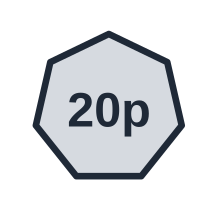
Look at the picture.

Which coin is this?

One silver coin with seven sides and its value printed on it.

Model answer

20p

Explanation

This silver coin has 7 sides and it says 20p. A common slip is to pick 2p, so look at both numbers on the coin: a 2 and a 0.

Mark scheme
  1. 1 mark

    20p

    Accept 20p, 20, 20 pence, twenty pence or the 20p coin. Do not accept 2p or £2.

Question 2

1 mark

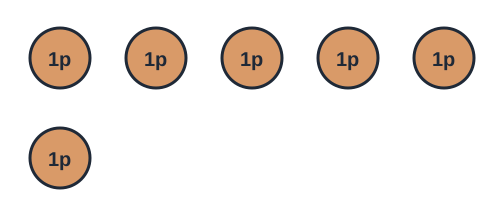
The picture shows the coins in Mia's purse.

How much money is in her purse?

Some 1p coins in two rows.

Model answer

6p

Explanation

Each coin is worth 1p, so count them one at a time: 1, 2, 3, 4, 5, 6. That makes 6p.

Mark scheme
  1. 1 mark

    6p

    Accept 6p, 6, 6 pence or six pence.

Question 3

2 marks

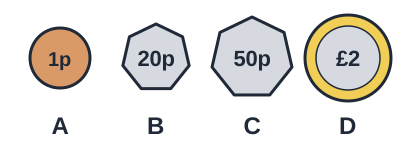
Look at the picture.

Which coin is worth the most?

Which coin is worth the least?

Four coins labelled A, B, C and D. A is a 1p coin, B is a 20p coin, C is a 50p coin and D is a £2 coin.

Model answer

D, A

Explanation

The £2 coin is in pounds, so it is worth the most. The 1p coin is worth the least. A common slip is to pick the 50p coin as the most because 50 is a big number.

Mark scheme
  1. 1 mark

    D

    Worth the most. Accept D, a small letter d, £2 or the £2 coin. Do not accept C, 50p or the 50p coin.

  2. 1 mark

    A

    Worth the least. Accept A, a small letter a, 1p or the 1p coin. Each part is marked on its own. Answers typed in order, such as D, A, score both marks. The same letter for both scores 1 mark at most.

Question 4

3 marks

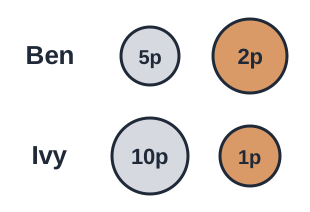
The picture shows Ben's coins and Ivy's coins.

How much money does Ben have?

How much money does Ivy have?

Who has more money?

Two rows of coins. Ben has a 5p coin and a 2p coin. Ivy has a 10p coin and a 1p coin.

Model answer

7p, 11p, Ivy

Explanation

Ben has 5p and 2p, which is \(5 + 2 = 7\). Ivy has 10p and 1p, which is \(10 + 1 = 11\). 11 is more than 7, so Ivy has more.

Mark scheme
  1. 1 mark

    7p

    Ben's money. Accept 7p, 7, 7 pence or seven pence.

  2. 1 mark

    11p

    Ivy's money. Accept 11p, 11, 11 pence or eleven pence.

  3. 1 mark

    Ivy

    Accept clear misspellings such as Ivey or Ivi. Do not accept Ben, unless the pupil's own amounts for Ben and Ivy give Ben more money (follow through). Each part is marked on its own. Answers typed in order, such as 7, 11, Ivy, score all 3 marks. Ivy alone scores this mark only.

Ready to try the rest? Tap your answers and see straight away how you did.

Topic notes

Coins and notes

The big idea

We pay for things with coins and notes. Coins are small and hard. You can fold a note. Each one has a number on it. The number tells us what it is worth. That means how much money it is.

The money we use

p stands for pence. £ stands for pounds.

The coins are 1p, 2p, 5p, 10p, 20p and 50p. Then there are £1 and £2. The notes we use most are £5, £10 and £20.

Eight coins in a row, marked 1p, 2p, 5p, 10p, 20p, 50p, £1 and £2. Below them, three notes marked £5, £10 and £20.
All 8 coins and the 3 notes we use most, each with its number. Real coins are different sizes and shapes.

Which is worth more?

Look at the sign first. A pound coin is worth more than a pence coin. If the signs match, the bigger number is worth more.

Pia has a £10 note. Ken has a £2 coin. Who has more money?

Look at the signs. Both are in pounds.

Look at the numbers. 10 is more than 2.

So Pia has more money.

Counting coins

Say one number for each coin.

  • Count 1p coins in 1s: 1, 2, 3, 4.
  • Count 2p coins in 2s: 2, 4, 6, 8, 10.
  • Count 5p coins in 5s: 5, 10, 15, 20.
  • Count 10p coins in 10s: 10, 20.

A pencil costs 20p. Ella pays with 5p coins. How many does she need?

Count in 5s until you reach 20. Put up a finger each time.

5, 10, 15, 20.

That is 4 fingers. So Ella needs 4 coins.

Are the coins different? Start with the coin worth the most. Then add the others.

Three boxes joined by arrows. 10p goes to 15p by adding 5p. Then 15p goes to 17p by adding 2p.
Start at 10p. Add 5p to make 15p. Add 2p to make 17p.

Tia finds three coins under the sofa. There is a 2p coin, a 10p coin and a 5p coin. How much is that?

Start with the coin worth the most. That is 10p.

Add the 5p: \(10 + 5 = 15\).

Add the 2p: \(15 + 2 = 17\).

Tia has 17p.

Remember

  • Say one number for each coin.
  • Start with the coin worth the most.

Common mistakes

  • Counting the coins, not what they are worth. Four 5p coins make 20p, not 4p.
  • Thinking a bigger coin is worth more. A 1p coin is bigger than a 5p coin. But it is worth less.
  • Mixing up 5p and 50p. Look at the whole number. 50p has a 5 and a 0.
  • Forgetting the £ sign. £1 is worth more than 20p, even though 20 is bigger.

Top tip

Use real coins on the table. Touch each coin as you count.

Study Helper Hints first, answers after you try

Stuck on this one? Ask for a hint and I’ll point you in the right direction, without giving the answer away. Once you’ve checked your answer, I’ll show you how the marks are awarded.