Level:
Correct: 0
Incorrect: 0
Marks: 0/0
Practice
Course:
Topics:
Year 1 Maths Smart practice A mixed round aimed at your weak spots
Unit 1
Place value
Unit 2
Addition and subtraction
Unit 3
Multiplication and division
Unit 4
Fractions
Unit 5
Measurement
Unit 6
Geometry
Avg
score:
–
Topics
done:
0/27

Capacity and volume

Practise 13 questions on Capacity and volume for Year 1 Maths. Tap your answer and find out straight away if you are right, with the Study Helper on hand if you get stuck.

  • 13 questions
  • 1–3 marks each
  • Instant marking
  • No sign-up needed
13 questions, marked as you go

Sample questions with model answers

Here are 4 of the questions in this topic, each with a model answer, an explanation of why it earns the marks and the mark scheme.

Question 1

1 mark

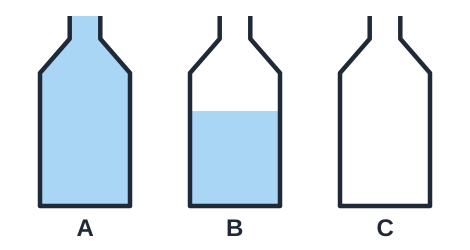
Look at the picture.

Which bottle is empty?

Three bottles of the same size, labelled A, B and C. They hold different amounts of water.

Model answer

C

Explanation

An empty bottle has nothing in it. Bottle C has no water, so it is empty. Bottle A is full and bottle B is half full.

Mark scheme
  1. 1 mark

    C

    Accept C or bottle C, with a capital or a small letter. Do not accept B, which is half full, or A, which is full.

Question 2

1 mark

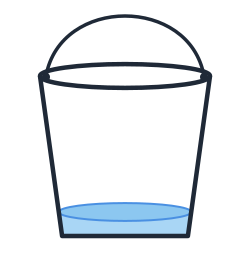
Look at the picture.

Is the bucket nearly full or nearly empty?

A bucket with some water in it.

Model answer

nearly empty

Explanation

There is only a little water at the bottom of the bucket. It is not quite empty, but it soon would be. So it is nearly empty.

Mark scheme
  1. 1 mark

    nearly empty

    Accept nearly empty, or a clear misspelling such as nearly emty. Do not accept nearly full. Empty alone scores 0, because the bucket has a little water in it.

Question 3

2 marks

Jug A holds 6 cups of water. Jug B holds 9 cups.

Which jug holds less?

How many more cups does jug B hold?

Model answer

A, 3

Explanation

6 cups is fewer than 9 cups, so jug A holds less. Count on from 6 to 9: 7, 8, 9. That is 3 more cups.

Mark scheme
  1. 1 mark

    A

    Accept A or jug A, with a capital or a small letter. Do not accept B.

  2. 1 mark

    3

    Accept 3 or three, with or without the word cups. Do not accept 15 (adding the two). Each part is marked on its own. Answers typed in order, such as A, 3, score both marks. 3 alone scores this mark only.

Question 4

3 marks

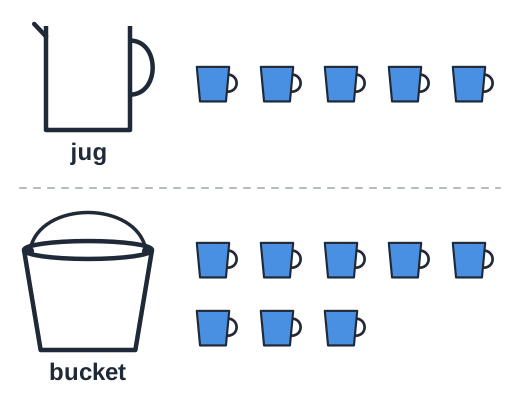
Look at the jug and the bucket.

The cups beside each one fill it.

How many cups fill the jug?

How many cups fill the bucket?

Which holds more?

A jug with a line of cups beside it. Below it, a bucket with cups beside it, in two lines.

Model answer

5, 8, bucket

Explanation

Count the cups beside each one. The jug takes 5 cups and the bucket takes 8 cups. 8 is more than 5, so the bucket holds more.

Mark scheme
  1. 1 mark

    5

    The jug. Accept 5 or five, with or without the word cups.

  2. 1 mark

    8

    The bucket. Accept 8 or eight, with or without the word cups.

  3. 1 mark

    the bucket

    Accept bucket or the bucket, and clear misspellings such as bukit. Do not accept the jug. Each part is marked on its own. Follow through: if a count is wrong, accept whichever their own two counts show holds more (for example 5, 4, then the jug). Answers typed in order, such as 5, 8, bucket, score all 3 marks. Bucket alone scores this mark only.

Ready to try the rest? Tap your answers and see straight away how you did.

Topic notes

Capacity and volume

The big idea

Capacity is how much something can hold. Volume is how much is in it now. We often measure water.

Full, half full and empty

  • Full means it cannot hold any more.
  • Nearly full means it is almost at the top.
  • Half full means the water comes halfway up.
  • Nearly empty means there is only a little water.
  • Empty means there is nothing in it.

A quarter full is less than half full. A quarter is half of a half.

Five pots of the same size in a row. The first is empty. The second is nearly empty. The third is half full. The fourth is nearly full. The fifth is full.
Five pots of the same size. Going along, they have more and more water.

Which holds more?

Some things hold more than others. Some things hold less. A bath holds more than a mug.

Two things the same size? Then look at how high the water comes.

Two mugs are the same size. Sam's mug is half full of juice. Pia's mug is nearly full. Who has more juice?

Look at how high the juice comes.

Half full comes up to the middle.

Nearly full comes almost to the top. That is higher.

So Pia has more juice.

How many cups fill it?

We can measure with cups. Fill a cup to the top. Pour it into the jug. Say 1. Keep going until the jug is full.

The same jug drawn four times in a row. After 1 cup the water is a little way up. After 2 cups it is halfway up. After 3 cups it is nearly at the top. After 4 cups the jug is full.
The same jug after each cup. After 4 cups it is full. So 4 cups fill this jug.

Jon fills a jug with small cups. Ali fills the same jug with big cups. Who needs more cups?

A small cup holds less. So Jon pours lots of times. Maybe he pours 8 times.

A big cup holds more. So Ali pours fewer times. Maybe he pours 4 times.

8 is more than 4. So Jon needs more cups.

Remember

  • Half full means halfway up.
  • Fill the cup to the top each time.
  • Use the same cups. More cups means it holds more.

Common mistakes

  • Thinking the tallest one holds the most. A wide pot can hold more than a thin vase.
  • Mixing up nearly full and nearly empty. Nearly full is close to the top. Nearly empty is close to the bottom.
  • Comparing water in things of different sizes. Use two things the same size.

Top tip

Play with water at bath time. Pour cups into a jug and count them.

Study Helper Hints first, answers after you try

Stuck on this one? Ask for a hint and I’ll point you in the right direction, without giving the answer away. Once you’ve checked your answer, I’ll show you how the marks are awarded.