Level:
Correct: 0
Incorrect: 0
Marks: 0/0
Practice
Course:
Topics:
Year 1 Maths Smart practice A mixed round aimed at your weak spots
Unit 1
Place value
Unit 2
Addition and subtraction
Unit 3
Multiplication and division
Unit 4
Fractions
Unit 5
Measurement
Unit 6
Geometry
Avg
score:
–
Topics
done:
0/27

Number bonds to 10

Practise 19 questions on Number bonds to 10 for Year 1 Maths. Tap your answer and find out straight away if you are right, with the Study Helper on hand if you get stuck.

  • 19 questions
  • 1–3 marks each
  • Instant marking
  • No sign-up needed
19 questions, marked as you go

Sample questions with model answers

Here are 4 of the questions in this topic, each with a model answer, an explanation of why it earns the marks and the mark scheme.

Question 1

1 mark

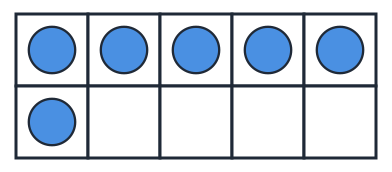
Look at the ten frame.

It has 6 counters in it.

How many squares are empty?

A ten frame. Some squares have a blue counter in them.

Model answer

4

Explanation

Count the empty squares: 1, 2, 3, 4. So 6 and 4 make 10.

Mark scheme
  1. 1 mark

    4

    Do not accept 6, which is the number of counters. Accept four.

Question 2

1 mark

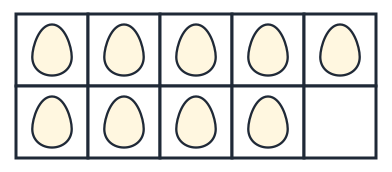
Look at the picture.

The egg box holds 10 eggs.

How many more eggs will fit?

An egg box, with rows of spaces. Some spaces hold an egg and the rest are empty.

Model answer

1

Explanation

Only 1 space is empty. 9 and 1 make 10.

Mark scheme
  1. 1 mark

    1

    Do not accept 9, which is the eggs already in the box. Accept one.

Question 3

2 marks

What are the missing numbers?

\(1 + \square = 10\)

\(4 + \square = 7\)

Model answer

9, 3

Explanation

Count on from each number. From 1 to 10 is 9. From 4 to 7 is 3.

Mark scheme
  1. 1 mark

    9

    Do not accept 11, which comes from adding 1 and 10. Accept nine.

  2. 1 mark

    3

    Do not accept 11, which comes from adding 4 and 7. Accept three. Each part is marked on its own. Answers typed in order, such as 9, 3, score both marks. 3 alone scores this mark only.

Question 4

3 marks

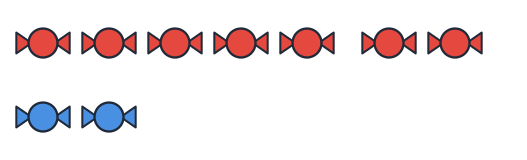
Look at the picture.

How many red sweets are there?

How many blue sweets are there?

What is \(7 + 2\)?

Some red sweets in a row, and some blue sweets in a row under them.

Model answer

7, 2, 9

Explanation

Count the red sweets, then the blue sweets. Then count them all to find 7 and 2 together: 9. Well done!

Mark scheme
  1. 1 mark

    7

    The red sweets. Accept seven.

  2. 1 mark

    2

    The blue sweets. Accept two.

  3. 1 mark

    9

    The answer to \(7 + 2\). Accept nine. Each part is marked on its own, with no follow through. Answers typed in order, such as 7, 2, 9, score all 3 marks. 9 alone scores this mark only.

Ready to try the rest? Tap your answers and see straight away how you did.

Topic notes

Number bonds to 10

The big idea

Two numbers can go together to make a number. That is a number bond. 6 and 4 make 10.

Pairs that make 10

A pair is two numbers. Say these pairs out loud.

  • 0 and 10
  • 1 and 9
  • 2 and 8
  • 3 and 7
  • 4 and 6
  • 5 and 5

A ten frame has 10 squares. The counters show one number. The empty squares show the other.

A ten frame with 7 counters and 3 empty squares.
7 counters and 3 empty squares. 7 and 3 make 10.

A ladybird has 10 spots. 3 are on one wing. How many are on the other wing?

Hold up 3 fingers. Those are the 3 spots.

Touch each finger still down. 1, 2, 3, 4, 5, 6, 7.

3 and 7 make 10.

There are 7 spots on the other wing.

Other bonds

Every number up to 10 has bonds. 8 can be 7 and 1.

A part-whole picture shows a bond. The top number is the whole. The two numbers below are the parts.

There are 8 ducks. 6 are in the pond. The rest are on the grass. How many are on the grass?

A part-whole picture. The top circle says 8. The circles below say 6 and a question mark.
The whole is 8. One part is 6.

All 8 ducks are the whole.

The 6 in the pond are one part.

Count on from 6 to 8. Say 7, 8. That is 2 more.

There are 2 ducks on the grass.

Take away facts

Take away means some go away. Each bond gives a take away fact.

A jar has 10 buttons. Ann takes out 4. How many are in the jar now?

Some buttons go, so take away.

Use the bond. 4 and 6 make 10.

So \(10 - 4 = 6\).

6 buttons are in the jar.

Missing numbers

A box shows a missing number. Look at \(2 + \square = 10\). What goes with 2 to make 10? 2 and 8 make 10. So 8 goes in the box.

Remember

Two parts make the whole.

Common mistakes

  • Adding the numbers you can see. In \(2 + \square = 10\), the box is not 12.
  • Counting the number you start on. To count on from 6, say 7, 8. Do not say 6.
  • Counting only the counters. To find the other part, count the empty squares.

Top tip

Hold up some fingers. The fingers still down are the other part.

Study Helper Hints first, answers after you try

Stuck on this one? Ask for a hint and I’ll point you in the right direction, without giving the answer away. Once you’ve checked your answer, I’ll show you how the marks are awarded.