Level:
Correct: 0
Incorrect: 0
Marks: 0/0
Practice
Course:
Topics:
Year 1 Maths Smart practice A mixed round aimed at your weak spots
Unit 1
Place value
Unit 2
Addition and subtraction
Unit 3
Multiplication and division
Unit 4
Fractions
Unit 5
Measurement
Unit 6
Geometry
Avg
score:
–
Topics
done:
0/27

Comparing numbers

Practise 16 questions on Comparing numbers for Year 1 Maths. Tap your answer and find out straight away if you are right, with the Study Helper on hand if you get stuck.

  • 16 questions
  • 1–3 marks each
  • Instant marking
  • No sign-up needed
16 questions, marked as you go

Sample questions with model answers

Here are 4 of the questions in this topic, each with a model answer, an explanation of why it earns the marks and the mark scheme.

Question 1

1 mark

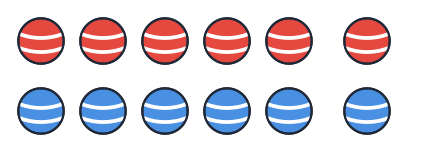
Look at the picture.

Count the red balls and the blue balls.

What do you find?

A row of red balls, and a row of blue balls under it.

Model answer

they are equal

Explanation

There are 6 red balls and 6 blue balls. 6 is equal to 6, so neither colour has more.

Mark scheme
  1. 1 mark

    they are equal

    Accept equal or the same. Accept clear misspellings such as eqal or eekwal. Do not accept red is more or red is less.

Question 2

1 mark

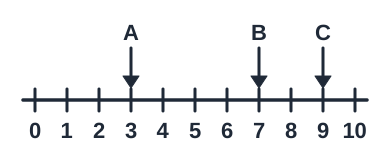
Look at the number line in the picture.

Which letter is at 7?

A number line from 0 to 10 with every mark numbered. Three arrows, A, B and C from left to right, each point to a mark.

Model answer

B

Explanation

Find 7 under the line. Then look up to the arrow above it. The arrow is labelled B.

Mark scheme
  1. 1 mark

    B

    Accept a small letter, b. Do not accept A or C.

Question 3

2 marks

Which number is more, 63 or 36?

Which number is less, 40 or 38?

Model answer

63, 38

Explanation

Look at the tens first. 6 tens is more than 3 tens, so 63 is more. 3 tens is less than 4 tens, so 38 is less.

Mark scheme
  1. 1 mark

    63

    The number that is more. Accept sixty-three, with or without the hyphen.

  2. 1 mark

    38

    The number that is less. Accept thirty-eight, with or without the hyphen. Do not accept 40: an 8 is bigger than a 0, but 4 tens is more than 3 tens. Each part is marked on its own. Answers typed in order, such as 63, 38, score both marks. 38 alone scores this mark only.

Question 4

3 marks

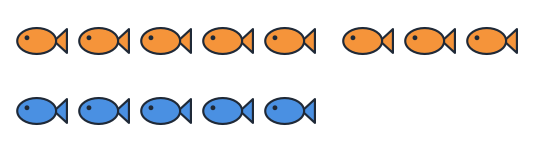
Look at the picture.

How many orange fish are there?

How many blue fish are there?

Which colour has fewer fish?

A row of orange fish, and a row of blue fish under it.

Model answer

8, 5, blue

Explanation

Count each colour: 8 orange fish and 5 blue fish. 5 is less than 8, so there are fewer blue fish.

Mark scheme
  1. 1 mark

    8

    The orange fish. Accept eight.

  2. 1 mark

    5

    The blue fish. Accept five.

  3. 1 mark

    blue

    Accept clear misspellings such as blew or bloo. Accept the blue fish. Do not accept orange. Allow follow-through: the colour with fewer fish by the pupil's own two counts. Each part is marked on its own. Answers typed in order, such as 8, 5, blue, score all 3 marks. Blue alone scores this mark only.

Ready to try the rest? Tap your answers and see straight away how you did.

Topic notes

Comparing numbers

The big idea

To compare means to look at two things. We see which is more, or if they are the same. We can compare groups. We can compare numbers too.

Words for comparing

  • More than means a bigger number. 9 is more than 3.
  • Less than means a smaller number. 3 is less than 9.
  • Fewer means not as many. We say it about things we count.
  • Equal to means the same. 9 is equal to 9.
  • Most means the biggest number of all.
  • Least means the smallest number of all.
Two rows of boxes lined up at the left. The top row shows 7 cups and the bottom row shows 4 spoons.
Each box is one thing. The rows are lined up. There are more cups than spoons.

There are 5 chairs and 4 children. Each child sits on a chair. Are there fewer chairs or fewer children?

Match them up. 1 child goes with 1 chair.

All the children have a chair. 1 chair is left over.

There are fewer children.

On a number line

A number line shows numbers in order. They get bigger as we go along. To find a number, start at one we can see. Then count along the marks.

A number line from 0 to 20 with a mark for every number. The numbers 0, 5, 10, 15 and 20 are written on it. Arrow A points to 6 and arrow B points to 14.
Arrow A points to 6. Arrow B points to 14. 14 is further along, so 14 is more than 6.

Putting numbers in order

To order numbers means to put them in a line. Find the smallest first. Then find the next one.

Lu has 14 stickers. Max has 7. Pip has 10. They line up with the least first. Who stands in the middle?

The least is 7. That is Max.

Next is 10. That is Pip.

The most is 14. That is Lu.

In order, the numbers are 7, 10, 14.

Pip stands in the middle.

Bigger numbers

Look at the tens first. More tens means a bigger number. If the tens are the same, look at the ones.

Train A has 52 seats. Train B has 47 seats. Which train has fewer seats?

Look at the tens first.

52 has 5 tens. 47 has 4 tens.

4 tens is less than 5 tens. So 47 is less than 52.

Train B has fewer seats.

Common mistakes

  • Looking at the size of things. 3 big cars are fewer than 5 small cars.
  • Looking at the ones first. 30 is more than 27. 3 tens beat 2 tens.
  • Starting at the wrong end. Check if it says smallest or biggest first.

Top tip

Put two groups side by side. Match them up. Then see which has more.

Study Helper Hints first, answers after you try

Stuck on this one? Ask for a hint and I’ll point you in the right direction, without giving the answer away. Once you’ve checked your answer, I’ll show you how the marks are awarded.