Level:
Correct: 0
Incorrect: 0
Marks: 0/0
Practice
Course:
Topics:
Year 1 Maths Smart practice A mixed round aimed at your weak spots
Unit 1
Place value
Unit 2
Addition and subtraction
Unit 3
Multiplication and division
Unit 4
Fractions
Unit 5
Measurement
Unit 6
Geometry
Avg
score:
–
Topics
done:
0/27

Length and height

Practise 16 questions on Length and height for Year 1 Maths. Tap your answer and find out straight away if you are right, with the Study Helper on hand if you get stuck.

  • 16 questions
  • 1–3 marks each
  • Instant marking
  • No sign-up needed
16 questions, marked as you go

Sample questions with model answers

Here are 4 of the questions in this topic, each with a model answer, an explanation of why it earns the marks and the mark scheme.

Question 1

1 mark

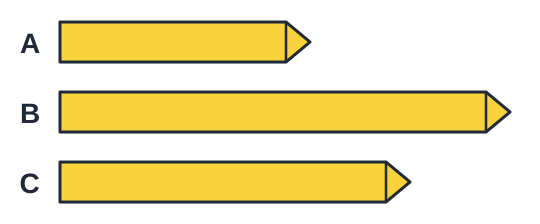
Look at the picture.

Which pencil is the longest?

Three pencils, labelled A, B and C, lie one above another. They all start at the same place on the left.

Model answer

B

Explanation

All the pencils start at the same place. Look at where each one ends. Pencil B goes the furthest, so it is the longest.

Mark scheme
  1. 1 mark

    B

    Accept B or pencil B, with a capital or a small letter. Do not accept C, which is the middle length, or A, which is the shortest.

Question 2

1 mark

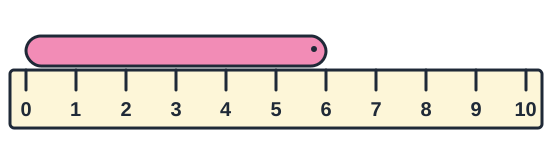
Look at the picture.

The worm starts at 0 on the ruler.

How many centimetres long is the worm?

A pink worm lies just above a ruler. The ruler is numbered in centimetres from 0. One end of the worm is at 0.

Model answer

6

Explanation

The worm starts at 0. Look at the number under its end: it is 6. So the worm is 6 cm long. Do not count the 0 as one.

Mark scheme
  1. 1 mark

    6

    Accept 6, 6 cm, 6 centimetres or six. Do not accept 7 (counting the marks, with the 0 mark as 1) or 10 (the end of the ruler).

Question 3

2 marks

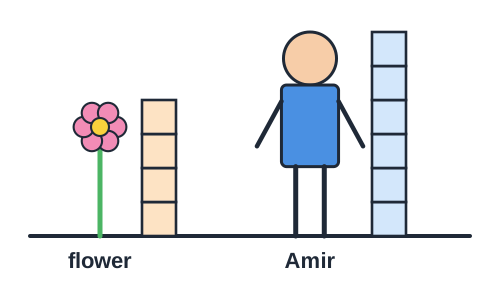
Look at the picture.

How many cubes tall is the flower?

How many cubes tall is Amir?

A flower with a tower of cubes beside it, and a child called Amir with a taller tower of cubes beside him. Each tower reaches the top of the flower or child next to it.

Model answer

4, 6

Explanation

Count the cubes in the tower beside each one. The flower is as tall as 4 cubes. Amir is as tall as 6 cubes.

Mark scheme
  1. 1 mark

    The flower is 4 cubes tall

    Accept 4 or four, with or without the word cubes.

  2. 1 mark

    Amir is 6 cubes tall

    Accept 6 or six, with or without the word cubes. Do not accept 10, which is all the cubes in the picture. Each part is marked on its own. Answers typed in order, such as 4, 6, score both marks. 6 alone scores this mark only.

Question 4

3 marks

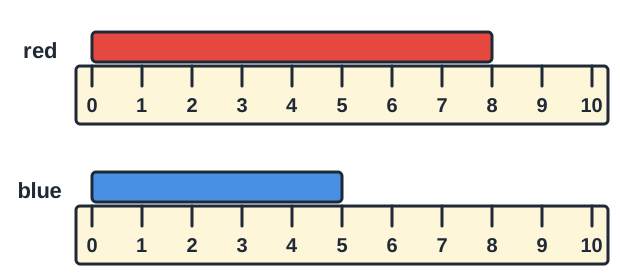
Look at the picture.

How many centimetres long is the red ribbon?

How many centimetres long is the blue ribbon?

How many centimetres longer is the red ribbon?

Two rulers, one above the other, numbered in centimetres from 0. A red ribbon lies above the top ruler and a blue ribbon lies above the bottom ruler. Each ribbon starts at 0.

Model answer

8, 5, 3

Explanation

The red ribbon ends at 8 and the blue ribbon ends at 5. Count on from 5 to 8: 6, 7, 8. That is 3 more, so the red ribbon is 3 cm longer.

Mark scheme
  1. 1 mark

    8

    The red ribbon. Accept 8, 8 cm, 8 centimetres or eight. Do not accept 9 (counting the marks, with the 0 mark as 1).

  2. 1 mark

    5

    The blue ribbon. Accept 5, 5 cm, 5 centimetres or five. Do not accept 6 (counting the marks, with the 0 mark as 1).

  3. 1 mark

    3

    How much longer. Accept 3, 3 cm, 3 centimetres or three. Do not accept 13 (adding the two lengths). Each part is marked on its own. Follow through: if a length is wrong, accept their red length take away their blue length, when the red is longer (for example 9, 5, then 4). Answers typed in order, such as 8, 5, 3, score all 3 marks. 3 alone scores this mark only.

Ready to try the rest? Tap your answers and see straight away how you did.

Topic notes

Length and height

The big idea

Length is how long something is. Height is how tall something is.

Longer, shorter and taller

To compare means to see which is more. Put the ends in line. Then look at the other ends.

  • The one that goes further is longer.
  • The other one is shorter.
  • Stand two things on the same floor. The higher one is taller.

With three or more things, we say the longest, the shortest and the tallest.

Measuring with cubes, clips and hands

To measure means to find how long or tall. Put cubes or paper clips in a line beside it. Leave no gaps. Then count them.

A hand span goes from thumb to little finger. Count each span.

Two rows of cubes, one above the other. The toy bus has 6 cubes. The toy car has 4 cubes. Both rows start at the same place.
Each box is one cube. Both toys start at the same place.

Look at the picture. Is the car longer or shorter than the bus?

Touch each cube for the car. 1, 2, 3, 4.

Touch each cube for the bus. 1, 2, 3, 4, 5, 6.

4 is less than 6. So the car is shorter than the bus.

Mrs Bell and Ali measure one table with hand spans. Mrs Bell counts 6 spans. Ali counts 9 spans. Why are the numbers different?

Mrs Bell's hand is bigger, so fewer spans fit.

Ali's hand is smaller, so more spans fit.

Bigger hands give a smaller number.

Measuring with a ruler

A ruler measures in centimetres. We write cm for short. Put one end on the 0. Then read the number at the other end.

A paintbrush above a ruler numbered from 0 to 8 centimetres. One end of the paintbrush is at 0. The other end is at 7.
The paintbrush starts at 0. It ends at the 7. So it is 7 cm long.

Putting three in order

A trainer is 8 clips long. A baby's shoe is 3 clips long. A boot is 10 clips long. Put them in order. Start with the longest.

10 is the biggest. So the boot comes first.

8 comes next. That is the trainer.

3 comes last. That is the baby's shoe.

The order is boot, trainer, baby's shoe.

Double and half

Double means two lots of the same length. Half means two pieces the same length.

A string is 20 cm long. Cut it in half. Each piece is 10 cm long, because \(10 + 10 = 20\). So double 10 cm is 20 cm.

Remember

  • Put the ends in line to compare.
  • Start at 0 on a ruler.

Common mistakes

  • Not putting the ends in line. Line up one end first.
  • Counting the 0 on a ruler as one. Ending at the 9 means 9 cm, not 10 cm.
  • Looking only at the tops. A toy on a chair looks taller. Stand both on the floor.

Top tip

Measure things at home with toy bricks. Touch each one as you count.

Study Helper Hints first, answers after you try

Stuck on this one? Ask for a hint and I’ll point you in the right direction, without giving the answer away. Once you’ve checked your answer, I’ll show you how the marks are awarded.