Level:
Correct: 0
Incorrect: 0
Marks: 0/0
Exam Practice
Subject:
Topics:
Avg
score:
–
Topics
done:
0/17

Trajan's campaigns against the Dacians

Practise 32 exam-style questions on Trajan's campaigns against the Dacians for OCR GCSE Classical Civilisation (War and Warfare). Write your answer as you would in the exam and get it marked in seconds against the mark scheme, point by point, with an AI tutor on hand if you get stuck.

  • 32 questions
  • 1–15 marks each
  • Instant marking
  • No sign-up needed
20 questions, marked as you go

Sample questions with model answers

Here are 4 of the questions in this topic, each with a model answer, an explanation of why it earns the marks and the mark scheme an examiner would use.

Question 1

1 mark

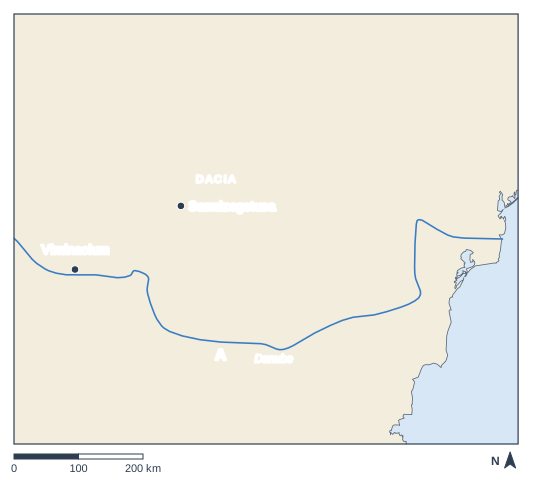
Figure 1 is a map of Dacia and the lower Danube. The Dacians had attacked the Roman province marked A, south of the river Danube.

Name the province marked A.

Map of Dacia and the lower Danube, drawn with real coastlines (land pale buff, sea pale blue) and no modern borders; a north arrow shows north at the top; the scale bar is 200 km long. Ancient region names printed in spaced capitals: Dacia. The letter A is printed on an area of land towards the bottom of the map (about 40% of the way across and 80% of the way down). Blue lines show a river: the Danube (named on the map). Points: a dot labelled "Sarmizegetusa" (inland); a dot labelled "Viminacium" (inland).

Model answer

Moesia.

Explanation

Moesia lay along the south bank of the Danube, facing Dacia. Dacian raids into Moesia in the reign of Domitian, in which a Roman governor was killed, showed how dangerous Decebalus' kingdom was to the frontier - one of the reasons for Trajan's wars.

Mark scheme
  1. 1 mark

    Moesia

    Accept 'Upper / Lower Moesia'. Do not accept Dacia, Pannonia or Thrace.

Question 2

2 marks

Source A: a scene on Trajan's Column. In a Dacian settlement, women torture naked Roman prisoners, whose hands are tied, with flaming torches.

Suggest two reasons why the designers of the Column included this scene.

Model answer

The scene shows the Dacians as cruel barbarians, even their women, which helped to justify the war and the harsh treatment of the Dacian people. It also reminded Roman viewers of the dangers and suffering their soldiers faced, honouring their sacrifice and stirring up anger against the enemy.

Explanation

The torture scene is one of the few on the Column showing Romans suffering, and it is carefully placed to contrast with Roman order and Trajan's mercy elsewhere. Good answers consider both its propaganda purpose and the possibility that it records something that really happened.

Mark scheme
  1. 1 mark

    First valid reason.

    Two from: to show the Dacians as cruel / savage barbarians (1); to justify the war and its harsh treatment of the Dacians (1); to make Roman viewers angry and want revenge (1); to show the dangers Roman soldiers faced and honour their sacrifice / courage (1); to contrast Dacian cruelty with Roman discipline and Trajan's mercy (1); because it may record a real event and the Column tells the story of the war (1). Max 2.

  2. 1 mark

    Second, different valid reason.

    As above; must be a different reason.

Question 3

4 marks

Source A: Cassius Dio, Roman History 68 (the battle of Tapae in the First Dacian War)

'Trajan joined battle with the enemy and saw many of his own men wounded, while he killed many of the enemy. When the bandages ran out, it is said that he did not spare even his own clothing, but cut it up into strips. In honour of the soldiers who had died in the battle, he ordered an altar to be built and funeral rites to be held there every year.'

What impressions of Trajan does Source A give? Make two points.

Model answer

Trajan seems to have cared deeply for his men: when the bandages ran out 'he did not spare even his own clothing, but cut it up into strips'. He also seems respectful and pious towards those who died, because he 'ordered an altar to be built and funeral rites to be held there every year' in their honour.

Explanation

Dio's story fits Trajan's image as a general who shared his soldiers' hardships - the same image found on Trajan's Column. Notice 'it is said': Dio is reporting a story, so good answers might mention that it could be a flattering anecdote.

Mark scheme
  1. 2 marks

    First impression with supporting evidence from Source A: 1 mark for a valid impression of Trajan, 1 mark for a relevant reference or quotation from the passage that supports it. The two marks are independent: award 1 for a valid point even if no evidence is given, and 1 for a relevant quotation from, reference to or close paraphrase of the source even if the point is missing, weak or wrong.

    Two pairs from, e.g.: he cared deeply for his soldiers (1) - 'he did not spare even his own clothing, but cut it up into strips' for bandages (1); he was generous / self-sacrificing (1) - giving up his own clothing (1); he shared his men's hardships / was close to them (1) - he was there in the battle and saw his men wounded (1); he was a successful commander (1) - 'he killed many of the enemy' (1); he was respectful / pious towards the dead (1) - he ordered an altar and yearly funeral rites for those who had died (1); he was practical in a crisis (1) - when bandages ran out he used his own clothes (1). The second pair must make a different point from the first. Points must come from the passage.

  2. 2 marks

    Second, different impression with supporting evidence from Source A: 1 mark for a valid impression of Trajan, 1 mark for a relevant reference or quotation from the passage that supports it. The two marks are independent: award 1 for a valid point even if no evidence is given, and 1 for a relevant quotation from, reference to or close paraphrase of the source even if the point is missing, weak or wrong.

    As above; must be a different impression from the first.

Question 4

8 marks

Source A: Pliny the Younger, Letters 8 (to a friend who was planning to write a poem about the Dacian War)

'You do well to plan to write about the Dacian War. For what subject is so fresh, so rich, so vast, and finally so poetic - and, though completely true, so like a legend? You will tell of new rivers made to flow over the land, new bridges thrown across rivers, camps clinging to sheer mountainsides, a king driven from his palace and even from life, yet never losing heart; and you will tell of two triumphs, one the first over a people never conquered before, the other the last.'

To what extent was the conquest of Dacia a remarkable achievement? Use Source A as a starting point and your own knowledge.

Model answer

Source A presents the conquest of Dacia as an extraordinary achievement, so remarkable that, though 'completely true', it seemed 'like a legend'. Pliny lists real feats: 'new rivers made to flow over the land', 'new bridges thrown across rivers' and 'camps clinging to sheer mountainsides'. My own knowledge supports this. Dacia was a mountain kingdom with strong fortresses, and Decebalus had defeated Roman armies under Domitian, so beating him was no small task. The Romans crossed the Danube on a bridge of boats, and between the wars Apollodorus of Damascus built a great stone bridge at Drobeta, which Cassius Dio says he could not admire enough. Sarmizegetusa was captured, Decebalus was driven to suicide, and Dacia became a new province whose gold and silver paid for Trajan's Forum, his Markets and games on 123 days. Pliny's 'two triumphs' over 'a people never conquered before' show how glorious it seemed in Rome.

However, we should not accept Pliny's view entirely. He was a senator and a friend of Trajan, and in this letter he is encouraging a friend to write a poem, so he deliberately makes the war sound epic. The conquest needed two wars, because the first peace failed, and it came at a terrible cost: villages were burned, prisoners enslaved and families deported, as Trajan's Column shows. Rome also had far greater resources than the Dacians, so victory was perhaps to be expected. Nor was the new province easy to hold: Hadrian removed the upper part of the bridge for fear of invasion, and Dacia was eventually given up in the third century.

Overall, the conquest was a genuinely remarkable military and engineering achievement and brought Trajan enormous glory and wealth. But Source A is a flattering literary account, and the achievement must be balanced against its human cost and its limited permanence.

Explanation

Strong answers use Pliny's details (rivers, bridges, mountain camps, the king's death, two triumphs) and support them with knowledge of the bridge, Sarmizegetusa and the booty, then evaluate Pliny's purpose and the costs of the conquest. Recognising that the letter is deliberately literary and flattering is the critical analysis that reaches Level 4.

Mark scheme
  1. 8 marks

    Levels of response (8 marks). AO1 (4) and AO2 (4) are equally weighted.
    Level 4 (7-8 marks): consistently accurate and detailed knowledge of the Dacian Wars and their results, using both Source A and own wider knowledge; shows very good understanding of the context and of Pliny's position and purpose; a well-argued response with a clear, substantiated judgement on how remarkable the conquest was, supported by a range of well-selected evidence, including critical analysis.
    Level 3 (5-6 marks): accurate knowledge, using both the source and own knowledge; a focused response with relevant analysis and a judgement.
    Level 2 (3-4 marks): sound, mostly accurate knowledge of the wars; engages with the general topic, using a limited range of evidence, with some analysis.
    Level 1 (1-2 marks): limited knowledge, may only use or paraphrase Source A; isolated analysis.
    0 marks: no response or no response worthy of credit.
    A mainly descriptive or narrative answer with little analysis or judgement cannot go above Level 2.

    Indicative content (not a checklist; credit other valid points): AO1: Source A - new rivers made to flow over the land, new bridges across rivers, camps on sheer mountainsides, a king driven from his palace and life but never losing heart, two triumphs, the first over a people never conquered before. Own knowledge - Decebalus had defeated Domitian's armies; the difficult mountain country and strong fortresses; the pontoon bridge and Apollodorus' stone bridge at Drobeta; the two wars, AD 101-102 and 105-106; the capture of Sarmizegetusa, Decebalus' suicide and his head shown to the troops; Dacia made a province, with gold and silver mines and Decebalus' treasure; Trajan's Forum, Markets and games of 107; Trajan's Column and the Arch at Benevento; victims - prisoners, deportations, burned villages; later, Hadrian removed the bridge's upper part and Dacia was eventually given up in the third century. AO2: remarkable - a dangerous enemy who had humiliated Rome was completely defeated in difficult terrain; outstanding engineering and logistics; the first new province for many years, bringing enormous wealth; Trajan's glory celebrated for centuries. Limits - Pliny was a senator and friend of Trajan writing in flattering literary style, encouraging a poem, so he exaggerates; the conquest took two wars, because the first peace failed; it cost many lives and great suffering for the Dacians; Rome had far greater resources than Dacia; the province was hard to defend and was later abandoned. A substantiated judgement might be that it was a genuinely remarkable military and engineering achievement, though the sources celebrating it are one-sided and its human cost was high.

Ready to try the rest? Every answer you write is marked against the mark scheme, so you can see exactly where the marks are.

AI Tutor Hints first, answers after you try

Hi! Stuck? Ask me for a hint and I’ll help you work it out. Once you’ve checked your answer I can explain exactly where the marks are.