Level:
Correct: 0
Incorrect: 0
Marks: 0/0
Exam Practice
Subject:
Topics:
Avg
score:
–
Topics
done:
0/17

The Battle of Thermopylae

Practise 35 exam-style questions on The Battle of Thermopylae for OCR GCSE Classical Civilisation (War and Warfare). Write your answer as you would in the exam and get it marked in seconds against the mark scheme, point by point, with an AI tutor on hand if you get stuck.

  • 35 questions
  • 1–15 marks each
  • Instant marking
  • No sign-up needed
20 questions, marked as you go

Sample questions with model answers

Here are 4 of the questions in this topic, each with a model answer, an explanation of why it earns the marks and the mark scheme an examiner would use.

Question 1

1 mark

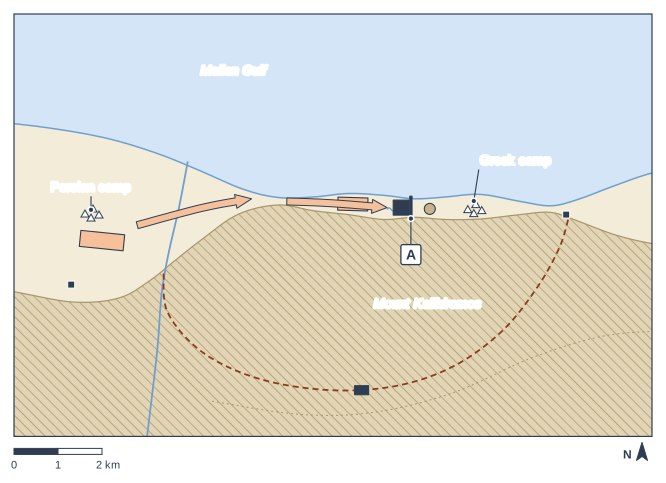
Figure 1 is a plan of the pass of Thermopylae in 480 BC, during the first two days of fighting.

Name the structure labelled A, which the Greeks rebuilt across the pass and defended against the Persians.

Schematic map of a narrow coastal pass between mountains and the sea. Schematic map (north at the top; scale bar 0-2 km). Sea runs along the top and hatched mountains fill the south; between them a narrow strip of coastal land runs east to west, pinched to almost nothing at three places, and widening at the western end into a plain with tents and a dark square at the foot of the mountains, where a river flows north out of a gorge. A thick dark line crosses the strip part way along, with a wavy symbol and a dot just west of it, and a small round hill and some tents just east of it; a dark square stands near the eastern end. A dashed track winds over the mountain from the river gorge in the west to the eastern end of the strip. A dark block fills the strip just west of the wall; pale blocks and arrows advance east along the strip from the western plain towards it; a small dark block stands on the dashed track high on the mountain. Label A points to the thick dark line across the coastal strip, part way along it; the label "Malian Gulf" points to the sea along the top of the map; the label "Mount Kallidromos" points to the mountains filling the southern half of the map; the label "Persian camp" points to the tents in the plain at the western end of the map; the label "Greek camp" points to the tents on the coastal strip east of the wall.

Model answer

The Phocian wall.

Explanation

Herodotus says the Phocians had long ago built a wall across the narrow part of the pass (the Middle Gate) to keep out the Thessalians; it had mostly fallen down, and the Greeks rebuilt it as the base of their defence. On the first two days the Greeks fought just in front of it; on the last day they advanced into the wider part of the pass and then fell back past the wall to the small hill (Kolonos) behind it.

Mark scheme
  1. 1 mark

    The Phocian wall

    Accept 'the wall of the Phocians' / 'the old wall built by the Phocians'. Do not accept just 'a wall', 'the Middle Gate' or 'the Long Walls'.

Question 2

2 marks

Source A: Herodotus, Histories 7.238

'After saying this, Xerxes walked through the bodies of the dead. He had heard that Leonidas had been the king and general of the Spartans, and he ordered his head to be cut off and set up on a stake. It is clear to me ... that King Xerxes was more angry with Leonidas while he was alive than with any other man; otherwise he would never have committed such an outrage against his corpse, since the Persians, more than any other people I know, are accustomed to honour men who are brave in war.'

Suggest two reasons why Xerxes treated Leonidas' body in this way.

Model answer

Xerxes was furious with Leonidas because, as the Spartan king and general, he had held up the Great King's huge army for days and caused very heavy losses, including two of Darius' sons. Setting the head up on a stake also warned other Greeks what would happen to anyone who resisted the king.

Explanation

Herodotus finds the mutilation surprising, because the Persians normally honoured brave enemies, so he explains it by Xerxes' personal anger. The episode fits his picture of Xerxes as a ruler driven by passion and pride. Leonidas' remains were later brought home and honoured at Sparta, which reversed the insult.

Mark scheme
  1. 1 mark

    One valid reason, e.g.: he was furious with Leonidas (as Herodotus says); Leonidas had caused very heavy Persian losses, including two sons of Darius (Xerxes' half-brothers Abrocomes and Hyperanthes); Leonidas had humiliated the Great King by holding up his vast army for days while he watched; as king and general Leonidas was the leader responsible for the resistance; to frighten other Greeks into submission / show what happened to those who resisted the king; revenge for Leonidas' defiance and refusal to surrender; to display the king's power and triumph.

    Two from the list. Reasons may come from the source (his anger) or own knowledge. Each mark needs a different reason.

  2. 1 mark

    A second, different reason from the list above.

Question 3

4 marks

Source A: Herodotus, Histories 7.220

On the third morning the Greeks learned that the Persians were coming round the mountain behind them.

'It is said that Leonidas himself sent the allies away, because he was concerned that they should not be killed; but he thought it was not honourable for himself and the Spartans with him to abandon the post which they had come to guard in the first place. I myself am more inclined to believe that, when Leonidas saw that the allies were unwilling and did not want to share the danger with him, he told them to go, but that he did not think it honourable to leave himself. By staying there he would leave behind great glory, and the prosperity of Sparta would not be wiped out.'

What does Source A suggest about Leonidas? Make two points.

Model answer

The passage suggests that Leonidas had a powerful sense of duty and honour, because he believed it was 'not honourable' to 'abandon the post which they had come to guard'. It also suggests that he was patriotic and wanted glory for his city: by staying he would 'leave behind great glory' and make sure that 'the prosperity of Sparta would not be wiped out'.

Explanation

Herodotus gives two versions of why the allies left and states which he prefers, which is typical of his method. The reference to Sparta's prosperity links back to the oracle that Sparta would lose either its city or a king. Good answers can note that Herodotus is interpreting Leonidas' motives, which he could not have known for certain.

Mark scheme
  1. 2 marks

    First point with supporting evidence from Source A: 1 mark for a valid point about Leonidas, 1 mark for a relevant reference or quotation from the passage that supports it. The two marks are independent: award 1 for a valid point even if no evidence is given, and 1 for a relevant quotation from, reference to or close paraphrase of the source even if the point is missing, weak or wrong.

    Two pairs from, e.g.: he cared about his allies' lives (1) - 'concerned that they should not be killed' (1); he had a strong sense of honour and duty (1) - 'not honourable ... to abandon the post which they had come to guard' (1); he was a good judge of his men / realistic (1) - 'saw that the allies were unwilling and did not want to share the danger' (1); he was decisive and in command (1) - 'he told them to go' (1); he was brave / self-sacrificing, staying to face certain death (1) - 'he did not think it honourable to leave himself' (1); he wanted glory (kleos) (1) - 'he would leave behind great glory' (1); he was patriotic, putting Sparta first (1) - 'the prosperity of Sparta would not be wiped out' (1). The second pair must make a different point from the first. Credit a relevant reference (1) even if the point is weak. Points must come from the passage.

  2. 2 marks

    Second, different point with supporting evidence from Source A: 1 mark for a valid point about Leonidas, 1 mark for a relevant reference or quotation from the passage that supports it. The two marks are independent: award 1 for a valid point even if no evidence is given, and 1 for a relevant quotation from, reference to or close paraphrase of the source even if the point is missing, weak or wrong.

    As above; must be a different point from the first.

Question 4

8 marks

Source A: Herodotus, Histories 7.186-187

Herodotus has added up all the forces Xerxes brought with him.

'So Xerxes, son of Darius, led five million, two hundred and eighty-three thousand, two hundred and twenty men as far as Sepias and Thermopylae. That is the number of his whole force; but as for the women who baked the bread, the concubines and the eunuchs, nobody could give an accurate number ... So I am not at all surprised that some of the rivers ran dry.'

To what extent can we trust Herodotus' account of the battle of Thermopylae? Use Source A as a starting point and your own knowledge.

Model answer

Source A suggests that we should be cautious. Herodotus claims that Xerxes brought exactly 5,283,220 men to Sepias and Thermopylae, an impossibly precise and enormous figure; no ancient army could have been fed or supplied on that scale, and modern historians think it was far smaller. His comment that 'some of the rivers ran dry' shows that he accepted dramatic stories which made the Greek victory seem more miraculous. On the other hand, he admits that some numbers could not be known 'accurately', showing that he was aware of the limits of his evidence.

In other ways Herodotus deserves trust. He wrote within living memory of the battle and questioned people who remembered it; he says he learned the names of all 300 Spartans, and he quotes inscriptions that stood at the site. His description of the pass - the Phocian wall at the Middle Gate, the hot springs, the mountain path from the Asopus gorge to Alpenoi - fits the landscape, and arrowheads found on the small hill support his account of the last stand. He often gives alternative versions, for example of why the allies left, and tells us which he prefers.

However, there are weaknesses. He includes speeches, such as Demaratus' conversations with Xerxes, which he could not have heard; he includes oracles and anecdotes labelled 'it is said', such as Xerxes leaping from his throne; and his informants were Greek, often Spartan, so the Spartans appear as heroes and the Thebans as traitors, a bias that Plutarch later criticised.

Overall, we can trust Herodotus for the outline of the battle, its geography and its outcome, but not for his numbers, his speeches or his interpretation of motives, which reflect the patriotic legend that grew up after 480 BC.

Explanation

A top answer uses Source A as evidence of a weakness (exaggerated numbers) and balances it against his strengths (inquiry, inscriptions, topography, alternative versions), ending with a judgement that distinguishes outline from detail. Knowledge of Herodotus' date, methods and informants is essential for AO1. Simply calling him 'biased' without explaining how is not enough.

Mark scheme
  1. 8 marks

    Levels of response (8 marks). AO1 (4) and AO2 (4) are equally weighted.
    Level 4 (7-8 marks): consistently accurate and detailed knowledge of Herodotus' account of Thermopylae and of Herodotus as a historian, using both Source A and own wider knowledge; very good understanding of his methods, sources and purposes and of other evidence; a well-argued response with a clear judgement on how far his account can be trusted, supported by a range of well-selected evidence, including critical analysis.
    Level 3 (5-6 marks): accurate knowledge, using both Source A and own knowledge; a focused response with relevant analysis of strengths and weaknesses of the account, and a judgement.
    Level 2 (3-4 marks): sound, mostly accurate knowledge; engages with the general topic of reliability; a limited range of evidence and some analysis.
    Level 1 (1-2 marks): limited knowledge, may only use the source given; isolated analysis.
    0 marks: no response or no response worthy of credit.
    A mainly descriptive or narrative answer with little analysis or judgement cannot go above Level 2.

    Indicative content (not a checklist; credit other valid points): AO1: Source A - the total of 5,283,220 is impossibly precise and far too large; the rivers 'ran dry' shows exaggeration; but Herodotus admits that some numbers could not be known. Own knowledge: Herodotus of Halicarnassus, born about 484 BC, writing a generation or two after the battle; he travelled and questioned witnesses (oral tradition); he says he learned the names of all 300; he quotes inscriptions that stood at the site; his description of the pass, the Phocian wall, the hot springs and the mountain path fits the landscape; arrowheads found on the hill of Kolonos support the last stand; modern estimates of Xerxes' army are far lower; he includes speeches (Demaratus) he could not have heard exactly, oracles, and reports marked 'it is said'; he gives alternative versions (did the allies leave or were they sent away?) and says which he prefers; he relied on Greek, often Spartan, informants; Plutarch accused him of bias against the Thebans; later writers such as Diodorus tell a different story of a night attack on Xerxes' camp. AO2: trustworthy for the outline of events, the geography, the names and the outcome; less trustworthy for numbers, motives, speeches and anecdotes; his openness about sources and alternatives is a strength; his storytelling and Greek perspective are weaknesses. Judgement: e.g. reliable in outline but not in detail, especially numbers.

Ready to try the rest? Every answer you write is marked against the mark scheme, so you can see exactly where the marks are.

AI Tutor Hints first, answers after you try

Hi! Stuck? Ask me for a hint and I’ll help you work it out. Once you’ve checked your answer I can explain exactly where the marks are.