Level:
Correct: 0
Incorrect: 0
Marks: 0/0
Exam Practice
Subject:
Topics:
Avg
score:
–
Topics
done:
0/17

The Battle of Salamis

Practise 35 exam-style questions on The Battle of Salamis for OCR GCSE Classical Civilisation (War and Warfare). Write your answer as you would in the exam and get it marked in seconds against the mark scheme, point by point, with an AI tutor on hand if you get stuck.

  • 35 questions
  • 1–15 marks each
  • Instant marking
  • No sign-up needed
20 questions, marked as you go

Sample questions with model answers

Here are 4 of the questions in this topic, each with a model answer, an explanation of why it earns the marks and the mark scheme an examiner would use.

Question 1

1 mark

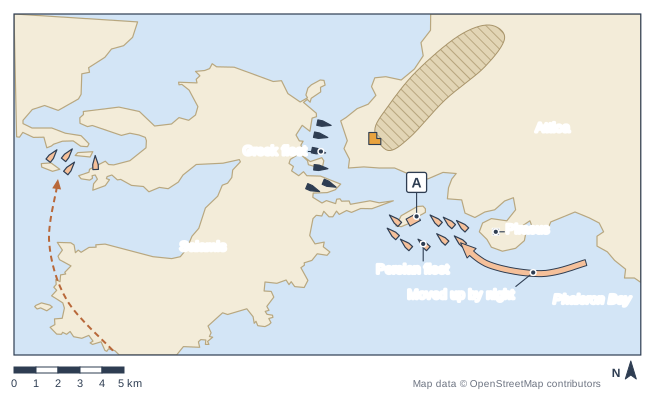
Figure 1 is a map of the straits of Salamis on the night before the battle in 480 BC.

Name the islet labelled A, where Xerxes landed Persian troops that night.

Map of an island close to a mainland coast, with fleets of ships. Map (north at the top; scale bar 0-5 km) of a large island close to a mainland coast. The mainland is in the top right, with hatched hills and a small seat symbol on the shore overlooking a narrow channel between the island and the mainland; a small islet lies at the eastern entrance to the channel, a dark square marks a headland to the south-east, and there is a bay in the bottom right. Another narrow channel separates the north-west tip of the island from the mainland on the left. Dark ships lie close to the east coast of the large island; a line of pale ships crosses the eastern entrance to the channel, either side of the small islet (with a pale block on it), and a broad pale arrow leads to them from the bay in the east; a few pale ships sit at the western end of the large island, with a dashed arrow coming up to them from the south. Label A points to the small islet at the eastern entrance to the straits; the label "Greek fleet" points to the dark ships close to the east coast of the large island; the label "Persian fleet" points to the pale ships in a line across the eastern entrance to the straits, either side of the islet; the label "Moved up by night" points to the broad pale arrow from the bay in the east towards the entrance to the straits; the label "Salamis" points to the large island in the middle and left of the map; the label "Attica" points to the mainland in the top right of the map; the label "Piraeus" points to the dark square on the headland east of the straits; the label "Phaleron Bay" points to the bay in the bottom right of the map.

Model answer

Psyttaleia.

Explanation

Psyttaleia lies at the eastern entrance to the straits. The Persians expected wrecks and swimmers to be carried there during the battle, but Aristides landed Athenian hoplites on it and killed every Persian on the island (Herodotus 8.95); Aeschylus' Messenger treats this as one of the worst disasters for the Persian nobility.

Mark scheme
  1. 1 mark

    Psyttaleia

    Accept Psyttalia or any recognisable spelling. Do not accept Salamis, Aegina or Piraeus.

Question 2

2 marks

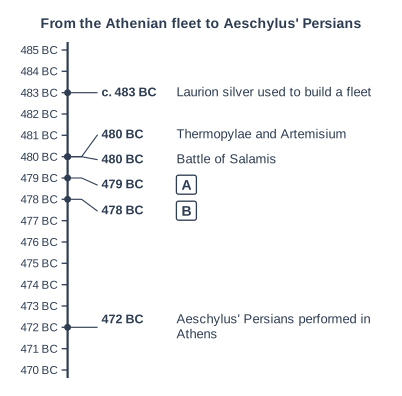
Figure 1 is a timeline of events from the building of the Athenian fleet to the first performance of Aeschylus' Persians.

Name the event labelled A, in which the army that Xerxes left in Greece was defeated, and the event labelled B, in which Athens became the leader of an alliance of Greek states against Persia.

Vertical timeline titled "From the Athenian fleet to Aeschylus' Persians", running from 485 BC at the top to 470 BC at the bottom, with the years marked every year (485 BC to 470 BC). Events marked by dots on the line, in date order: c. 483 BC: Laurion silver used to build a fleet; 480 BC: Thermopylae and Artemisium; 480 BC: Battle of Salamis; 479 BC: label A; 478 BC: label B; 472 BC: Aeschylus' Persians performed in Athens.

Model answer

A is the battle of Plataea, where Mardonius' army was defeated, and B is the founding of the Delian League under Athenian leadership.

Explanation

Salamis forced Xerxes back to Asia; Plataea (479 BC) destroyed the army he left behind, and the Delian League (478/477 BC) let Athens use its fleet to free the Greek cities of Asia and keep Persia out of the Aegean. The League grew into the Athenian empire - one reason why the Athenians remembered Salamis as their own victory.

Mark scheme
  1. 1 mark

    A: the battle of Plataea

    Accept 'Plataea' or 'the defeat and death of Mardonius at Plataea'. Do not accept Mycale, Salamis or Marathon.

  2. 1 mark

    B: the founding of the Delian League

    Accept 'the Delian League was formed' or 'an alliance with its treasury on Delos'. Do not accept 'the Athenian empire' on its own or the Peloponnesian League.

Question 3

4 marks

Source A: Aeschylus, Persians

The Messenger tells the Persian queen how the battle went.

'At once ship struck ship with its bronze ram. A Greek ship began the charge and smashed off the whole curved stern of a Phoenician ship, and each captain steered his ship against another. At first the flood of the Persian fleet held out; but when the mass of ships was crowded together in the narrows, and none could help another, they were struck by their own side's bronze-mouthed rams, and their whole banks of oars were shattered. Then the Greek ships, not without a plan, surrounded them and struck them from every side. Hulls were turned upside down, and the sea could no longer be seen, so full was it of wrecks and slaughtered men; the shores and the reefs were filled with corpses. ... But the Greeks, as if they were catching tunny or a haul of fish, kept striking and hacking at them with broken oars and pieces of wreckage, and groaning and shrieking filled the open sea until the eye of dark night took it away.'

How does Aeschylus make this description of the battle horrifying? Make two points.

Model answer

Aeschylus uses violent images of destruction: the Persian ships are 'struck by their own side's bronze-mouthed rams' and 'their whole banks of oars were shattered', so the Persians seem to destroy themselves. He also uses a simile from fishing, saying the Greeks hacked at the drowning men 'as if they were catching tunny', which makes the killing seem pitiless and turns the Persians into helpless creatures rather than men.

Explanation

The tunny simile refers to the way fishermen trapped shoals of tuna in nets and clubbed them - a vivid and shocking image for an audience that knew the sea. Good answers name a technique (imagery, simile, sound, scale) and quote the exact words that create the effect.

Mark scheme
  1. 2 marks

    First point with supporting evidence from Source A: 1 mark for a valid technique or way the passage creates horror, 1 mark for a relevant reference or quotation from the passage that supports it. The two marks are independent: award 1 for a valid point even if no evidence is given, and 1 for a relevant quotation from, reference to or close paraphrase of the source even if the point is missing, weak or wrong.

    Two pairs from, e.g.: violent imagery of ships smashing (1) - 'ship struck ship with its bronze ram', 'smashed off the whole curved stern', 'banks of oars were shattered' (1); the Persians destroy themselves (1) - 'struck by their own side's bronze-mouthed rams', 'none could help another' (1); the scale of the death and destruction (1) - 'the sea could no longer be seen', 'the shores and the reefs were filled with corpses' (1); simile dehumanising the victims (1) - 'as if they were catching tunny or a haul of fish' (1); brutal hand-to-hand killing (1) - 'striking and hacking at them with broken oars and pieces of wreckage' (1); sound (1) - 'groaning and shrieking filled the open sea' (1); it goes on and on / no escape (1) - 'until the eye of dark night took it away' (1); the Persian survivor's point of view makes it a tragedy for the audience to imagine (1) - the Messenger is reporting to the Persian queen (1). The second pair must make a different point from the first.

  2. 2 marks

    Second, different point with supporting evidence from Source A: 1 mark for a valid technique or way the passage creates horror, 1 mark for a relevant reference or quotation from the passage that supports it. The two marks are independent: award 1 for a valid point even if no evidence is given, and 1 for a relevant quotation from, reference to or close paraphrase of the source even if the point is missing, weak or wrong.

    As above; must be a different point from the first.

Question 4

8 marks

Source A: Thucydides, History of the Peloponnesian War 1.73-74

Athenian envoys at Sparta in 432 BC remind the Spartans of the Persian Wars.

'We say that at Marathon we alone faced the barbarian first, and when he came the second time, since we were not strong enough to resist him on land, we embarked on our ships with our whole people and fought alongside you in the sea-battle at Salamis. It was this that stopped him sailing against the Peloponnese and destroying it city by city, since you could not have helped one another against so many ships. The barbarian himself gave the greatest proof of this: when he was defeated at sea, he quickly withdrew with the greater part of his army, as if his strength was no longer equal to ours. So it was clearly shown that the fate of the Greeks depended on their ships, and to this we contributed the three most useful things: the largest number of ships, the most intelligent general, and the most fearless determination.'

To what extent did the battle of Salamis save Greece from Persian conquest? Use Source A as a starting point and your own knowledge.

Model answer

Source A claims that Salamis saved Greece, and there is much truth in this. Without a fleet Xerxes could not support his huge army by sea or land troops behind the wall the Peloponnesians were building across the Isthmus; as the Athenian envoys say, the Peloponnesian cities could not have helped one another against so many ships. After the defeat Xerxes did withdraw to Asia with most of his army, fearing, as Herodotus says, that the Greeks would sail to the Hellespont and break his bridges. The Persian navy never again threatened mainland Greece.

However, Salamis did not end the war. Xerxes left Mardonius in Greece with a large army of picked troops, and Athens was occupied a second time in 479 BC. The decisive land victory came at Plataea in 479 BC, where the Spartan-led hoplite army under Pausanias defeated and killed Mardonius; according to tradition, on the same day the Greeks destroyed the Persian forces at Mycale in Ionia. So Salamis made final victory possible rather than securing it, and the earlier resistance at Thermopylae and Artemisium had also bought time.

We should also consider who is speaking in Source A. These are Athenian envoys at Sparta in 432 BC, defending Athens' empire on the eve of war with Sparta. They stress that Athens provided the most ships, the cleverest general and the greatest determination, and they ignore the Spartan contribution at Thermopylae and Plataea, so their claim is partly propaganda.

Overall, Salamis saved Greece to a great extent, because it destroyed Persian sea power and drove Xerxes himself out of Europe; without it, the Isthmus could not have been held. But it was Plataea and Mycale that ended the danger, so Salamis was the turning point of the war rather than its end.

Explanation

The strongest answers explain why sea power mattered (supply, outflanking the Isthmus, the Hellespont bridges), set Salamis against Plataea and Mycale, and question Source A as Athenian self-justification from 432 BC. Describing the battle itself does not answer the question.

Mark scheme
  1. 8 marks

    Levels of response (8 marks). AO1 (4) and AO2 (4) are equally weighted.
    Level 4 (7-8 marks): consistently accurate and detailed knowledge of the results of Salamis and of the later events of the war, using both Source A and own wider knowledge; very good understanding of the context, including who is speaking in Source A and why; a well-argued response with a clear, substantiated judgement on how far Salamis saved Greece, supported by a range of well-selected evidence, including critical analysis.
    Level 3 (5-6 marks): accurate knowledge, using both Source A and own knowledge; good understanding of the significance of the battle; a focused response with relevant analysis and a judgement on how far it saved Greece.
    Level 2 (3-4 marks): sound, mostly accurate knowledge; engages with the general topic of the importance of Salamis, with a limited range of evidence and some analysis; any judgement is asserted rather than supported.
    Level 1 (1-2 marks): limited knowledge, may only use Source A; isolated analysis with little or no judgement.
    0 marks: no response or no response worthy of credit.
    A mainly descriptive or narrative answer with little analysis or judgement cannot go above Level 2.

    Indicative content (not a checklist; credit other valid points): AO1: Source A: the Athenians abandoned Athens and fought at Salamis; this stopped the Persians sailing against the Peloponnese city by city; Xerxes withdrew quickly with most of his army; Athens provided the most ships, the cleverest general (Themistocles) and the greatest determination. Own knowledge: the Persian navy was decisively beaten and never again threatened mainland Greece; without a fleet Xerxes could not supply his army by sea or land troops behind the Isthmus wall; Xerxes withdrew to Asia, fearing for his Hellespont bridges; but he left Mardonius with a large army; Athens was occupied again in 479 BC; the Spartan-led army under Pausanias defeated and killed Mardonius at Plataea in 479 BC; the Persian forces in Ionia were defeated at Mycale (by tradition on the same day); the Delian League (478/477 BC) then carried the war to Persia. Earlier: Thermopylae and Artemisium delayed Xerxes; Marathon (490 BC). AO2: Salamis was the turning point - it removed Persian sea power, made the Isthmus defence workable and drove Xerxes himself out of Europe; but it did not end the land threat, which was removed only at Plataea, so it made victory possible rather than certain. Source A's reliability: Athenian envoys in 432 BC justifying their empire to Sparta; they exaggerate the Athenian share, ignore Thermopylae and Plataea, and use the past as propaganda; Thucydides' speeches give the general sense of what was said. Judgement: e.g. 'Salamis saved Greece to a great extent, but Plataea finished the job'.

Ready to try the rest? Every answer you write is marked against the mark scheme, so you can see exactly where the marks are.

AI Tutor Hints first, answers after you try

Hi! Stuck? Ask me for a hint and I’ll help you work it out. Once you’ve checked your answer I can explain exactly where the marks are.