Level:
Correct: 0
Incorrect: 0
Marks: 0/0
Exam Practice
Subject:
Topics:
Avg
score:
–
Topics
done:
0/17

The Roman army: recruitment, pay, training and organisation

Practise 35 exam-style questions on The Roman army: recruitment, pay, training and organisation for OCR GCSE Classical Civilisation (War and Warfare). Write your answer as you would in the exam and get it marked in seconds against the mark scheme, point by point, with an AI tutor on hand if you get stuck.

  • 35 questions
  • 1–15 marks each
  • Instant marking
  • No sign-up needed
20 questions, marked as you go

Sample questions with model answers

Here are 4 of the questions in this topic, each with a model answer, an explanation of why it earns the marks and the mark scheme an examiner would use.

Question 1

1 mark

According to the Roman writer Vegetius, how far were recruits expected to march in five hours at the normal military pace?

Model answer

Twenty Roman miles.

Explanation

Vegetius (1.9) says recruits should cover 20 Roman miles (about 30 km) in five summer hours at the military step, and 24 miles at the faster full pace, often carrying a pack of up to 60 Roman pounds. Regular route marches kept the legions fit to move quickly across the empire.

Mark scheme
  1. 1 mark

    20 Roman miles

    Accept '20 miles' or 'about 30 km'. Do not accept 24 miles (Vegetius' figure for the faster 'full pace').

Question 2

2 marks

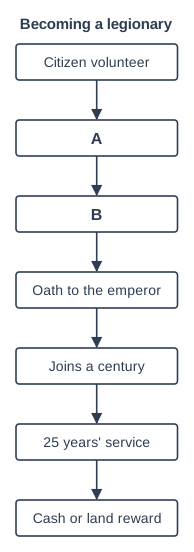
Figure 1 is a flow chart showing how a man became a legionary.

What belongs in box A (what the volunteer had to bring with him) and in box B (the checks he had to pass)?

Becoming a legionary. Flow chart of 7 boxes joined by arrows, read from top to bottom. The first box is "Citizen volunteer", which leads to box A, which leads to box B, which leads to "Oath to the emperor", which leads to "Joins a century", which leads to "25 years' service", which leads to "Cash or land reward".

Model answer

Box A is a letter of recommendation from someone of standing, such as a patron or local official. Box B is the probatio, an examination of the recruit's health, height and fitness, and a check that he was free and a Roman citizen.

Explanation

Only after passing the probatio did the recruit swear the sacramentum and receive travel money to join his unit. Vegetius says recruits should ideally be tall and strong, with alert eyes and broad shoulders; Pliny's letters to Trajan show that slaves who slipped through the checks could be executed.

Mark scheme
  1. 1 mark

    A: a letter of recommendation

    Accept 'a letter from a patron, local official or veteran vouching for him'. Do not accept 'proof of citizenship' on its own.

  2. 1 mark

    B: the probatio - a medical examination, height and fitness check

    Accept 'probatio', 'medical examination', 'height check', 'fitness test' or 'interview to check that he was free-born / a citizen'.

Question 3

4 marks

Source A: Josephus, Jewish War 3.72-75

Josephus, a Jewish commander who surrendered to the Romans in AD 67, describes the Roman army.

'The Romans do not wait for war to break out before they handle their weapons, nor do they sit idle in peacetime and only move their hands when the need arises; as if they had been born with weapons in their hands, they never stop training and never wait for an emergency. Their exercises lack none of the vigour of real warfare: every soldier trains every day with all his energy, as if he were at war. That is why they endure battle so easily: no confusion breaks up their usual formation, no fear drives them out of it, and no exhaustion wears them out. ... One would not be wrong to call their drills bloodless battles, and their battles bloody drills.'

What impressions of Roman training does Josephus give in this passage? Make two points.

Model answer

Josephus gives the impression that Roman training was constant: the soldiers 'never stop training' and do not wait for war to break out. He also suggests it was so realistic and demanding that it made real battle easy for them - their drills were 'bloodless battles', so that in combat 'no confusion breaks up their usual formation'.

Explanation

Josephus had fought against the legions in Galilee before surrendering to Vespasian, and he wrote his history in Rome under Flavian patronage, so his admiration may be genuine but also flattering - and meant to show other peoples how hopeless resistance was. Good answers quote precisely and pick two distinct impressions.

Mark scheme
  1. 2 marks

    First point with supporting evidence from Source A: 1 mark for a valid impression of Roman training, 1 mark for a relevant reference or quotation from the passage that supports it. The two marks are independent: award 1 for a valid point even if no evidence is given, and 1 for a relevant quotation from, reference to or close paraphrase of the source even if the point is missing, weak or wrong.

    Two pairs from, e.g.: constant / continuous, in peace as well as war (1) - 'they never stop training', 'do not wait for war to break out' (1); realistic, as hard as real fighting (1) - 'lack none of the vigour of real warfare', 'bloodless battles' (1); daily and demanding (1) - 'every soldier trains every day with all his energy' (1); it produced discipline and steady formations (1) - 'no confusion breaks up their usual formation' (1); it built courage and endurance (1) - 'no fear drives them out of it, and no exhaustion wears them out' (1); it made fighting second nature (1) - 'as if they had been born with weapons in their hands' (1); it explains Roman success (1) - 'that is why they endure battle so easily', 'their battles bloody drills' (1). The second pair must make a different point from the first. Points must come from the passage.

  2. 2 marks

    Second, different point with supporting evidence from Source A: 1 mark for a valid impression, 1 mark for a relevant reference or quotation from the passage. The two marks are independent: award 1 for a valid point even if no evidence is given, and 1 for a relevant quotation from, reference to or close paraphrase of the source even if the point is missing, weak or wrong.

    As above; must be a different impression from the first point.

Question 4

8 marks

Source A: Suetonius, Life of Augustus 49

'Of his military forces, he distributed the legions and the auxiliaries throughout the provinces. He stationed one fleet at Misenum and another at Ravenna to guard the Upper and Lower Seas, and the rest of his forces he enlisted partly to guard the city and partly to guard himself. ... All the soldiers everywhere he bound to a fixed scale of pay and rewards, laying down according to each man's rank both the length of his service and the benefits on discharge, so that neither age nor poverty would tempt them to revolution after their discharge. And so that there would always be money, without difficulty, to maintain them and to pay their rewards, he set up a military treasury funded by new taxes.'

To what extent did Augustus' reforms make the army loyal to the emperor? Use Source A as a starting point and your own knowledge.

Model answer

Source A shows that Augustus deliberately designed his reforms to secure the army's loyalty. He fixed every soldier's pay, length of service and discharge rewards according to rank, 'so that neither age nor poverty would tempt them to revolution', and set up a military treasury with new taxes so that the money would always be there. This tackled the main cause of the civil wars of the late Republic, when soldiers had looked to generals such as Sulla, Caesar and Antony to give them land. Now the rewards came from the emperor: Augustus gave 170 million sesterces of his own money to the aerarium militare, and legionaries knew they would receive 3,000 denarii after their service. Every recruit swore the sacramentum to the emperor, the imaginifer carried his portrait among the standards, and the legions in the frontier provinces were commanded by legates whom he appointed. He also kept guards for the city and himself.

However, the reforms did not guarantee loyalty. As soon as Augustus died in AD 14, the legions in Pannonia and Germany mutinied over pay and length of service, and the German legions even tried to make Germanicus emperor. Soldiers were also loyal to their own legion, its eagle and their comrades, and later emperors still had to work to keep the army on their side: Domitian raised pay and limited the savings kept at the standards after Lucius Antonius' rebellion in AD 89. Suetonius, writing over a century later, may present as a complete success a system that sometimes failed.

Overall, Augustus' reforms made the army loyal to the emperor to a large extent, because pay, oath and rewards now came from him rather than from individual generals, and the system lasted for generations. But loyalty depended on the emperor continuing to pay and reward the soldiers, so it had to be maintained and could break down.

Explanation

Top answers explain why the reforms targeted the causes of late-Republican disloyalty, use details of oath, pay, terms and the aerarium militare, and then test the claim against the mutinies of AD 14 and later revolts. A description of the reforms without a judgement on loyalty stays in Level 2.

Mark scheme
  1. 8 marks

    Levels of response (8 marks). AO1 (4) and AO2 (4) are equally weighted.
    Level 4 (7-8 marks): consistently accurate and detailed knowledge of Augustus' reforms and of the army's loyalty in the imperial period, using both Source A and own wider knowledge; very good understanding of the context, including the armies of the late Republic; a well-argued response with a clear, substantiated judgement on how far the reforms made the army loyal to the emperor, supported by a range of well-selected evidence, including critical analysis.
    Level 3 (5-6 marks): accurate knowledge, using both Source A and own knowledge; good understanding of the reforms; a focused response with relevant analysis and a judgement.
    Level 2 (3-4 marks): sound, mostly accurate knowledge; engages with the general topic of Augustus and the army, with a limited range of evidence and some analysis; any judgement is asserted rather than supported.
    Level 1 (1-2 marks): limited knowledge, may only use Source A; isolated analysis with little or no judgement.
    0 marks: no response or no response worthy of credit.
    A mainly descriptive or narrative answer with little analysis or judgement cannot go above Level 2.

    Indicative content (not a checklist; credit other valid points): AO1: Source A: legions and auxiliaries distributed to the provinces; fleets at Misenum and Ravenna; guards for the city and himself (the Praetorian Guard); fixed pay and rewards by rank and fixed terms of service, so veterans would not turn to revolution; the military treasury with new taxes. Own knowledge: in the late Republic armies were loyal to generals who promised land (Marius, Sulla, Caesar, Antony); Augustus created a standing professional army of about 28 legions; the sacramentum sworn to the emperor; pay of 225 denarii; service of 20 years plus 5 as a veteran and a gratuity of 3,000 denarii from the aerarium militare (AD 6, 170 million sesterces of his own money, 5% inheritance tax, 1% sales tax); legions in the armed provinces governed by his own legates; the imaginifer carrying the emperor's portrait; the Praetorian Guard on higher pay. Limits: the mutinies of AD 14 on his death, when the German legions wanted to make Germanicus emperor; soldiers' loyalty also to their legion, eagle and comrades; later emperors still had to buy loyalty (Domitian's pay rise, caps on savings after Lucius Antonius' revolt in AD 89); armies later made their own commanders emperor (AD 69). AO2: the reforms removed the main cause of disloyalty - dependence on a general for rewards - and tied pay, oath and rewards to the emperor; Source A shows this was deliberate. But loyalty depended on continued payment and on the emperor's success, and was never guaranteed; Suetonius writes with hindsight about a reform that seemed to work. Judgement: e.g. 'to a large extent, but loyalty had to be maintained and could break'.

Ready to try the rest? Every answer you write is marked against the mark scheme, so you can see exactly where the marks are.

AI Tutor Hints first, answers after you try

Hi! Stuck? Ask me for a hint and I’ll help you work it out. Once you’ve checked your answer I can explain exactly where the marks are.