Level:
Correct: 0
Incorrect: 0
Marks: 0/0
Exam Practice
Subject:
Topics:
Avg
score:
–
Topics
done:
0/17

Athens at war: army, navy and democracy

Practise 34 exam-style questions on Athens at war: army, navy and democracy for OCR GCSE Classical Civilisation (War and Warfare). Write your answer as you would in the exam and get it marked in seconds against the mark scheme, point by point, with an AI tutor on hand if you get stuck.

  • 34 questions
  • 1–15 marks each
  • Instant marking
  • No sign-up needed
20 questions, marked as you go

Sample questions with model answers

Here are 4 of the questions in this topic, each with a model answer, an explanation of why it earns the marks and the mark scheme an examiner would use.

Question 1

1 mark

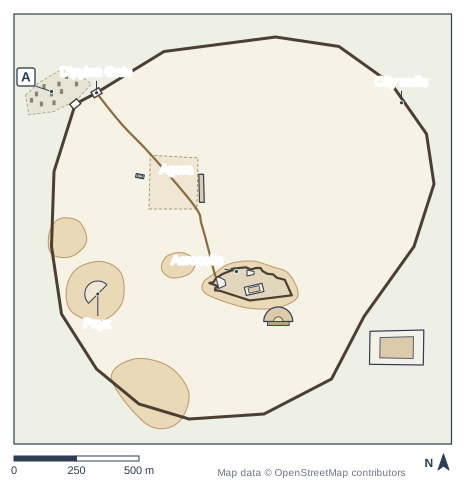
Figure 1 is a plan of Athens in the 5th century BC.

Name the area labelled A, just outside the city walls, where the Athenians buried their war dead in the public tomb.

Plan of an ancient walled city, north at the top, with a scale bar of 500 m. A walled rock stands in the middle, with a large rectangular temple along its southern side, a smaller temple on its northern side and a gateway building at its western end. A semicircular theatre sits on the south-eastern slope below the rock. Just north-west of the rock is a small rocky hill; further west are three more hills, the middle one with a semicircular meeting place on it, and the southern one crossed by the city wall. North-west of the rock is a large open square with a long narrow building along its east side and a temple on a low hill along its west side. A road runs from a gate in the north-western part of the wall diagonally across the square and up to the western end of the rock. Outside that gate and a second gate beside it is an area with grave markers. A thick dark wall encloses the city; a large temple stands outside the wall to the south-east. The label "Acropolis" points to the walled rock in the middle of the plan; the label "Agora" is written on the large open square north-west of the walled rock, crossed diagonally by the road; the label "Pnyx" points to the hill west of the walled rock, with a semicircular meeting place on it; label A points to the area with grave markers outside the north-western stretch of the city wall; the label "Dipylon Gate" points to the gate in the north-western stretch of the city wall where the diagonal road starts; the label "City walls" points to the thick dark line enclosing the city.

Model answer

The Kerameikos.

Explanation

Thucydides says the war dead were laid in the public tomb 'in the most beautiful suburb of the city', along the road leading out from the Dipylon Gate through the Kerameikos. The dead of Marathon were the exception: because of their outstanding courage they were buried on the battlefield.

Mark scheme
  1. 1 mark

    The Kerameikos

    Accept Ceramicus / the Kerameikos cemetery / the public tomb (demosion sema) in the Kerameikos. Do not accept the Agora, the Pnyx or the Acropolis.

Question 2

2 marks

Explain two ways in which the Athenian democracy kept control over its generals (strategoi).

Model answer

Generals were elected by the Assembly for only one year at a time, so the people could refuse to re-elect a general who had failed. They could also be put on trial, during or after their year of office, and fined, exiled or even executed - Pericles was fined in 430 BC, and six generals were executed after Arginusae in 406 BC.

Explanation

Athenian generals had great power in the field but were always answerable to the people who elected them. This accountability was a key feature of the democracy, though critics then and now argue that it made generals cautious or afraid to return home after failure.

Mark scheme
  1. 1 mark

    One valid way, e.g.: generals were elected by the Assembly every year, so they could be voted out at the next election; they could be deposed during their year of office (as Pericles was in 430 BC); at the end of their year they had to give an account of their conduct and their spending (euthynai); they could be prosecuted and punished with fines, exile or death (Pericles fined; Thucydides exiled after Amphipolis; the generals executed after Arginusae); the Assembly decided whether to go to war, which campaigns to send and which generals to command them; there were ten generals, so power was shared.

    Two from the list, each with some explanation. Examples are not required but should be credited.

  2. 1 mark

    A second, different way from the list above.

Question 3

4 marks

Source A: Plutarch, Life of Themistocles 4

'The Athenians were in the habit of sharing out among themselves the revenue from the silver mines at Laurion. Themistocles alone dared to come before the people and propose that they should stop this distribution and use the money to build triremes for the war against Aegina ... From then on, little by little, he led the city down to the sea, and he made them, instead of steady hoplites, as Plato says, into sailors tossed about on the sea. So he gave rise to the charge against him that he took the spear and shield away from the citizens and reduced the Athenian people to the rowing cushion and the oar.'

What does Source A suggest about Themistocles' naval policy? Make two points.

Model answer

The passage suggests that Themistocles' policy was bold, because he 'alone dared' to ask the people to give up the share-out of the Laurion silver and spend it on triremes instead. It also suggests that the policy transformed Athenian society and was controversial: he turned the citizens from 'steady hoplites' into 'sailors', and critics accused him of reducing them 'to the rowing cushion and the oar'.

Explanation

Plutarch, writing about 600 years later, is drawing on earlier sources, including the philosopher Plato, who disliked the naval democracy. Plutarch says 100 triremes were built; Herodotus says 200. The criticism reflects the aristocratic view that rowing was less noble than fighting as a hoplite.

Mark scheme
  1. 2 marks

    First point with supporting evidence from Source A: 1 mark for a valid point about Themistocles' naval policy, 1 mark for a relevant reference or quotation from the passage that supports it. The two marks are independent: award 1 for a valid point even if no evidence is given, and 1 for a relevant quotation from, reference to or close paraphrase of the source even if the point is missing, weak or wrong.

    Two pairs from, e.g.: it was bold / took courage to propose (1) - 'Themistocles alone dared' (1); it needed the people's agreement / he was persuasive (1) - 'come before the people and propose' (1); it put the state's needs before handouts to citizens (1) - 'stop this distribution and use the money to build triremes' (1); it had a practical, immediate justification (1) - 'for the war against Aegina' (1); it gradually turned Athens into a sea power (1) - 'little by little, he led the city down to the sea' (1); it changed the kind of citizen-soldier Athens relied on (1) - 'instead of steady hoplites ... sailors' (1); it was controversial and criticised by conservatives (1) - 'the charge against him' / 'as Plato says' / 'reduced the Athenian people to the rowing cushion and the oar' (1). The second pair must make a different point from the first. Credit a relevant reference (1) even if the point is weak. Points must come from the passage.

  2. 2 marks

    Second, different point with supporting evidence from Source A: 1 mark for a valid point about Themistocles' naval policy, 1 mark for a relevant reference or quotation from the passage that supports it. The two marks are independent: award 1 for a valid point even if no evidence is given, and 1 for a relevant quotation from, reference to or close paraphrase of the source even if the point is missing, weak or wrong.

    As above; must be a different point from the first.

Question 4

8 marks

Source A: 'The Old Oligarch', The Constitution of the Athenians 1.19-20

'Because of their possessions overseas and the offices they hold abroad, the Athenians and their attendants learn to row without even noticing it. A man who often goes to sea is bound to take an oar, and so is his slave, and they learn the terms used in seafaring. They become good helmsmen through experience of voyages and through practice: some practise steering an ordinary boat, others a merchant ship, and from there some move on to the triremes. Most of them can row as soon as they board their ships, since they have been practising all their lives.'

To what extent was the training of the Athenian army and navy effective? Use Source A as a starting point and your own knowledge.

Model answer

Source A suggests that Athenian naval training was effective precisely because it was not formal training at all, but a lifetime of experience. Because Athens ruled an empire overseas, its citizens and their slaves were always at sea and 'learn to row without even noticing it'; helmsmen worked their way up from small boats and merchant ships to triremes, so that 'most of them can row as soon as they board their ships'. Plutarch adds that Pericles sent out sixty triremes every year for eight months, with citizen crews paid while 'practising and learning' seamanship. The results were impressive: in 429 BC Phormio's crews could row round a Peloponnesian circle in single file, brushing past the enemy, and then strike at exactly the right moment, defeating a much larger fleet. Manoeuvres such as the diekplous required this kind of practised skill.

Training for the army was much less effective. In the 5th century there was no state training for hoplites - the two-year ephebic training came only in the 4th century - and citizen-soldiers relied on their fitness from athletics and on their experience of campaigns. Pericles boasted in the Funeral Speech that the Athenians 'live a relaxed life' and yet are as brave as the Spartans, but in practice Athenian hoplites were defeated by the Boeotians at Delium in 424 BC and by the Spartans at Mantinea in 418 BC. Pericles himself avoided a land battle with the professional Spartan army.

We should treat Source A with some caution, since the Old Oligarch generalises and is writing to explain, rather than praise, the power of the common people. Overall, though, the evidence suggests that Athens' informal, constant practice at sea produced the best crews in Greece, while its untrained citizen hoplites were adequate but no match for Sparta.

Explanation

The key distinction is between the navy (constant practice, highly skilled, proven in battle) and the army (no formal training in the 5th century, weaker results). Using the Funeral Speech claim about a 'relaxed life' as something to test is a good evaluative move. Remember that the ephebeia belongs to the 4th century.

Mark scheme
  1. 8 marks

    Levels of response (8 marks). AO1 (4) and AO2 (4) are equally weighted.
    Level 4 (7-8 marks): consistently accurate and detailed knowledge of how Athenian rowers, officers and hoplites gained their skills and of their performance in war, using both Source A and own wider knowledge; very good understanding of the context, including the contrast with Sparta; a well-argued response with a clear judgement on how effective Athenian training was, supported by a range of well-selected evidence, including critical analysis.
    Level 3 (5-6 marks): accurate knowledge, using both Source A and own knowledge; a focused response with relevant analysis and a judgement.
    Level 2 (3-4 marks): sound, mostly accurate knowledge; engages with the general topic; a limited range of evidence and some analysis.
    Level 1 (1-2 marks): limited knowledge, may only use the source given; isolated analysis.
    0 marks: no response or no response worthy of credit.
    A mainly descriptive or narrative answer with little analysis or judgement cannot go above Level 2.

    Indicative content (not a checklist; credit other valid points): AO1: Source A - Athenians and their slaves learn rowing and sea terms through constant voyages; helmsmen learn by experience, moving from small boats and merchant ships to triremes; 'most of them can row as soon as they board'. Own knowledge: Plutarch - Pericles sent out sixty triremes each year for eight months with paid citizen crews, practising seamanship; rowers trained at sea in crews, keeping time to the aulos and the keleustes; Phormio's crews out-manoeuvred larger fleets (429 BC); Pericles in the Funeral Speech - Athenians 'live a relaxed life' yet face the same dangers as the Spartans; no state training for hoplites in the 5th century (the ephebeia came in the 4th century); hoplites trained informally, e.g. through athletics in the gymnasium; Athenian hoplite defeats at Delium (424 BC) and Mantinea (418 BC); Spartans as full-time soldiers trained from age 7 in the agoge. AO2: navy - training was highly effective: constant practice produced crews able to perform the diekplous and periplous and win against the odds; experience could not be matched quickly by enemies. Army - little formal training; adequate against most enemies but usually inferior to Sparta in the field, so Pericles avoided land battles. Limits - the Old Oligarch is a hostile, generalising writer; skill could be lost through casualties (plague, Sicily); rowers included metics and slaves. Judgement: e.g. training at sea was very effective, training on land much less so.

Ready to try the rest? Every answer you write is marked against the mark scheme, so you can see exactly where the marks are.

AI Tutor Hints first, answers after you try

Hi! Stuck? Ask me for a hint and I’ll help you work it out. Once you’ve checked your answer I can explain exactly where the marks are.