Level:
Correct: 0
Incorrect: 0
Marks: 0/0
Exam Practice
Subject:
Topics:
Avg
score:
–
Topics
done:
0/17

The Battle of Actium

Practise 32 exam-style questions on The Battle of Actium for OCR GCSE Classical Civilisation (War and Warfare). Write your answer as you would in the exam and get it marked in seconds against the mark scheme, point by point, with an AI tutor on hand if you get stuck.

  • 32 questions
  • 1–15 marks each
  • Instant marking
  • No sign-up needed
20 questions, marked as you go

Sample questions with model answers

Here are 4 of the questions in this topic, each with a model answer, an explanation of why it earns the marks and the mark scheme an examiner would use.

Question 1

1 mark

In which city did Antony and Cleopatra commit suicide in 30 BC?

Model answer

Alexandria, in Egypt.

Explanation

After Actium, Antony and Cleopatra retreated to Alexandria. When Octavian arrived in 30 BC, Antony stabbed himself and Cleopatra killed herself soon afterwards rather than be led in Octavian's triumph; Egypt became a Roman province and the Ptolemaic kingdom came to an end.

Mark scheme
  1. 1 mark

    Alexandria

    Do not accept 'Egypt' on its own.

Question 2

2 marks

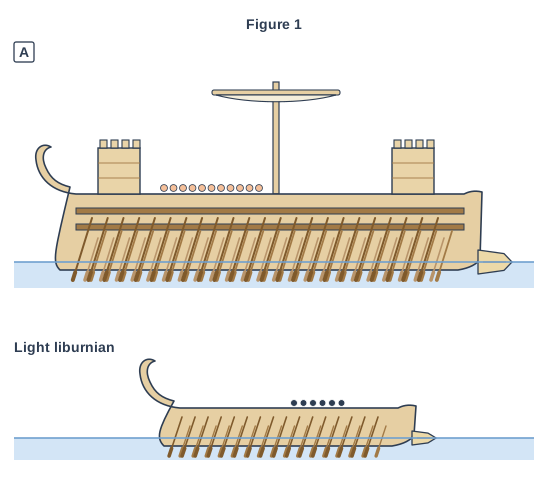
Figure 1 compares two kinds of warship which fought at Actium.

To whose fleet did ship A belong? Give one disadvantage of ships of this type in the battle.

Two ancient oared warships compared, side views. The heading reads "Figure 1". Two ancient warships in side view, fronts to the right, one above the other. The upper ship is much bigger, with high sides, dark horizontal timbers along the side, many slanting oars in three rows, a large pointed metal projection at the front, two box-like structures with battlements on the deck, a row of small dots on deck and an upright pole with rolled-up cloth on a cross-bar. The lower ship is small, low and light, with two rows of slanting oars, a pointed metal projection at the front, a few small dots on deck and no structures or pole. Label A is the heading above the upper ship; the label "Light liburnian" is the heading above the lower ship.

Model answer

Ship A belonged to Antony's fleet. Its great size made it slow and hard to manoeuvre, so three or four of Agrippa's lighter ships could surround it and attack it from all sides.

Explanation

Antony's large polyremes were very strongly built, with towers for archers and catapults, so they were hard to sink, but they were slow and needed many rowers. Agrippa's lighter, faster ships could avoid their rams and swarm round them, which Plutarch says made the battle like the siege of a fortress.

Mark scheme
  1. 1 mark

    Antony's (and Cleopatra's) fleet

    Accept 'Antony' or 'Antony and Cleopatra'. Do not accept Octavian or Agrippa.

  2. 1 mark

    A valid disadvantage: slow / heavy / hard to manoeuvre; could be surrounded by several smaller, faster ships; could not build up speed to ram; needed large crews, which Antony lacked.

    Any one valid disadvantage. The disadvantage can earn the mark even if the fleet is wrong.

Question 3

4 marks

Source A: Plutarch, Life of Antony 66 (Plutarch calls Octavian 'Caesar')

'Although the ships came to close quarters, they did not ram or smash one another. Antony's ships were too heavy to build up the speed which gives a ram its force, while Caesar's ships avoided charging head-on into their bronze-armoured bows, and did not dare to strike them in the side either, because their rams would easily have snapped off against hulls made of huge square timbers bolted together with iron. So the fighting was like a battle on land, or rather like the storming of a fortified town: three or four of Caesar's ships clustered round each of Antony's, and the men fought with wicker shields, spears, poles and fire-arrows, while Antony's men shot back with catapults from wooden towers.'

What does Source A suggest about the fighting at Actium? Make two points.

Model answer

Source A suggests that the battle was not a normal sea battle of ramming, but more like a siege: Plutarch says it was 'like the storming of a fortified town'. It also suggests that Octavian's side won by using its numbers and lighter ships to surround Antony's huge ones, since 'three or four of Caesar's ships clustered round each of Antony's'.

Explanation

Plutarch's account explains why the size of Antony's ships did not bring victory: they were too heavy to ram and could be surrounded, while their strong hulls made ramming them pointless. Good answers pick a clear point and support it with a short, precise quotation.

Mark scheme
  1. 2 marks

    First point with supporting evidence from Source A: 1 mark for a valid point about the fighting, 1 mark for a relevant reference or quotation from the passage that supports it. The two marks are independent: award 1 for a valid point even if no evidence is given, and 1 for a relevant quotation from, reference to or close paraphrase of the source even if the point is missing, weak or wrong.

    Two pairs from, e.g.: ramming was not the main tactic (1) - 'they did not ram or smash one another' (1); Antony's ships were too slow (1) - 'too heavy to build up the speed which gives a ram its force' (1); Antony's ships were very strongly built (1) - huge square timbers bolted with iron, rams would 'snap off' (1); it was more like a land battle or siege than a sea battle (1) - 'like the storming of a fortified town' (1); Octavian's side used numbers and speed to surround the enemy (1) - 'three or four of Caesar's ships clustered round each of Antony's' (1); missiles and fire were important (1) - fire-arrows, catapults from wooden towers (1). The second pair must make a different point from the first. Points must come from the passage.

  2. 2 marks

    Second, different point with supporting evidence from Source A: 1 mark for a valid point about the fighting, 1 mark for a relevant reference or quotation from the passage that supports it. The two marks are independent: award 1 for a valid point even if no evidence is given, and 1 for a relevant quotation from, reference to or close paraphrase of the source even if the point is missing, weak or wrong.

    As above; must be a different point from the first.

Question 4

8 marks

Source A: a silver denarius of Octavian, 28 BC. The obverse shows a portrait head of Octavian with the legend CAESAR COS VI (Caesar, consul for the sixth time). The reverse shows a crocodile with the legend AEGVPTO CAPTA ('Egypt captured').

To what extent did Octavian use his victory at Actium to strengthen his own position? Use Source A as a starting point and your own knowledge.

Model answer

Source A shows clearly how Octavian used his victory. On one side is his own portrait with his sixth consulship; on the other a crocodile and the words 'Egypt captured'. The coin presents the war as the conquest of a foreign country and does not mention Antony at all, so it hides the fact that Actium was a civil war and presents Octavian as the man who defeated Rome's enemies. Coins passed through everyone's hands, so this message reached ordinary people across the empire.

My own knowledge shows that he used Actium in many other ways. He founded Nicopolis, 'victory city', on the site of his camp, with a monument decorated with the bronze rams of captured ships, and he set up the Actian games. In Rome he linked the victory with Apollo and his temple on the Palatine, and in 29 BC he celebrated a magnificent triple triumph. Poets such as Virgil, who placed Actium at the centre of the shield of Aeneas, and Horace, who called Cleopatra a 'deadly monster', spread the same story. In the Res Gestae he claimed that the whole of Italy had chosen him as leader in the war. The wealth of Egypt, which he kept under his own control, paid and settled his soldiers.

However, his position did not rest on Actium alone. He was Caesar's heir, which gave him his name and the support of Caesar's soldiers, and he relied on loyal friends such as Agrippa. His settlement of 27 BC, when he claimed to restore the Republic and was given the name Augustus, and the long period of peace that followed, were just as important. Also, the victory itself removed his only rival; its commemoration made it glorious, but the military result mattered most.

Overall, Octavian used Actium to a very great extent, turning a civil war into a patriotic victory that justified his rule, but it was one foundation of his power among several rather than the only one.

Explanation

A top answer uses the coin precisely (portrait and consulship, crocodile, 'Egypt captured', no mention of Antony) and links it to the wider programme of commemoration, then weighs Actium against other foundations of Octavian's power. A list of commemorations without a judgement on 'to what extent' stays at Level 2.

Mark scheme
  1. 8 marks

    Levels of response (8 marks). AO1 (4) and AO2 (4) are equally weighted.
    Level 4 (7-8 marks): consistently accurate and detailed knowledge of how Octavian commemorated and exploited Actium and of other foundations of his power, using both Source A and own wider knowledge; shows very good understanding of the political context after the civil wars; a well-argued response with a clear, substantiated judgement on how far Actium was used to strengthen his position, supported by a range of well-selected evidence, including critical analysis.
    Level 3 (5-6 marks): accurate knowledge, using both the source and own knowledge; a focused response with relevant analysis and a judgement.
    Level 2 (3-4 marks): sound, mostly accurate knowledge; engages with the general topic, using a limited range of evidence, with some analysis.
    Level 1 (1-2 marks): limited knowledge, may only describe Source A; isolated analysis.
    0 marks: no response or no response worthy of credit.
    A mainly descriptive or narrative answer with little analysis or judgement cannot go above Level 2.

    Indicative content (not a checklist; credit other valid points): AO1: Source A - Octavian's portrait and sixth consulship on one side, the crocodile and 'Egypt captured' on the other; the victory presented as the conquest of Egypt, Antony not mentioned. Own knowledge - war declared on Cleopatra; Nicopolis on the site of his camp, the victory monument with the rams of captured ships dedicated to Neptune and Mars; the Actian games; the temple of Apollo on the Palatine; the triple triumph of 29 BC; coins showing ships and Victory; Virgil's shield of Aeneas (Aeneid 8) and Horace's Odes (1.37); Res Gestae 25 (all Italy swore an oath to him); the wealth of Egypt used to pay and settle his soldiers; Egypt kept under his personal control; the name Augustus in 27 BC. AO2: for - he made Actium the founding victory of his rule, presented as a patriotic war against a foreign queen, which hid the civil war and made him Rome's saviour; it was celebrated in coins, monuments, games and poetry that reached all classes; Egypt's wealth gave him the means to reward the army. Against - his position also rested on other things: being Caesar's heir, the loyalty of the army, Agrippa and Maecenas, the 'restoration of the Republic' and the settlement of 27 BC, peace and prosperity, and his long rule; the victory itself, not just its commemoration, removed his rival; poets such as Virgil and Horace may not simply have followed orders. A substantiated judgement might be that Octavian used Actium very fully, but it was one foundation of his power among several.

Ready to try the rest? Every answer you write is marked against the mark scheme, so you can see exactly where the marks are.

AI Tutor Hints first, answers after you try

Hi! Stuck? Ask me for a hint and I’ll help you work it out. Once you’ve checked your answer I can explain exactly where the marks are.