Level:
Correct: 0
Incorrect: 0
Marks: 0/0
Exam Practice
Subject:
Topics:
Avg
score:
–
Topics
done:
0/17

Roman equipment, tactics and the navy

Practise 31 exam-style questions on Roman equipment, tactics and the navy for OCR GCSE Classical Civilisation (War and Warfare). Write your answer as you would in the exam and get it marked in seconds against the mark scheme, point by point, with an AI tutor on hand if you get stuck.

  • 31 questions
  • 1–15 marks each
  • Instant marking
  • No sign-up needed
20 questions, marked as you go

Sample questions with model answers

Here are 4 of the questions in this topic, each with a model answer, an explanation of why it earns the marks and the mark scheme an examiner would use.

Question 1

1 mark

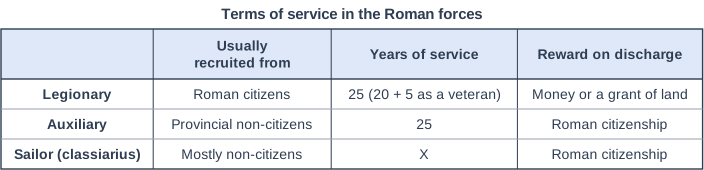
Study the table in Figure 1, which compares service in different parts of the Roman armed forces in the first and second centuries AD.

What number of years should replace X?

Terms of service in the Roman forces. Table with columns (row headings), "Usually recruited from", "Years of service", "Reward on discharge". Legionary; Usually recruited from: Roman citizens; Years of service: 25 (20 + 5 as a veteran); Reward on discharge: Money or a grant of land | Auxiliary; Usually recruited from: Provincial non-citizens; Years of service: 25; Reward on discharge: Roman citizenship | Sailor (classiarius); Usually recruited from: Mostly non-citizens; Years of service: X; Reward on discharge: Roman citizenship.

Model answer

26 years.

Explanation

Sailors in the imperial fleets (classiarii) served 26 years, a year longer than auxiliaries, and like auxiliaries they were usually non-citizens who were given Roman citizenship when they were discharged. The longer service and the recruitment of non-citizens show that the navy had a lower status than the legions.

Mark scheme
  1. 1 mark

    26 (years)

    Accept 26 only. Do not accept 25 or 20.

Question 2

2 marks

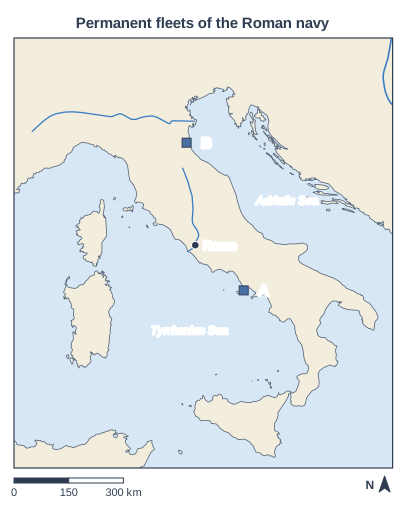
Figure 1 is a map of Italy. The squares marked A and B show the bases of the two permanent fleets which Augustus created to guard the seas around Italy.

Name the bases marked A and B.

Map of Italy and Sicily, titled "Permanent fleets of the Roman navy", drawn with real coastlines (land pale buff, sea pale blue) and no modern borders; a north arrow shows north at the top; the scale bar is 300 km long. Sea names printed in blue italics: Adriatic Sea and Tyrrhenian Sea. Blue lines show rivers. Points: a blue square labelled A on the coast, near the centre of the map (about 60% of the way across and 60% of the way down), about 180 km south-east of the point labelled "Rome"; a blue square labelled B on the coast, towards the top of the map (about 45% of the way across and 25% of the way down), about 280 km north of the point labelled "Rome"; a dot labelled "Rome" (inland).

Model answer

A is Misenum and B is Ravenna.

Explanation

Augustus based one fleet at Misenum, on the northern headland of the Bay of Naples, to guard the Tyrrhenian Sea (the 'Lower Sea'), and another at Ravenna, on the Adriatic coast (the 'Upper Sea'). Misenum was the larger and more important; its fleet was commanded by a prefect appointed by the emperor, such as Pliny the Elder in AD 79.

Mark scheme
  1. 1 mark

    A: Misenum

    Accept 'Misenum, on the Bay of Naples' and close misspellings. Do not accept Naples, Puteoli or Ostia.

  2. 1 mark

    B: Ravenna

    Do not accept Ancona or Aquileia.

Question 3

4 marks

Source A: Julius Caesar, The Gallic War 1 (a battle against the Helvetii in Gaul, 58 BC)

'The soldiers threw their pila from the higher ground and easily broke through the enemy's close formation. When it had been scattered, they drew their swords and charged. The Gauls were greatly hampered in the fight, because several of their shields had been pierced and pinned together by a single pilum; since the iron had bent, they could not pull it out, nor fight properly with their left hand weighed down. So many of them, after shaking their arm for a long time, preferred to let the shield drop and fight with their bodies unprotected.'

What does Source A suggest about how effective the pilum was as a weapon? Make two points.

Model answer

Source A suggests the pilum was very powerful, because 'several of their shields had been pierced and pinned together by a single pilum'. It also suggests that it took away the enemy's protection: since the iron had bent they could not pull it out, so many of them 'preferred to let the shield drop and fight with their bodies unprotected', which left them open to the Roman swords.

Explanation

Caesar shows exactly how the pilum was meant to work: a volley broke the enemy formation, the bent soft iron shank pinned and weighed down the shields, and the charge with the gladius followed. Good answers make a clear point and back it with a precise quotation; the passage is from the late Republic, but the pilum was used in the same way by imperial legionaries.

Mark scheme
  1. 2 marks

    First point with supporting evidence from Source A: 1 mark for a valid point about the effectiveness of the pilum, 1 mark for a relevant reference or quotation from the passage that supports it. The two marks are independent: award 1 for a valid point even if no evidence is given, and 1 for a relevant quotation from, reference to or close paraphrase of the source even if the point is missing, weak or wrong.

    Two pairs from, e.g.: it broke up the enemy formation (1) - 'easily broke through the enemy's close formation' (1); it prepared the way for the sword charge (1) - 'when it had been scattered, they drew their swords and charged' (1); it was powerful / could pierce more than one shield (1) - 'several of their shields had been pierced and pinned together by a single pilum' (1); the bent iron made it impossible to remove (1) - 'since the iron had bent, they could not pull it out' (1); it disabled the enemy's shield arm (1) - 'nor fight properly with their left hand weighed down' (1); it forced the enemy to abandon their protection (1) - 'preferred to let the shield drop and fight with their bodies unprotected' (1). The second pair must make a different point from the first. Points must come from the passage.

  2. 2 marks

    Second, different point with supporting evidence from Source A: 1 mark for a valid point about the effectiveness of the pilum, 1 mark for a relevant reference or quotation from the passage that supports it. The two marks are independent: award 1 for a valid point even if no evidence is given, and 1 for a relevant quotation from, reference to or close paraphrase of the source even if the point is missing, weak or wrong.

    As above; must be a different point from the first.

Question 4

8 marks

Source A: Suetonius, Life of Augustus 49

'He distributed the legions and the auxiliary troops among the provinces. He stationed one fleet at Misenum and another at Ravenna, to guard the Upper Sea and the Lower Sea.'

To what extent was the main purpose of the Roman navy in the Imperial period to protect the seas around Italy? Use Source A as a starting point and your own knowledge.

Model answer

Source A supports the view to a large extent. Suetonius says that Augustus stationed one fleet at Misenum and another at Ravenna 'to guard the Upper Sea and the Lower Sea' - the Adriatic and Tyrrhenian seas on either side of Italy. These were the two main fleets of the empire, and their position shows that protecting Italy came first. This made sense after the late Republic, when pirates and Sextus Pompeius had threatened the grain supply to Rome and the civil wars had been fought at sea, ending at Actium. The fleets kept the sea lanes safe for the grain ships and were a force close to the emperor.

However, the navy as a whole did much more than guard Italy. Provincial fleets such as the Classis Britannica, based at Boulogne and Dover, controlled the Channel and supported the army in Britain, and river fleets on the Rhine and Danube patrolled the frontiers and carried troops and supplies, for example in Trajan's Dacian Wars. Even the Italian fleets had other jobs: in AD 79 Pliny the Elder took the quadriremes of Misenum to rescue people from Vesuvius, and sailors from Misenum worked the awnings of the Colosseum. Because Rome controlled the whole Mediterranean after Actium, there was no enemy fleet to fight, so policing, transport and support for the army became the navy's main work. Suetonius also describes Augustus' original arrangements, not how the navy developed over the next century.

Overall, guarding the seas around Italy was the main purpose of the two great fleets at Misenum and Ravenna, but for the navy as a whole the most important role was supporting the army and keeping the empire's communications open, so the statement is only partly true.

Explanation

Strong answers use Source A precisely (two fleets, the Upper and Lower Seas) and then test it against the provincial and river fleets and the navy's many non-combat roles. Pointing out that Suetonius describes Augustus' original plan rather than the later navy, and that there was no enemy fleet after Actium, is the kind of analysis that reaches Level 4.

Mark scheme
  1. 8 marks

    Levels of response (8 marks). AO1 (4) and AO2 (4) are equally weighted.
    Level 4 (7-8 marks): consistently accurate and detailed knowledge of the imperial fleets and their work, using both Source A and own wider knowledge; shows very good understanding of the context (the peace in the Mediterranean after Actium, the needs of the frontiers); a well-argued response with a clear, substantiated judgement on what the navy's main purpose was, supported by a range of well-selected evidence, including critical analysis.
    Level 3 (5-6 marks): accurate knowledge, using both the source and own knowledge; a focused response with relevant analysis and a judgement.
    Level 2 (3-4 marks): sound, mostly accurate knowledge of the navy; engages with the general topic, using a limited range of evidence, with some analysis.
    Level 1 (1-2 marks): limited knowledge, may only use Source A; isolated analysis.
    0 marks: no response or no response worthy of credit.
    A mainly descriptive or narrative answer with little analysis or judgement cannot go above Level 2.

    Indicative content (not a checklist; credit other valid points): AO1: Source A - Augustus created two permanent fleets, at Misenum and Ravenna, to guard the Lower (Tyrrhenian) and Upper (Adriatic) Seas. Own knowledge - Misenum was the larger fleet, commanded by a prefect appointed by the emperor (e.g. Pliny the Elder, AD 79); provincial fleets such as the Classis Britannica (Boulogne and Dover), and river fleets on the Rhine and Danube; liburnians and larger ships (triremes, quadriremes); sailors (classiarii) mostly non-citizens serving 26 years; marines; roles - policing the seas and suppressing piracy, protecting the grain supply to Rome, transporting troops and supplies, supporting campaigns (e.g. Trajan's Dacian Wars, Britain), carrying officials and messages, rescue at Vesuvius, sailors from Misenum working the Colosseum awnings. AO2: for - the two main fleets were placed to guard Italy's seas, protecting Rome and its grain supply after the piracy and naval civil wars of the late Republic (Sextus Pompeius, Actium); for the emperor, the fleets near Italy were also a force under his control. Against - the provincial and river fleets worked far from Italy and mainly supported the army on the frontiers; with no rival navy after Actium, transport, policing and support mattered more than guarding; the Italian fleets themselves did many other jobs (rescue, awnings, carrying the emperor). Suetonius writes about Augustus' original plan, not how the navy developed later. A substantiated judgement might be that guarding Italy was the purpose of the two main fleets, but the navy as a whole mainly supported the army and kept communications open across the empire.

Ready to try the rest? Every answer you write is marked against the mark scheme, so you can see exactly where the marks are.

AI Tutor Hints first, answers after you try

Hi! Stuck? Ask me for a hint and I’ll help you work it out. Once you’ve checked your answer I can explain exactly where the marks are.