Level:
Correct: 0
Incorrect: 0
Marks: 0/0
Exam Practice
Subject:
Topics:
Avg
score:
–
Topics
done:
0/17

Spartan society and the Spartan army

Practise 37 exam-style questions on Spartan society and the Spartan army for OCR GCSE Classical Civilisation (War and Warfare). Write your answer as you would in the exam and get it marked in seconds against the mark scheme, point by point, with an AI tutor on hand if you get stuck.

  • 37 questions
  • 1–15 marks each
  • Instant marking
  • No sign-up needed
20 questions, marked as you go

Sample questions with model answers

Here are 4 of the questions in this topic, each with a model answer, an explanation of why it earns the marks and the mark scheme an examiner would use.

Question 1

1 mark

Source A: Plutarch, Life of Lycurgus 20

'A tiresome man kept pestering Demaratus with ill-timed questions, and in particular kept asking him, "Who is the best of the Spartans?" Demaratus replied, "The one least like you."'

Spartan boys were trained to speak in the short, sharp style shown in Source A. What name is given to this style of speech?

Model answer

Laconic speech.

Explanation

The word 'laconic' comes from Lakonike (Laconia), Sparta's territory. In the agoge boys were trained to answer briefly, sharply and wittily and to say much in few words; long-winded talk was despised. A famous example is Dienekes at Thermopylae, who was told that the Persian arrows would hide the sun and replied that they would fight in the shade.

Mark scheme
  1. 1 mark

    Laconic (speech)

    Accept 'laconic', 'laconism', 'Laconian style'. Do not accept 'Spartan' or 'rude' on their own.

Question 2

2 marks

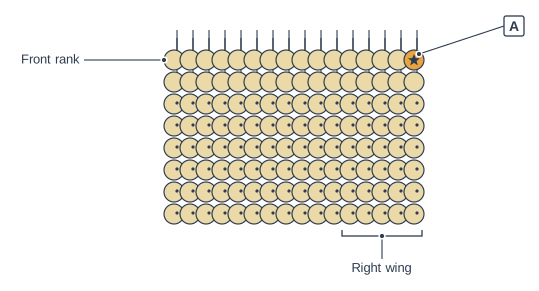
Figure 1 shows a Spartan phalanx seen from above, advancing up the page. The commander's position is marked A.

Who normally commanded the Spartan army in the field and took the position marked A? Name also the picked unit of 300 Spartiates who fought around him.

A formation of soldiers seen from above, each shown as a round shield. Plan, seen from above, of a block of soldiers facing the top of the figure, each shown as a round shield: 16 columns side by side and 8 rows from front to back, with the circles overlapping side to side. Short lines stick out forward from the first two rows; the rows behind have a dot in each circle. The circle at the right-hand end of the first row is darker and marked with a star. A bracket under the last row marks the right third of the block. Label A points to the darker circle marked with a star at the right-hand end of the first row; the label "Front rank" points to the first row of circles, nearest the top; the label "Right wing" points to the bracket under the right-hand third of the formation.

Model answer

One of the two kings commanded the army in the field and stood at the right-hand end of the front rank, the place of honour. Around him fought the hippeis, a picked guard of 300 young Spartiates who, despite their name ('horsemen'), fought on foot as hoplites.

Explanation

From the late 6th century only one king led an army at a time (Herodotus 5.75). Xenophon says the 300 hippeis were chosen by three officers called hippagretai, each picking 100 of the best young men; Thucydides places 'the 300 called hippeis' around King Agis at Mantinea (418 BC). The right wing was the place of honour because it was the most exposed side of the phalanx.

Mark scheme
  1. 1 mark

    One of the two kings / the king

    Accept a named king, e.g. Leonidas, Agis, Cleomenes. Do not accept ephor, polemarch, or 'the general' / strategos without 'king'.

  2. 1 mark

    The hippeis ('horsemen' / 'knights')

    Accept hippeis / hippies / 'the knights' / 'the horsemen (who fought on foot)'. Do not accept 'the 300' without the name, 'cavalry' on its own, or the Immortals.

Question 3

4 marks

Source A: Xenophon, Constitution of the Spartans 11

'Most people think that the Spartan battle formation is very complicated, but in fact it is very easy to understand. In the Spartan formation the men in the front rank are all commanders, and each file has everything it needs to play its part. The formation is so easy to understand that no one who can recognise the men around him could go wrong: some have been given the job of leading, and the others are told to follow. Changes of formation are announced by the enomotarch's voice, like a herald's, and in this way the line is made thinner or deeper. None of this is at all hard to learn. But to keep on fighting just as well when the line has been thrown into confusion, alongside whoever happens to be next to you - that is not easy to learn, except for men trained under the laws of Lycurgus.'

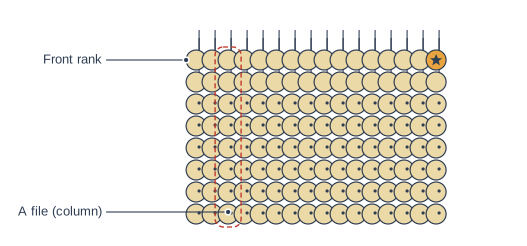
Figure 1 shows a phalanx from above, with its front rank and one file marked.

Using Source A, explain two reasons why the Spartan phalanx was so effective. Make two points, supporting each with evidence from Source A.

A formation of soldiers seen from above, each shown as a round shield. Plan, seen from above, of a block of soldiers facing the top of the figure, each shown as a round shield: 16 columns side by side and 8 rows from front to back, with the circles overlapping side to side. Short lines stick out forward from the first two rows; the rows behind have a dot in each circle. The circle at the right-hand end of the first row is darker and marked with a star. One column near the left is outlined with a dashed line. The label "Front rank" points to the first row of circles, nearest the top; the label "A file (column)" points to the column of circles inside a dashed outline running from front to back near the left.

Model answer

First, the phalanx had a very clear command structure. Xenophon says 'the men in the front rank are all commanders' and that 'some have been given the job of leading, and the others are told to follow', so everyone knew whom to obey and orders were carried out quickly.

Second, the Spartans were so well trained that they could cope with confusion. Xenophon says that to 'keep on fighting just as well when the line has been thrown into confusion, alongside whoever happens to be next to you' is hard to learn 'except for men trained under the laws of Lycurgus' - so a Spartan phalanx did not collapse when its order was broken, as other phalanxes often did.

Explanation

Most Greek hoplites were part-time citizen-farmers who could do little more than advance in a straight line; the Spartans, trained from childhood, could change formation on the word of command and keep fighting when their line was disrupted. The figure shows what Xenophon means by a file (a column of men one behind another) and the front rank, where the leaders stood. Good answers make two different points, each with a precise quotation.

Mark scheme
  1. 2 marks

    First point with supporting evidence from Source A: 1 mark for a valid reason why the Spartan phalanx was effective, 1 mark for a relevant reference or quotation from the passage that supports it. The two marks are independent: award 1 for a valid point even if no evidence is given, and 1 for a relevant quotation from, reference to or close paraphrase of the source even if the point is missing, weak or wrong.

    Two pairs from, e.g.: a clear chain of command / plenty of leaders (1) - 'the men in the front rank are all commanders'; 'some have been given the job of leading, and the others are told to follow' (1); each file could act on its own (1) - 'each file has everything it needs to play its part' (1); it was flexible / could change formation quickly (1) - orders by 'the enomotarch's voice'; 'the line is made thinner or deeper' (1); it was simple, so mistakes were rare (1) - 'very easy to understand'; 'no one ... could go wrong' (1); superior training / discipline in a crisis (1) - they could 'keep on fighting just as well when the line has been thrown into confusion, alongside whoever happens to be next to you' (1). The second pair must make a different point from the first. Points must come from the passage.

  2. 2 marks

    Second, different point with supporting evidence from Source A: 1 mark for a valid reason, 1 mark for a relevant reference or quotation from the passage that supports it. The two marks are independent: award 1 for a valid point even if no evidence is given, and 1 for a relevant quotation from, reference to or close paraphrase of the source even if the point is missing, weak or wrong.

    As above; must be a different reason from the first point.

Question 4

8 marks

Source A: Plutarch, Life of Lycurgus 21

'They took no less care over songs and music than over the clarity and correctness of their speech. Their songs had a sting in them that roused the spirit and stirred men to eager action. The language was simple and plain, and the subjects were serious and good for the character. For the most part they were praises of those who had died for Sparta, calling them blessed, and attacks on the tremblers, as men living a painful and wretched life, together with boasts of courage suited to each age-group. At festivals three choirs were formed from the three age-groups. The old men sang first: "We were once young men, brave and strong." The men in their prime replied: "And we are so now: if you like, look and see." Then the boys sang: "And we shall be far stronger still."'

To what extent did Spartan society glorify war and death in battle? Use Source A as a starting point and your own knowledge.

Model answer

Source A suggests that Spartan society glorified death in battle very strongly. Plutarch says their songs were mostly 'praises of those who had died for Sparta, calling them blessed', while the tremblers were attacked as men living 'a painful and wretched life'. The three choirs of old men, men in their prime and boys showed that every generation was expected to be brave, and the boys promised to be 'far stronger still'.

Much other evidence supports this. Spartan mothers told their sons to come back 'either with this or upon this', and one mother of five sons 'gladly' accepted their deaths when she heard Sparta had won. Only those who died in war were allowed a named gravestone, and surviving stones simply say 'in war'. Tyrtaeus' poems, which praised dying in the front rank, were sung on campaign, and cowards such as Aristodemus 'the Trembler' were shunned. The epitaph at Thermopylae, telling the Spartans that 'here we lie, obedient to their words', turned a defeat into a model of glory.

However, Spartans glorified courage and obedience more than war itself. Thucydides presents them as slow and cautious about going to war, and religious festivals sometimes kept them at home. Plutarch says they pursued a defeated enemy only far enough to secure victory, and at Sphacteria in 425 BC 120 Spartiates surrendered rather than die. Much of our evidence, including the sayings of Spartan women, was collected centuries later by admirers such as Plutarch, so the picture may be part of the 'Spartan mirage'.

Overall, Spartan culture glorified a brave death to a great extent, especially through songs, sayings and burial customs, but its aim was to make men hold their place in the line rather than to make war an end in itself, and the sources probably exaggerate it.

Explanation

The best answers separate glorifying a brave death (which the evidence strongly supports) from glorifying war itself (which is more doubtful, given Spartan caution and the surrender at Sphacteria). Level 4 also needs some critical awareness that much evidence comes from later admirers. A list of sayings and customs with no argument stays in Level 2.

Mark scheme
  1. 8 marks

    Levels of response (8 marks). AO1 (4) and AO2 (4) are equally weighted.
    Level 4 (7-8 marks): consistently accurate and detailed knowledge of how Spartan society presented war and death in battle (songs and poetry, the sayings of Spartan women, burial customs, the treatment of cowards), using both Source A and own wider knowledge; shows very good understanding of the cultural context and possible interpretations, including the 'Spartan mirage'; a well-argued response with a clear, substantiated judgement on how far Sparta glorified war and death in battle, supported by a range of well-selected evidence, including critical analysis.
    Level 3 (5-6 marks): accurate knowledge, using both the source and own knowledge; a focused response with relevant analysis and a judgement.
    Level 2 (3-4 marks): sound, mostly accurate knowledge; engages with the general topic of Spartan values, limited range of evidence, some analysis.
    Level 1 (1-2 marks): limited knowledge, may only use the source given; isolated analysis.
    0 marks: no response or no response worthy of credit.
    A mainly descriptive or narrative answer with little analysis or judgement cannot go above Level 2.

    Indicative content (not a checklist; credit other valid points): AO1: Source A - songs that 'roused the spirit'; praise of those who died for Sparta as 'blessed'; attacks on the tremblers; boasts of courage for each age-group; the three choirs of old men, men in their prime and boys. Own knowledge - 'either this or upon this' and the mother of five sons (Sayings of Spartan Women); named gravestones only for the war dead ('in war'); Tyrtaeus' poems sung on campaign with a prize of meat; the tresantes shunned (Xenophon 9; Aristodemus the Trembler; Pantites); the Thermopylae epitaph ('tell the Spartans that here we lie, obedient to their words'); Dienekes' remark about fighting in the shade; Demaratus: 'win or die'; red cloaks and long hair; the calm, cheerful advance to the aulos (Plutarch). AO2: for - from childhood songs, poems, mothers' sayings and burial customs taught that a death for Sparta was glorious and cowardice worse than death; the whole community enforced it. Against - what was glorified was courage, obedience and duty rather than war itself; Thucydides shows the Spartans as slow and cautious about going to war; religious festivals kept them at home (Marathon, Thermopylae); Plutarch says they pursued a beaten enemy only far enough to secure victory; 120 Spartiates surrendered at Sphacteria (425 BC); much of the evidence (Plutarch's sayings) comes from later, admiring non-Spartan writers - the Spartan mirage; the purpose was practical - holding the phalanx line. Judgement: e.g. a brave death was glorified to a great extent, but war was not loved for its own sake, and the sources probably exaggerate.

Ready to try the rest? Every answer you write is marked against the mark scheme, so you can see exactly where the marks are.

AI Tutor Hints first, answers after you try

Hi! Stuck? Ask me for a hint and I’ll help you work it out. Once you’ve checked your answer I can explain exactly where the marks are.